CIS LEBANON SECURITY INDEX – July 4 2026
CIS LEBANON SECURITY INDEX – July 4 2026
Saturday, July 4, 2026
🔴 WAR DAY 125 | JULY 3 ESCALATION CONFIRMED: HEZBOLLAH GUNMAN WOUNDS IDF RESERVIST IN BINT JBEIL, IDF STRIKES ~10 SITES IN RESPONSE | TUNNEL OPERATIVE KILLED AT ALI TAHER RIDGE (~30 STILL HOLED UP) | JULY 4: SECOND OPERATIVE KILLED AFTER MANHUNT IN MAJDAL ZOUN | AOUN: DEAL “DOES NOT LEGITIMIZE” OCCUPATION | AMNESTY: FRAMEWORK “BETRAYS WAR CRIMES VICTIMS” | ISRAELI AMBASSADOR: FOCUS IS DISARMAMENT, “NOT THE WITHDRAWAL OF ISRAEL” | KHAMENEI FUNERAL PROCESSION BEGINS, “VENGEANCE” THEMES | NETANYAHU, TRUMP AGREE TO MEET IN US “SOON”
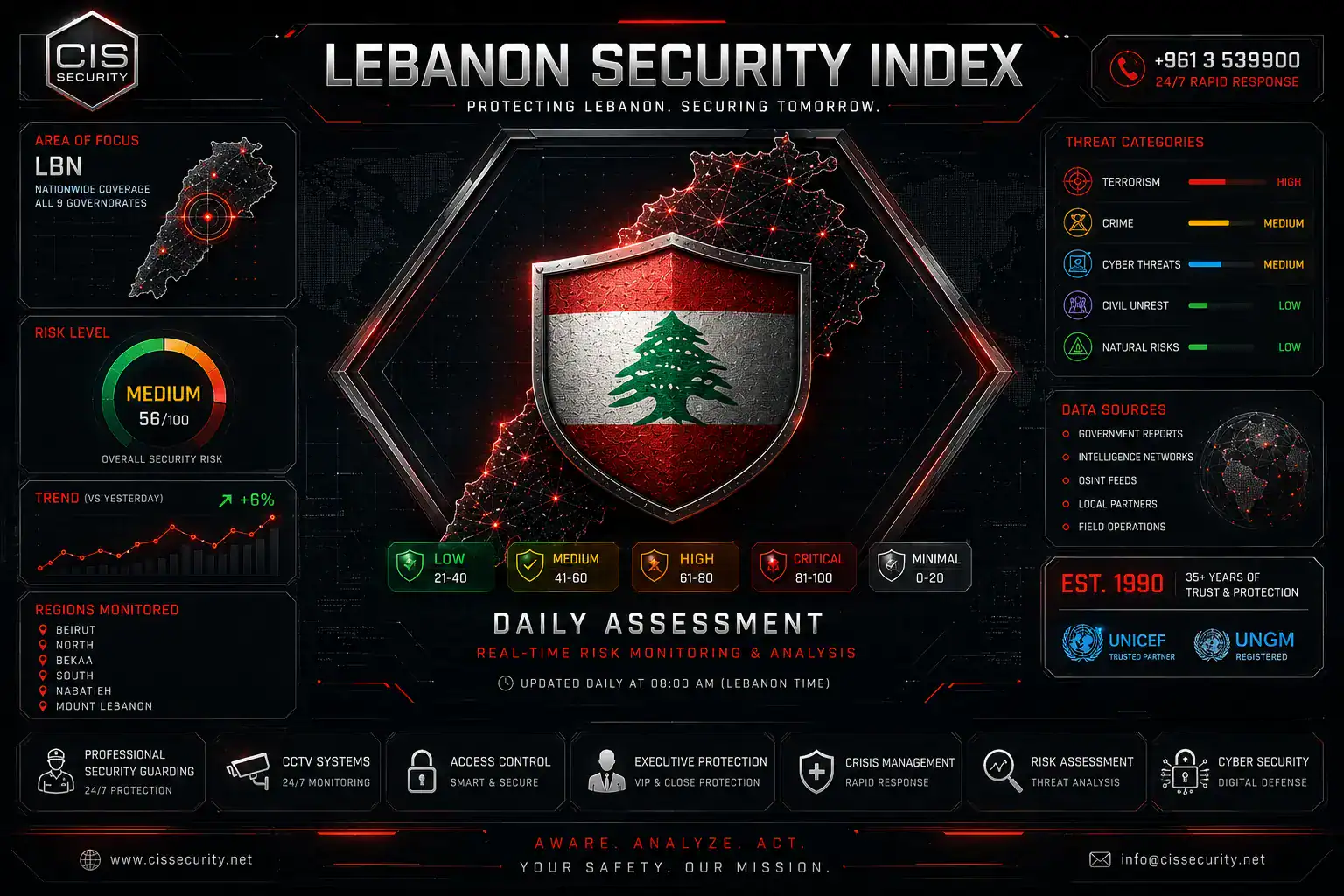
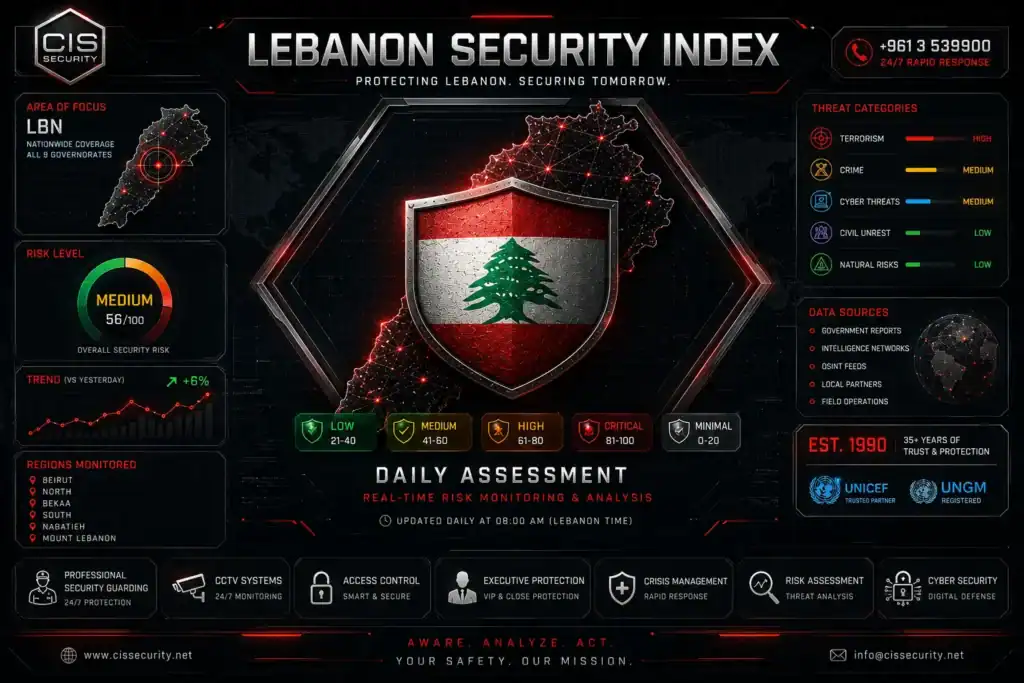
INDEX LEVEL: 🔴 HIGH-CRITICAL — CONFIRMED ESCALATION, HOLDING ELEVATED OVERALL INDEX: 68/100 TREND: ↔️ HOLDING NEAR THIS WEEK’S PEAK — CIS is revising Thursday’s assessment upward after confirming a significant escalation on Friday, July 3: a Hezbollah gunman opened fire on Israeli troops of the 679th “Yiftah” Armored Brigade in Bint Jbeil, seriously wounding a reservist (with two others lightly hurt) — the most direct, close-quarters exchange of fire CIS has recorded in the post-framework period.
Israel responded with tank fire on the building the gunman shot from and an air force strike package hitting roughly 10 Hezbollah infrastructure sites across Bint Jbeil, Beit Yahoun, Kounine, and Baraashit, plus a separate strike destroying a truck used by a Hezbollah cell to move weapons near the security zone. In a third, distinct incident, Israel’s Egoz commando unit killed a Hezbollah operative emerging from the underground tunnel network at the Ali Taher ridge — a facility the IDF says still houses an estimated 30 operatives. This pattern continued into Saturday, July 4, with a fourth incident: reservists of the 551st Brigade killed an armed operative after a manhunt in Majdal Zoun.
Diplomatically, President Aoun pushed back forcefully against both Hezbollah’s rejectionism and international legal criticism, insisting the framework “does not legitimize the continuation of the Israeli occupation,” while Amnesty International and five other rights groups separately warned the deal “betrays victims of war crimes.” Israel’s Washington ambassador gave the most candid Israeli statement yet of what the deal actually requires: Hezbollah’s dismantlement, not a withdrawal timeline. And in Tehran, the delayed funeral procession for assassinated Supreme Leader Ali Khamenei began, with explicit Iranian warnings against US/Israeli attacks during the multi-day mourning period and “vengeance” rhetoric from senior officials.
⛔ EXECUTIVE SUMMARY — SATURDAY JULY 4, 2026 (WAR DAY 125)
CONFIRMED: THE LULL BROKE ON JULY 3 — DIRECT FIREFIGHT, RESERVIST WOUNDED, ~10-SITE RETALIATORY STRIKE
The IDF confirms that at approximately 6 p.m. on Thursday, July 2, during operations of the 679th “Yiftah” Armored Brigade inside the security zone in Bint Jbeil (about 4.5 km from the northern Israeli community of Avivim), troops encountered a Hezbollah gunman who opened fire on them, seriously wounding one reservist; two additional soldiers sustained light wounds. Troops immediately fired tank shells at the building the gunman had shot from, and the Israeli Air Force struck additional targets in the area. Troops continued scanning for the gunman into Friday morning.
In response — and citing this incident as “another violation” of the ceasefire — the Israeli Air Force struck approximately 10 Hezbollah infrastructure sites in Bint Jbeil, Beit Yahoun, Kounine, and Baraashit, which the military said had been used to advance attacks on troops in southern Lebanon. In a separate incident overnight, troops identified a Hezbollah cell transporting weapons by truck near the security zone; the Air Force struck the truck “to remove the threat.”
CIS assessment: This is a materially different and more dangerous pattern than the airstrike-dominant activity CIS has tracked through most of the post-framework period — direct, close-quarters gunfire initiated by an armed Hezbollah fighter against Israeli ground forces, with a confirmed serious Israeli casualty, followed by the largest single retaliatory strike package (by site count) CIS has recorded since the framework signing.
TUNNEL SIEGE AT ALI TAHER RIDGE — OPERATIVE KILLED, ~30 STILL HOLED UP
In a third, separate incident, Israel’s Egoz commando unit (36th Division) killed a Hezbollah operative who emerged from one of the shafts of the underground tunnel complex at the Ali Taher ridge, also inside the security zone. The IDF states the facility is believed to house approximately 30 Hezbollah operatives, and that Israeli forces are actively preventing anyone from exiting the tunnel network or moving through the area: “The IDF will continue operating to remove any threat to its forces and will not allow the Hezbollah terrorist organization to harm the citizens of the State of Israel.”
CIS assessment: This is a significant data point independent of the Bint Jbeil incident. It confirms a substantial, organized, and still-active underground Hezbollah presence in at least one specific location well after the framework’s signing, directly complicating any narrative of meaningful disarmament progress in areas closest to Israeli forces.
JULY 4: FOURTH INCIDENT — OPERATIVE KILLED AFTER MANHUNT IN MAJDAL ZOUN
The pattern continued into Saturday: reservists of the 551st Brigade (91st Division) identified an armed operative inside the security zone in the Majdal Zoun area. Troops opened fire and, after an extensive search, killed the operative “to remove the threat,” according to the IDF.
CIS assessment: Four distinct kinetic incidents in three days (Bint Jbeil firefight, Ali Taher ridge tunnel kill, weapons-truck strike, Majdal Zoun manhunt-kill) is the highest-tempo stretch of confirmed activity CIS has documented in the two-plus weeks since the framework signing. While Saturday’s single incident is smaller in scale than Friday’s retaliatory strike package, the underlying pattern — active, contact-level Hezbollah presence across multiple distinct locations in the security zone — remains unresolved.
AOUN PUSHES BACK ON TWO FRONTS: “DOES NOT LEGITIMIZE” OCCUPATION, AND ANSWERS AMNESTY
President Joseph Aoun used a Friday meeting with delegations from the Association of Universities of Lebanon, the Order of Physicians of Lebanon, and the Lebanese Maronite Order to deliver his most direct defense yet of the framework. He said the agreement “does not legitimize the continued Israeli occupation in Lebanon; rather, it stipulates empowering the Lebanese Army to extend its control over all Lebanese territories.” He said the absence of a withdrawal timetable reflects that this is a “framework formula” rather than a final agreement, adding: “Our shared objective is one: to secure Israel’s withdrawal.”
Aoun also addressed the growing rift with Hezbollah-aligned critics directly: “Our sovereign decision to separate our track from the Iranian-US track is a problem for some who have become accustomed to being under guardianship that controls us, decides for us and negotiates on our behalf.” He added a warning of his own: “We are a democratic country that respects freedom of opinion, but there are red lines that must not be crossed, such as inciting sedition or attempting to topple the government in the streets.” He summarized his underlying philosophy: “Power does not lie in the ability to wage war or sustain it, but in the courage to end it through negotiation, which is a battle without bloodshed.”
Responding specifically to Amnesty International’s Friday critique (below), Aoun said the text “affirms the suspension of legal proceedings between the two states during the negotiation period” but “does not preclude” any private entity from taking legal action.
AMNESTY INTERNATIONAL: FRAMEWORK “BETRAYS VICTIMS OF WAR CRIMES”
Amnesty International, together with five other human rights and press freedom organizations, said Friday that the framework agreement “threatens to betray war crimes victims in Lebanon.” Their core objections:
- Article/Clause 13 commits Israel and Lebanon to cease “all hostile or adverse actions in international political or legal fora,” which Amnesty says could preclude action at the ICJ or ICC. The groups note the agreement “does not appear to commit Israel to halt any initiatives in international forums against Hezbollah” — an asymmetry they highlight as troubling.
- Clause 3 conditions the return of displaced residents to Israeli-occupied border zones on the successful disarmament of non-state armed groups — which Amnesty argues violates international humanitarian law’s requirement that displaced people be allowed to return once hostilities end.
- Union of Journalists in Lebanon President Elsy Moufarrej: “The Lebanese government has conceded a right that is not its right: the right of the victims to pursue and hold the perpetrators accountable.”
ISRAELI AMBASSADOR LEITER: THE FOCUS IS DISARMAMENT, “NOT THE WITHDRAWAL OF ISRAEL”
In an unusually candid on-record interview, Israel’s ambassador to Washington, Yechiel Leiter, laid out Israel’s official reading of the framework:
- “The focus of this agreement is the dismantlement of Hezbollah. It’s not the withdrawal of Israel,” Leiter said. “Israel is not going to be in Lebanon the moment Hezbollah is dismantled… Hezbollah is dismantled, Israel withdraws and we have full peace.”
- Israel will not leave its current security zone until all of southern Lebanon south of the Litani River is under verified Lebanese Army control, and is “demanding more than nominal control.”
- Leiter claimed the Lebanese Army has been “sidelining Shiite troops and officers” unwilling to confront Hezbollah, asserting roughly 25–30% of the LAF is Shia, of whom 30–50% support Hezbollah.
- He confirmed CENTCOM chief Admiral Brad Cooper was in Beirut the day after the June 26 signing, and said US support to the LAF should become “progress-based, performance-based.”
- He said Hezbollah’s tunnel infrastructure — like the Ali Taher ridge network struck this week — must be destroyed, describing it as built to allow cross-border infiltration “like the Nukhba [Hamas special forces] did in Gaza.”
CIS assessment: This is the clearest official articulation to date of Israel’s operative definition of “success,” and it should be read alongside this week’s Ali Taher ridge operation as consistent, not contradictory, Israeli policy.
KHAMENEI FUNERAL BEGINS — “VENGEANCE” THEMES, EXPLICIT WARNINGS TO US/ISRAEL
The long-delayed funeral procession for assassinated Iranian Supreme Leader Ali Khamenei began Saturday, July 4, and continues through July 9 (burial in Mashhad), with 15–20 million people expected to participate across the coming days. Iran’s parliament speaker has urged mass attendance, framing it explicitly around the “nation’s call for vengeance.” Iranian officials have explicitly warned the US and Israel against carrying out attacks during the mourning period. Iran’s military separately warned commercial vessels against using Strait of Hormuz routes it has not approved. Pakistan’s PM Shehbaz Sharif, a key US-Iran mediator, is attending the funeral ceremonies.
Iran’s chief negotiator, parliament speaker Ghalibaf, separately warned Tehran will react “proportionately” if Israel and the US do not honor the MOU. This follows a sharper warning from FM Araghchi earlier in the week: “POTUS has committed the U.S. to muzzling its pets in Tel Aviv. If they ignore their master, Iran will school them.” Iranian Foreign Minister Araghchi was photographed meeting Hamas and Hezbollah delegations, including Hamas Shura Council chairman Muhammad Ismail Darwish, on the sidelines of the mourning period.
CIS assessment: The combination of a mass, emotionally charged funeral explicitly framed around “vengeance,” explicit Iranian warnings against US/Israeli attacks, and this week’s confirmed direct Hezbollah-IDF firefight creates a genuinely elevated risk window through July 9. Any perceived provocation on either side carries higher-than-usual escalation risk during this period.
WASHINGTON TRACK — TRUMP CLAIMS PROGRESS, NETANYAHU-TRUMP CALL, “BOSS” REMARK
President Trump told CNBC that Iran has “agreed to just about everything we need” in ongoing negotiations, while separately claiming the US “totally defeated them militarily” — though Iran retains “some missiles left” that the US “could wipe out too.” He said, “I hit them three times last week very hard… three nights in a row.” CIS notes Trump has previously claimed Iran agreed to let the US extract its enriched uranium stockpiles — a claim Iran denies and which remains, per multiple reports, one of the unresolved sticking points in talks that “have reportedly not made much progress” substantively even as the diplomatic atmosphere is described as improving.
Separately, Netanyahu and Trump spoke by phone on July 3 and agreed to meet in the US “soon,” according to the Israeli PMO. Netanyahu congratulated Trump on America’s 250th anniversary. Naharnet’s headline roundup separately reported Trump saying Netanyahu “knows who the boss is.”
SYRIA TRACK: DAMASCUS “OPEN” TO MEETING HEZBOLLAH, CAFE BOMBING KILLS FIVE
Syria’s Foreign Minister Asaad al-Shaibani said Damascus is “open” to meeting with Hezbollah, after President Trump publicly suggested Syria should confront the group militarily — an idea Syrian officials and Damascus residents have reportedly rejected as a direct military intervention. Shaibani’s comments came the same week he visited Beirut, meeting President Aoun and, for the first time, Speaker Berri. Aoun, hosting Syrian officials, defended his government’s ongoing talks with Israel and vowed Lebanon “will not give up its land.”
Underscoring continued instability tied to Syria’s post-Assad transition, a bomb blast tore through a cafe in Damascus this week, killing at least five people and wounding 16.
Separately, France and Italy confirmed plans, with US support, to deploy international forces in southern Lebanon after UNIFIL’s mission ends, at Lebanon’s request, in support of the Lebanese Army — the first concrete indication of what will replace UNIFIL’s peacekeeping presence.
LEBANESE DOMESTIC POLITICS: A MORE NUANCED PICTURE THAN EARLIER THIS WEEK
CIS’s Tuesday update flagged Speaker Berri’s move to organize opposition to the framework as the most concrete institutional threat to ratification. Subsequent reporting refines that picture: a political source told Asharq Al-Awsat that Berri is not planning to form a formal blocking coalition, “because he does not want to polarize the country,” and is instead seeking a “settlement” or amendments. Druze leader Walid Jumblat said he does not support the deal but “will not be part of a coalition to bring it down.”
Lebanese Forces leader Samir Geagea said the framework “has shattered Hezbollah’s narrative,” and, with Kataeb leader Sami Gemayel, welcomed it. Hezbollah Secretary-General Naim Qassem remains the clearest rejectionist, calling the deal “humiliating, shameful and a surrender of sovereignty.” FPM leader Jebran Bassil “voiced reservations but warned against dismissing it entirely.”
Separately, PM Salam announced a new Lebanon-Syria committee aimed at “boosting ties based on sovereignty, non-interference,” and IOM data shows 646,107 internally displaced Lebanese have begun returning to their communities, with roughly 500,000 others still displaced.
📊 KEY CASUALTY FIGURES — AS OF JULY 3–4, 2026
| Metric | Figure | Source |
|---|---|---|
| Lebanon killed (cumulative, since March 2) | At least 4,246 | Lebanese Ministry of Public Health, via Al Jazeera (June 27 update) |
| Lebanon wounded (cumulative) | At least 12,190 | Lebanese Ministry of Public Health |
| Displaced Lebanese returned home | 646,107 | IOM (July 2–3 update) |
| Displaced Lebanese still displaced | ~500,000 | IOM |
| Israeli soldiers killed (cumulative) | 38 soldiers + 1 civilian contractor | Israeli military, via Naharnet (June 30) |
| Est. Hezbollah operatives, Ali Taher ridge tunnel | ~30 | IDF |
| Khamenei funeral expected attendance | 15–20 million | Iranian officials, via Times of Israel |
| Funeral period | July 4–9 (burial in Mashhad July 9) | Times of Israel |
CIS notes an unreconciled discrepancy between this officially tracked figure (~4,246) and PM Salam’s July 1 remark citing “more than five thousand martyrs” for the current war phase — CIS continues to flag this pending an official reconciliation.
📌 WHAT CIS IS WATCHING THROUGH JULY 9
- Does the four-incidents-in-three-days tempo (Bint Jbeil, Ali Taher, weapons truck, Majdal Zoun) continue, ease, or spike further — particularly given the elevated-risk backdrop of the Khamenei funeral period?
- Does the Ali Taher ridge siege escalate toward a direct assault on the tunnel network, given ~30 operatives remain, and what risk does that pose to surrounding areas?
- Does Iran’s “proportionate response” warning from Ghalibaf, or Araghchi’s harsher “Iran will school them” rhetoric, translate into any concrete action if the funeral period passes without incident — or if it doesn’t?
- Does the more moderate read on Berri (seeking a “settlement,” not blocking ratification) hold, or does Hezbollah’s rejectionist line pull him back toward confrontation?
- Does the Amnesty International critique gain political or legal traction, complicating international legitimacy of the framework?
- What form will the French-Italian post-UNIFIL force take, and will Israel accept it as adequate?
🛡️ CIS SECURITY — JULY 4 ASSESSMENT & GUIDANCE
Trusted Security Excellence Since 1990 | “Because Your Safety Isn’t Optional”
CIS POSTURE: LEVEL 5 — SEVERE ALERT (maintained from July 3)
CIS is maintaining its Level 5 — Severe Alert posture for the south Lebanon operational zone, first raised following Friday’s confirmed direct firefight and retaliatory strike package. Saturday’s Majdal Zoun incident confirms the elevated-tempo pattern has not resolved. Combined with the ongoing Ali Taher ridge siege and the heightened regional risk window created by the Khamenei funeral period (through July 9), CIS advises continued extreme caution.
ZONE-BY-ZONE GUIDANCE
BINT JBEIL: Avoid entirely — site of the direct firefight and a serious Israeli casualty. BEIT YAHOUN / KOUNINE / BARAASHIT: Avoid — struck as part of the retaliatory package. ALI TAHER RIDGE: Avoid — active tunnel siege, ~30 operatives believed present. MAJDAL ZOUN: Avoid — site of Saturday’s manhunt and kill. SECURITY ZONE / BUFFER ZONE (GENERAL): Do not approach under any circumstances. DAHIYEH, BEKAA VALLEY: Maintain elevated caution. BEIRUT (general), MOUNT LEBANON, NORTH LEBANON, AKKAR: Calm, normal operations continue; heightened general awareness advised given the week’s trajectory and the funeral-period risk window.
📞 EMERGENCY CONTACTS — JULY 4, 2026
CIS Security 24/7: +961-3-539900 | info@cissecurity.net | www.cissecurity.net Lebanese Army South Lebanon Liaison: +961-8-802-510 US Embassy Emergency: +1-202-501-4444 | BeirutACS@state.gov Lebanese Red Cross: 1760 Civil Defence: 125 ISF: 112 National Mental Health Lifeline: 1564 (24/7 — confidential)
⚠️ FINAL ASSESSMENT — WAR DAY 125, JULY 4, 2026
This week confirms the most significant military escalation CIS has tracked since the June 26 framework signing, alongside a genuinely more contested political and legal landscape.
Friday’s direct firefight in Bint Jbeil — a Hezbollah gunman engaging Israeli troops at close range, seriously wounding a reservist — is qualitatively different from the pattern of Israeli-initiated strikes CIS has documented for weeks. It confirms that armed, organized Hezbollah elements remain in direct contact with Israeli positions inside the security zone. The scale of Israel’s response (roughly 10 sites across four towns, plus a separate tunnel kill at Ali Taher ridge and a weapons-truck strike) and Saturday’s follow-on incident in Majdal Zoun together represent the highest-tempo three-day stretch since the agreement was signed.
Politically, President Aoun has taken the most assertive public stance yet in defending the framework — rejecting both Hezbollah’s “occupation” framing and Amnesty International’s legal critique in the same week — while acknowledging real constraints (no timetable, ongoing legal ambiguity). Israel’s own ambassador has meanwhile made explicit what Lebanese officials have downplayed: withdrawal is conditioned entirely on Hezbollah’s dismantlement, with no fixed schedule.
Overhanging all of this is the Khamenei funeral period, now underway and continuing through July 9, with explicit Iranian warnings against US/Israeli attacks and “vengeance” framing from senior officials. CIS assesses this as a genuine risk-amplification window: any further incident in south Lebanon carries elevated potential to trigger a broader regional reaction while regional attention and emotion are concentrated on Tehran.
CIS maintains Level 5 — Severe Alert for the south Lebanon operational zone and will continue monitoring closely through the funeral period and beyond.
+961-3-539900 | info@cissecurity.net | cissecurity.net CIS Security — Because Your Safety Isn’t Optional — Est. 1990
CIS Lebanon Security Index™ | Saturday, July 4, 2026 | WAR DAY 125
All casualty and displacement figures as reported by named officials, IOM, Lebanese Ministry of Public Health, or Israeli military statements via the outlets above. All diplomatic and political statements from named officials or sourced reporting, July 2–4, 2026. Index compiled: Saturday, July 4, 2026 — Beirut time.
CIS SECURITY
Because Your Safety Isn’t Optional
Lebanon’s only daily security intelligence platform · Updated daily at 8 AM
Daily Intelligence Dashboard LIVE RAGEX Intelligence Partner FEATUREDCIS Security · Beirut, Lebanon · ISO Certified