CIS LEBANON SECURITY INDEX – Jan 15 2026
🇱🇧 CIS LEBANON SECURITY INDEX™ – Thursday, Jan 15 2026
📊 TODAY’S LEBANON SECURITY INDEX READING
INDEX LEVEL: 🔴 CRITICAL
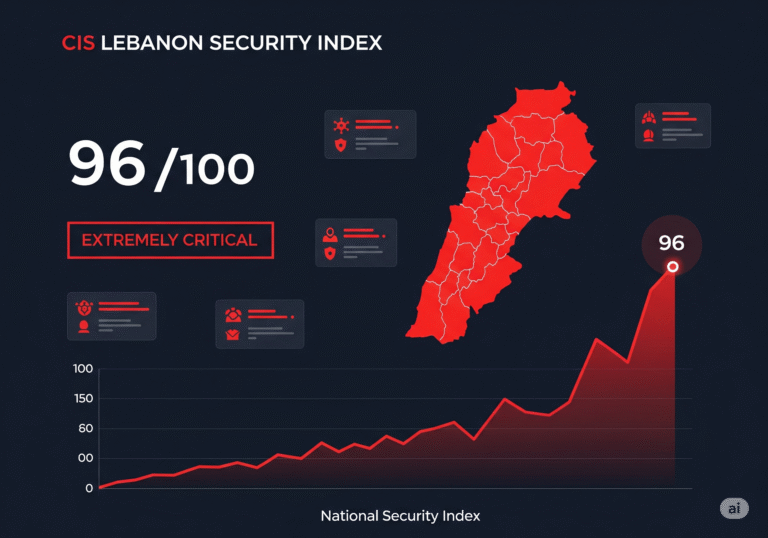
TODAY’S OVERALL INDEX: 88/100
TREND ANALYSIS: ⚠️ DANGEROUS ESCALATION – BEKAA STRIKES & HEZBOLLAH CIVIL WAR WARNING
🚨 BREAKING: ISRAEL BOMBS BEEKA VALLEY VILLAGES AS HEZBOLLAH WARNS OF CIVIL WAR
CRITICAL DEVELOPMENTS – THURSDAY, JANUARY 15, 2026:
BEKAA VALLEY STRIKES TODAY: Israel’s military carried out attacks on two villages in Lebanon’s Bekaa Valley today, with Israeli army spokesman Avichay Adraee issuing evacuation warnings for the neighboring villages of Sohmor and Mashghara ahead of planned strikes on buildings he claimed contained Hezbollah infrastructure. The Israeli army targeted two residential buildings in Sohmor and two buildings in Mashghara following evacuation warnings.
HEZBOLLAH’S CIVIL WAR WARNING: A senior Hezbollah official warned on January 14 that disarming the group beyond southern Lebanon would be “the biggest crime committed by the state” and that “the path taken by the Lebanese government and state institutions will lead Lebanon to instability, chaos and perhaps even civil war”. Mahmoud Qmati, deputy head of Hezbollah’s political council, made these statements to Russian state television.
SOUTHERN LEBANON STRIKES CONTINUE: Two people were killed in Israeli strikes on Mansouri and Mayfadoun in southern Lebanon, with the Lebanese Health Ministry confirming the casualties. Israel has launched near-daily attacks on Lebanon despite a ceasefire agreement, with those attacks ramping up in recent months as Israel and the United States push the Lebanese government to disarm Hezbollah.
GREEK MILITARY AID ARRIVES: Greece completed the delivery of 13 M113 armored personnel carriers and 10 STEYR trucks to Lebanon on January 15, 2026, via Hellenic Navy transport to Beirut. This donation strengthens Lebanon’s defense capabilities as the Lebanese Armed Forces work to establish state authority.
JORDAN SIGNS 22 COOPERATION AGREEMENTS: Jordanian Prime Minister Jaafar Hassan met with President Aoun and Parliament Speaker Berri on Thursday after signing 21-22 agreements and memoranda of understanding covering industry, energy, transport, education, tourism, and investment. Jordan pledged continued support for Lebanon’s security and the Lebanese Armed Forces.
LAF DISARMAMENT PROGRESS: The Lebanese military said the first phase of its plan is to bring all weapons held by non-state actors between the Litani River and the Israeli border under its control, with the army stating on January 8 that it had established a state monopoly on arms in the south in an “effective and tangible way”, though Israel has called these efforts insufficient.
MINISTER’S CONTROVERSIAL STATEMENT: Lebanon’s Foreign Minister Youssef Rajji reportedly said “so long as Hezbollah is not completely disarmed, Israel has the right to continue its attacks” in an interview with Sky News, a statement that has generated controversy given the ongoing violations.
ESCALATION CONCERNS: Israel launched strikes on Hezbollah targets across Lebanon on Thursday, accusing the Iranian-backed group of “repeated violations” of the 2024 ceasefire, increasing pressure on Lebanon’s fragile government which faces U.S. and Israeli demands to disarm Hezbollah and fears a dramatic Israeli campaign to force its hand.
🌡️ COMPREHENSIVE GOVERNORATE-BY-GOVERNORATE SECURITY ASSESSMENT
BEIRUT 🏙️
Index Reading: 84/100 🔴
Status: Critical with Diplomatic Activity. The capital experiences intense political pressure as the government navigates between international demands for Hezbollah disarmament and the group’s explicit civil war warnings. President Joseph Aoun and Prime Minister Nawaf Salam face an impossible dilemma.
Today’s diplomatic activity included Jordanian Prime Minister Jaafar Hassan’s meetings with President Aoun and Parliament Speaker Nabih Berri following the signing of 22 cooperation agreements. The agreements cover industry, energy, transport, education, tourism, and investment, demonstrating continued Arab support despite security challenges.
Lebanon’s Foreign Minister Youssef Rajji’s controversial statement that Israel has the right to continue attacks as long as Hezbollah remains armed has created internal political tensions. This position, while reflecting international pressure, contradicts Lebanon’s official stance condemning Israeli violations.
The government operates under extraordinary pressure, with Hezbollah’s January 14 warning that extending disarmament beyond the Litani River could trigger civil war creating a stark political crisis. The group insists Israel must first withdraw from five occupied positions, halt airstrikes, and release Lebanese prisoners before any further disarmament discussions.
Economic activities continue under this cloud of uncertainty, with businesses monitoring the escalating tensions between governmental authority and Hezbollah’s resistance to full disarmament. The arrival of Greek military aid demonstrates international support for state institutions.
Key Factor: Government caught between Hezbollah’s civil war threats and international demands for disarmament, while today’s Bekaa Valley strikes demonstrate Israeli pressure tactics.
MOUNT LEBANON 🏞️
Index Reading: 80/100 🔴
Status: Critical with Political Anxiety. The governorate experiences heightened concern as Hezbollah’s civil war warning reverberates through Lebanese society. The prospect of internal conflict creates deep anxiety among populations that remember the 1975-1990 civil war.
Religious and political leaders in Mount Lebanon are calling for dialogue and restraint, recognizing that civil conflict would be catastrophic for Lebanon’s recovery efforts. The region’s Christian communities support governmental authority but fear the consequences of forced disarmament.
Business operations continue with growing uncertainty about Lebanon’s political stability. The stark choice between accepting Hezbollah’s “state within a state” status or risking internal violence creates paralysis in economic planning and investment decisions.
Infrastructure improvements proceed cautiously under governmental framework, while the region continues hosting displaced populations from southern areas. The escalating political crisis compounds existing humanitarian and economic challenges.
Key Factor: Civil war warnings creating profound anxiety in communities that remember Lebanon’s devastating 15-year conflict, with calls for dialogue to prevent catastrophe.
NORTH LEBANON 🌊
Index Reading: 82/100 🔴
Status: Critical with Economic Concerns. Tripoli and surrounding areas monitor the escalating crisis with deep concern about economic and security implications. The port city’s commerce depends on stability that appears increasingly fragile.
Cross-border dynamics with Syria remain stable, though the regional context of today’s Israeli strikes in Bekaa Valley creates concerns about potential spillover effects. Economic conditions show vulnerability to any escalation of internal or external conflicts.
The 22 agreements signed with Jordan offer some economic hope, particularly in energy cooperation and trade development. However, the fundamental political crisis over disarmament overshadows these positive developments.
Infrastructure projects face uncertainty as the political confrontation between government and Hezbollah intensifies. International support may be contingent on disarmament progress that Hezbollah explicitly rejects.
Key Factor: Economic vulnerability to escalating political crisis while Jordan agreements offer limited positive momentum amid overwhelming uncertainty.
AKKAR 🌲
Index Reading: 83/100 🔴
Status: Critical – Border Security Under Pressure. The Syrian border situation remains stable but the overall security environment deteriorates with today’s escalation. The Lebanese Armed Forces maintain border operations despite being caught in the political crossfire.
Cross-border security operations continue effectively, though LAF faces the impossible task of satisfying international demands for comprehensive disarmament while Hezbollah explicitly threatens chaos if pressed beyond the Litani River.
The region benefits from LAF presence, but the army’s position becomes increasingly untenable as it’s asked to potentially confront Hezbollah or face continued Israeli strikes. The Greek military aid arriving today strengthens LAF capabilities but doesn’t resolve the fundamental political crisis.
Key Factor: Border security maintained but LAF caught between impossible demands as political crisis over disarmament escalates to civil war threats.
BEQAA VALLEY 🍇
Index Reading: 92/100 🔴
Status: CRITICAL – UNDER ACTIVE ATTACK. The valley experiences direct Israeli strikes today with evacuation warnings issued for Sohmor and Mashghara before attacks on four residential buildings. This represents a significant escalation beyond the pattern of southern Lebanon strikes.
Israeli army spokesman Avichay Adraee’s evacuation warnings for Bekaa Valley villages mark an expansion of Israeli military operations into areas previously less frequently targeted. The strikes on two buildings in Sohmor followed by attacks on two buildings in Mashghara demonstrate Israel’s willingness to operate throughout Lebanese territory.
Agricultural operations are disrupted by today’s strikes and evacuation orders. The expansion of Israeli operations into Bekaa Valley coincides with pressure on Lebanon to extend disarmament operations beyond the Litani River, creating a dangerous cycle of escalation.
Hezbollah’s presence throughout Bekaa Valley makes the region central to the disarmament crisis. The group’s explicit warning that extending disarmament north of the Litani would be “the biggest crime” directly impacts Bekaa Valley security calculations.
International development projects face immediate threats from today’s escalation, while the civilian population experiences fear and displacement from strikes on residential buildings despite evacuation warnings.
Key Factor: Direct Israeli strikes today on Bekaa Valley villages representing dangerous escalation coinciding with Hezbollah’s civil war warnings against extended disarmament.
BAALBEK-HERMEL 🕌
Index Reading: 90/100 🔴
Status: CRITICAL – High Escalation Risk. This region faces extreme tension as Hezbollah stronghold potentially subject to expanded Israeli operations and future disarmament efforts. Israel targeted Hermel’s outskirts in Bekaa following strikes on Sohmor and Mashghara.
Infrastructure faces direct threats from today’s expanded strike pattern. Hezbollah’s statement that disarmament beyond Litani would trigger chaos applies directly to Baalbek-Hermel, a core area of the group’s presence and support.
The regional security dynamics create existential concerns for communities that view Hezbollah as defenders against external threats. The group’s civil war warning resonates particularly strongly in areas where its social services and military presence are deeply embedded.
Key Factor: Hermel strikes today demonstrating Israeli willingness to target deep into Lebanon while Hezbollah’s civil war warning indicates potential for violent resistance to disarmament in this region.
KESERWAN-JBEIL 🏛️
Index Reading: 76/100 🔴
Status: Critical with Heightened Anxiety. The coastal governorate experiences relative security from direct strikes but profound political anxiety about the escalating crisis. Communities fear both continued Israeli operations and potential internal conflict.
Tourism infrastructure faces challenges as the escalating security situation deters visitors. Business operations continue but with growing uncertainty about Lebanon’s political trajectory and potential for internal violence.
The region’s Christian populations support state authority and LAF operations but deeply fear civil conflict. Memories of Lebanon’s 15-year civil war create powerful incentives for compromise and dialogue rather than confrontation.
Key Factor: Relative security from strikes but intense anxiety about Hezbollah’s civil war warning and potential for internal violence devastating Lebanese society.
SOUTH LEBANON 🌴
Index Reading: 91/100 🔴
Status: CRITICAL – Near-Daily Violations Continue. The south experiences ongoing attacks despite ceasefire framework, with two people killed today in strikes on Mansouri and Mayfadoun. Israeli attacks have killed more than 300 people in Lebanon since the ceasefire agreement was signed in November 2024.
The Lebanese Armed Forces maintain their presence south of the Litani River, with the army claiming on January 8 to have established state monopoly on arms in the south “in an effective and tangible way.” However, Israel has called those efforts insufficient, demanding more comprehensive disarmament.
Israel maintains five strategic hilltop positions inside Lebanese territory despite ceasefire requirements for complete withdrawal. This ongoing occupation compounds tensions over disarmament implementation.
Civilian populations continue experiencing casualties and displacement from near-daily strikes. The deaths today in Mansouri and Mayfadoun demonstrate that Israeli operations continue regardless of LAF’s claimed progress on disarmament.
UNIFIL peacekeepers maintain operations but face criticism from Israel and uncertainty about their mandate, which ends in December 2026. The international force’s future remains unclear as political dynamics shift.
Key Factor: Two killed today in continued violations while LAF claims disarmament progress south of Litani, but Israel demands more comprehensive action and maintains occupied positions.
NABATIEH ⛪
Index Reading: 89/100 🔴
Status: Critical with Ongoing Strikes. The governorate continues experiencing Israeli operations as part of the pattern of near-daily violations. Lebanese official National News Agency reported “a series of violent Israeli strikes” on Jezzine, Mahmoudiyeh, al-Dimasqiyeh, and “more than 10 strikes” on al-Bureij in southern Lebanon.
Infrastructure restoration efforts face constant disruption from ongoing strikes. The LAF’s claimed establishment of arms monopoly south of Litani has not ended Israeli operations, creating frustration about the effectiveness of disarmament efforts.
Civilian populations balance reconstruction needs with ongoing security threats. Hezbollah’s warning about civil war if disarmament extends beyond Litani creates additional anxiety about future government operations in the region.
Key Factor: Ongoing strikes including series of violent attacks on multiple locations demonstrating Israeli operations continue despite LAF disarmament claims.
🎯 CRITICAL SECURITY INTELLIGENCE BRIEF – DANGEROUS ESCALATION
🔥 CURRENT HIGH-RISK AREAS:
Priority Level 1 – Active Combat/Strike Zones:
- Bekaa Valley – Sohmor & Mashghara – Four residential buildings struck today following evacuation warnings
- Hermel Outskirts – Targeted today in expanded strike pattern
- South Lebanon – Mansouri & Mayfadoun – Two killed today in ongoing violations
- Southern Lebanon Broadly – Near-daily strikes with 300+ killed since ceasefire
- Israeli-Occupied Positions – Five hilltop locations inside Lebanese territory
Priority Level 2 – Civil War Risk Zones: 6. Areas North of Litani River – Hezbollah warns extending disarmament here risks civil war 7. Beirut Political Centers – Government facing impossible demands from all sides 8. Hezbollah Strongholds – Baalbek-Hermel, southern suburbs at risk if disarmament extended 9. Palestinian Refugee Camps – Also subject to disarmament demands 10. LAF Deployment Areas – Army caught between international pressure and Hezbollah threats
✅ NO TRULY STABLE ZONES – ALL AREAS UNDER CRITICAL ALERT:
Relatively Lower Risk (But Still Critical):
- Keserwan-Jbeil – Furthest from today’s strikes but facing political crisis
- Northern Coastal Areas – Not directly targeted but economically vulnerable
- Syrian Border Areas – Cross-border security maintained but overall environment deteriorating
⚠️ ESCALATION FACTORS:
Immediate Triggers:
- Bekaa Valley strikes today represent geographic expansion of Israeli operations
- Hezbollah’s explicit civil war warning if disarmament extended beyond Litani
- Foreign Minister’s statement about Israel’s “right” to strike creating internal tensions
- 300+ Lebanese killed since ceasefire demonstrating pattern of violations
- LAF caught between impossible demands from Israel/US and Hezbollah threats
Medium-Term Risks:
- Government briefing on northern disarmament due in early February
- Hezbollah refuses any dialogue on weapons beyond Litani until Israeli withdrawal
- Israel maintains occupied positions and continues strikes despite ceasefire
- International aid potentially conditional on disarmament progress
- May 2026 parliamentary elections creating political pressures
📱 CURRENT SECURITY GUIDANCE – DANGEROUS ESCALATION PERIOD
🏠 GUIDANCE FOR RESIDENTS:
IMMEDIATE THREAT ASSESSMENT: Lebanon faces the most dangerous security environment since the November 2024 ceasefire, with Israeli strikes expanding into Bekaa Valley while Hezbollah explicitly warns of civil war if disarmament extends beyond the Litani River.
CURRENT CRISIS FACTORS:
- Bekaa Valley Strikes Today: Four residential buildings bombed in Sohmor and Mashghara
- Civil War Warning: Hezbollah senior official states extending disarmament could trigger internal conflict
- Ongoing Southern Violations: 300+ killed since ceasefire, two more today
- Government Paralysis: Caught between international pressure and Hezbollah threats
IMMEDIATE SAFETY RECOMMENDATIONS:
- Bekaa Valley Residents: Heed any evacuation warnings immediately – today’s strikes show Israeli willingness to target residential buildings
- All Areas: Monitor news continuously for evacuation orders or escalation warnings
- Emergency Preparedness: Maintain supplies, fuel, medications for potential rapid deterioration
- Avoid Large Gatherings: Political tensions could trigger demonstrations or clashes
- Communication Plans: Ensure family members know emergency contact procedures
🏢 BUSINESS OPERATIONS GUIDANCE:
CRISIS ENVIRONMENT:
- Bekaa Valley: Operations severely disrupted by today’s strikes and evacuation orders
- Southern Lebanon: Near-daily strikes creating impossible operating environment
- National Level: Political crisis over disarmament creating profound uncertainty
- International Relations: Foreign investors watching closely for civil war indicators
OPERATIONAL RECOMMENDATIONS:
- Emergency evacuation plans for all facilities, especially in Bekaa and South
- Remote work capabilities where possible to reduce employee exposure
- Financial contingency planning for potential escalation or internal conflict
- Supply chain redundancy given potential for rapid deterioration
- Insurance review for coverage of civil unrest and continued military operations
🚗 TRAVEL ADVISORY – EXTREME CAUTION:
CURRENT TRAVEL STATUS: Extremely dangerous security environment with active strikes in Bekaa Valley today, near-daily violations in South Lebanon, and explicit warnings of potential civil war over disarmament crisis.
CRITICAL TRAVEL RESTRICTIONS:
- AVOID Bekaa Valley: Active strike zone with four buildings bombed today
- AVOID South Lebanon: Two killed today in ongoing pattern of 300+ deaths since ceasefire
- AVOID Border Areas: Five Israeli-occupied positions and continued military operations
- Exercise Extreme Caution Nationwide: Political crisis could trigger rapid escalation
IF TRAVEL ESSENTIAL:
- Monitor real-time security updates continuously
- Have multiple evacuation routes planned
- Carry emergency supplies and communications equipment
- Register with embassy and maintain emergency contact protocols
- Consider postponing non-essential travel until situation stabilizes
📊 THURSDAY, JANUARY 15, 2026 SECURITY ANALYSIS
Today’s Assessment: Most Dangerous Day Since November 2024 Ceasefire
Geographic Escalation: Israeli strikes expand into Bekaa Valley beyond usual southern pattern
Political Crisis: Hezbollah explicit warning of civil war if disarmament extended
Casualties: Two killed today continuing pattern of 300+ deaths since ceasefire
Critical Analysis: Thursday, January 15, 2026, represents the most dangerous escalation since the November 2024 ceasefire, with Israeli strikes expanding into Bekaa Valley while Hezbollah explicitly warns that government efforts to extend disarmament beyond the Litani River could trigger civil war.
Israel’s military carried out attacks on the Bekaa Valley villages of Sohmor and Mashghara today, with Israeli army spokesman Avichay Adraee issuing evacuation warnings before strikes on buildings he claimed contained Hezbollah infrastructure. The Israeli army targeted two residential buildings in each village following these warnings, representing a geographic expansion beyond the usual pattern of strikes focused on southern Lebanon.
The Bekaa Valley strikes carry particular significance because they demonstrate Israeli willingness to operate throughout Lebanese territory as pressure intensifies on Lebanon to extend disarmament operations north of the Litani River. This geographic expansion coincides ominously with Hezbollah’s starkest warning yet about the consequences of such efforts.
On January 14, senior Hezbollah official Mahmoud Qmati warned that disarming the group beyond southern Lebanon would be “the biggest crime committed by the state” and that “the path taken by the Lebanese government and state institutions will lead Lebanon to instability, chaos and perhaps even civil war”. Qmati, deputy head of Hezbollah’s political council, made these statements in an interview with Russian state television RT.
The civil war warning represents Hezbollah’s most explicit threat yet regarding the disarmament crisis. The group insists the November 2024 ceasefire agreement applies only to areas south of the Litani River and that it will not relinquish weapons elsewhere in Lebanon. Qmati stated “There will be no talk or dialogue about any situation north of the Litani River before Israel withdraws from all Lebanese territory, liberates the south and the prisoners, and stops its violations against Lebanon”.
President Joseph Aoun and Prime Minister Nawaf Salam face an impossible dilemma. Israel and the United States are pushing the Lebanese government to disarm Hezbollah, with fears of a dramatic Israeli campaign to force the government’s hand. However, Hezbollah’s explicit civil war threat makes comprehensive disarmament potentially catastrophic for internal stability.
Lebanon’s Foreign Minister Youssef Rajji reportedly told Sky News that “so long as Hezbollah is not completely disarmed, Israel has the right to continue its attacks”, a controversial statement reflecting the intense international pressure on Lebanese authorities. This position contradicts Lebanon’s official condemnation of Israeli violations while acknowledging the political reality of international demands.
Southern Lebanon continues experiencing near-daily strikes despite the ceasefire. Two people were killed today in Israeli strikes on Mansouri and Mayfadoun, adding to the toll of more than 300 people killed in Lebanon since the ceasefire agreement was signed in November 2024.
The Lebanese Armed Forces claimed progress on disarmament south of the Litani River. The Lebanese military stated on January 8 that it had established a state monopoly on arms in the south in an “effective and tangible way”, representing completion of phase one of the disarmament plan. However, Israel has called those efforts insufficient, maintaining that comprehensive disarmament is required.
Israel maintains five strategic hilltop positions inside Lebanese territory despite ceasefire requirements for complete withdrawal. This ongoing occupation provides Hezbollah with justification for refusing further disarmament discussions, creating a stalemate where each side conditions progress on the other’s actions.
Positive developments today include Greece completing delivery of 13 M113 armored personnel carriers and 10 STEYR trucks to Lebanon via Hellenic Navy transport to Beirut. This military aid strengthens the Lebanese Armed Forces’ capabilities for sovereignty operations. Additionally, Jordanian Prime Minister Jaafar Hassan met with President Aoun and Parliament Speaker Berri after signing 21-22 cooperation agreements covering industry, energy, transport, education, tourism, and investment.
However, these diplomatic and military assistance achievements are overshadowed by the fundamental security crisis. The Lebanese government faces a choice between attempting comprehensive disarmament and risking civil conflict, or accepting Hezbollah’s continued armed presence and facing continued Israeli strikes and international isolation.
Israel has kept up regular strikes in Lebanon despite the November 2024 ceasefire, with Lebanese official National News Agency reporting “a series of violent Israeli strikes” on multiple southern locations including “more than 10 strikes” on al-Bureij. This pattern of violations demonstrates that Israeli operations continue regardless of LAF’s claimed disarmament progress.
The Lebanese cabinet has requested the army brief it in early February on plans for extending disarmament beyond the Litani River. This timeline creates a critical pressure point where the government must decide whether to proceed despite Hezbollah’s explicit warnings or to halt efforts and face international and Israeli pressure.
Regional Context: The crisis occurs as Israel maintains military pressure on multiple fronts and as the United States under President Trump takes a more aggressive stance toward Iran and its regional allies. Lebanon’s government operates in an environment of maximum external pressure while facing explicit internal threats of violent resistance.
Historical Parallel: Hezbollah’s civil war warning deliberately evokes memories of Lebanon’s devastating 1975-1990 civil war that killed an estimated 120,000-150,000 people. The threat resonates powerfully in Lebanese society where memories of internal conflict remain vivid and traumatic.
May 2026 Elections: The approaching parliamentary elections create additional pressure, with Hezbollah potentially seeking to maintain political influence through demonstrations of strength against disarmament efforts. The electoral timeline complicates any governmental decisions about confronting the group.
Long-term Prospects: Lebanon faces its most dangerous political crisis since the ceasefire. The combination of Israeli strikes expanding geographically, Hezbollah’s explicit civil war warning, governmental paralysis between impossible demands, and approaching elections creates multiple escalation pathways with few obvious de-escalation mechanisms.
The fundamental question remains whether Lebanon can find a political compromise that satisfies international demands for disarmament, addresses Israeli security concerns, prevents civil conflict, and preserves national sovereignty. Today’s events suggest that compromise becomes increasingly difficult as positions harden and violence escalates.
🛡️ CIS SECURITY: CRISIS ESCALATION RESPONSE
🚨 EMERGENCY PROTOCOLS ACTIVATED – DANGEROUS ESCALATION PERIOD
CIS Security activates enhanced crisis response protocols following today’s Bekaa Valley strikes, Hezbollah’s civil war warning, and the most dangerous security environment since the November 2024 ceasefire. Our 35+ years of experience in managing Lebanese security crises enables comprehensive protection during this critical period.
CRISIS-LEVEL SECURITY SERVICES:
Immediate Strike Zone Protection:
- Bekaa Valley Emergency Response – Enhanced security and evacuation support for Sohmor, Mashghara, Hermel areas
- Southern Lebanon Protection – Continued operations despite two killed today and 300+ deaths since ceasefire
- Evacuation Coordination – Professional support for Israeli warning responses and emergency relocations
- Real-Time Intelligence – Continuous monitoring of strike warnings, evacuation orders, escalation indicators
Civil Unrest Preparedness:
- Political Violence Assessment – Monitoring Hezbollah’s civil war warning implications for security planning
- Demonstration Intelligence – Tracking potential protests or clashes over disarmament crisis
- Facility Hardening – Enhanced physical security for businesses and residences facing unrest risks
- Emergency Extraction – Rapid response capabilities for personnel caught in escalating situations
Comprehensive Crisis Management:
- 24/7 Operations Center – Continuous monitoring of strikes, warnings, political developments
- Multi-Site Coordination – Protecting clients across Lebanon’s diverse threat environments
- International Liaison – Coordination with embassies, UNIFIL, international organizations
- Supply Chain Security – Protecting logistics and commerce during crisis escalation
SPECIALIZED CRISIS SERVICES:
Government & Diplomatic Protection:
- Professional security supporting President Aoun’s administration during impossible political crisis
- Protection for international diplomatic missions navigating escalation environment
- Security for Jordanian delegation and ongoing Arab cooperation initiatives
- Coordination with LAF operations receiving Greek military aid
Business Continuity Support:
- Crisis management enabling operations during most dangerous period since ceasefire
- Security assessments for Bekaa Valley facilities after today’s strikes
- Emergency response planning for rapid deterioration scenarios
- Insurance documentation support for strike and civil unrest coverage
Residential & Family Protection:
- Enhanced home security during period of multiple escalation risks
- Family evacuation planning and coordination services
- Safe haven identification and access arrangements
- Emergency supplies and communications support
📞 CRISIS RESPONSE COORDINATION
EMERGENCY SECURITY HOTLINE: +961-3-539900
24/7 crisis response during Lebanon’s most dangerous escalation since ceasefire
BEKAA VALLEY EMERGENCY: Immediate support for strike zone residents and businesses
EVACUATION COORDINATION: Professional extraction and relocation services
CIVIL UNREST PROTECTION: Security against political violence and demonstrations
Crisis Response Centers:
- Strike Zone Operations: Bekaa Valley, South Lebanon emergency response
- Political Violence Monitoring: Civil war warning assessment and protection
- Evacuation Coordination: Multi-site emergency relocation capabilities
- 24/7 Command Center: Continuous crisis monitoring and client coordination
During Lebanon’s most dangerous security crisis since the November 2024 ceasefire, with Bekaa Valley strikes today, Hezbollah civil war warnings, 300+ killed since ceasefire, and government facing impossible demands, CIS Security’s crisis management expertise provides comprehensive protection enabling safety and business continuity during this critical escalation period.
⚠️ CRITICAL ESCALATION NOTICE
EXTREME DANGER ALERT: Thursday, January 15, 2026 marks the most dangerous escalation since November 2024 ceasefire with Israeli strikes expanding into Bekaa Valley, Hezbollah explicitly warning of civil war over disarmament, two more killed today in South Lebanon, and government caught between impossible international and internal demands.
Bekaa Valley Strikes: Four residential buildings bombed in Sohmor and Mashghara today following evacuation warnings, representing geographic expansion beyond usual southern strike pattern and demonstrating Israeli willingness to operate throughout Lebanon.
Civil War Warning: Senior Hezbollah official Mahmoud Qmati stated extending disarmament beyond Litani River would be “biggest crime” and could trigger “instability, chaos and perhaps even civil war,” most explicit threat yet regarding disarmament crisis.
Ongoing Violations: Two killed today in Mansouri and Mayfadoun adding to 300+ deaths since ceasefire, demonstrating Israeli operations continue regardless of LAF’s claimed disarmament progress south of Litani River.
Impossible Dilemma: Government faces choice between comprehensive disarmament risking civil conflict or accepting Hezbollah’s armed presence facing continued Israeli strikes and international isolation.
Multiple Escalation Pathways: Government briefing on northern disarmament due early February, May 2026 elections creating political pressures, Israeli-occupied positions maintained, international aid conditional on progress.
CIS Crisis Response: Emergency protocols activated with 24/7 operations center, evacuation coordination, strike zone protection, civil unrest preparedness, and comprehensive crisis management during Lebanon’s most dangerous period since ceasefire.
Immediate Action Required: All residents, businesses, international personnel must review emergency plans, monitor real-time security updates, prepare for potential rapid deterioration, and maintain crisis communication protocols.
🔍 PROFESSIONAL SECURITY SERVICES – CIS SECURITY LEBANON
Trusted Security Excellence Since 1990 – “Because Your Safety Isn’t Optional”
During Lebanon’s most dangerous security crisis since the November 2024 ceasefire, with Israeli strikes expanding into Bekaa Valley today, Hezbollah’s explicit civil war warning over disarmament, 300+ killed since ceasefire including two today, and government facing impossible demands from all sides, trust CIS Security’s 35+ years of proven crisis management expertise. As Lebanon’s most reviewed security company, we provide emergency response for Bekaa Valley strike zones, South Lebanon ongoing violations, civil unrest preparedness for political crisis, evacuation coordination, and comprehensive 24/7 crisis operations. Our trained, uniformed, and licensed security personnel deliver professional protection enabling safety and business continuity during this critical escalation period with multiple pathways toward further deterioration.
CIS Security Crisis Response Services:
- Strike Zone Protection – Emergency response for Bekaa Valley attacks today and South Lebanon ongoing violations
- Evacuation Coordination – Professional extraction from threatened areas with Israeli warning responses
- Civil Unrest Preparedness – Security against political violence from disarmament crisis and civil war warnings
- 24/7 Crisis Operations – Continuous monitoring of strikes, warnings, political developments, escalation indicators
- Government Security – Supporting President Aoun and PM Salam during impossible political crisis
- International Protection – Embassy, diplomatic, NGO security during dangerous escalation
- Business Continuity – Crisis management enabling operations during most dangerous period since ceasefire
Why Choose CIS During Critical Escalation: ✓ 35+ Years Crisis Experience – Proven management of Lebanon’s most dangerous security environments
✓ Real-Time Intelligence – Continuous monitoring of Bekaa strikes, South violations, political crisis developments
✓ Evacuation Expertise – Professional extraction capabilities from multiple threatened zones
✓ Civil Unrest Preparation – Security protocols for demonstrations, clashes, political violence scenarios
✓ Multi-Zone Operations – Simultaneous protection across Lebanon’s diverse threat environments
✓ International Coordination – Embassy, UNIFIL, LAF liaison during crisis escalation
Emergency Security Services: 📞 Crisis Hotline: +961-3-539900 – 24/7 IMMEDIATE RESPONSE
💬 Strike Zone Emergency: Bekaa Valley and South Lebanon evacuation and protection
🌐 Crisis Management: www.cissecurity.net – Comprehensive escalation response
📧 Emergency Coordination: Rapid deployment for any security contingencies
Serving all Lebanese governorates during the most dangerous security crisis since November 2024 ceasefire. CIS Security – Your trusted crisis management partner with proven capabilities protecting clients during Israeli strikes expansion into Bekaa Valley today, Hezbollah’s explicit civil war warnings, 300+ deaths since ceasefire including two today, and government paralysis between impossible demands. Professional protection enabling safety and business continuity when Lebanon faces multiple escalation pathways toward further deterioration.
📈 ESCALATION TIMELINE & THREAT ANALYSIS
CRISIS DEVELOPMENT SEQUENCE:
November 27, 2024 – CEASEFIRE ESTABLISHED:
- Agreement ending 14-month conflict that killed 4,000+ Lebanese
- Terms require Israeli withdrawal from Lebanese territory
- LAF to establish state monopoly on arms south of Litani River
- 60-day implementation period for Israeli withdrawal
November 2024 – January 2026 – PATTERN OF VIOLATIONS:
- 300+ Lebanese killed by Israeli strikes despite ceasefire
- 5,198+ total violations documented by Lebanese authorities
- 657+ airstrikes conducted by Israeli military
- Five positions occupied by Israel inside Lebanese territory
- Near-daily attacks continuing throughout ceasefire period
January 8, 2026 – LAF CLAIMS PHASE ONE COMPLETION:
- Lebanese military states state monopoly on arms south of Litani achieved
- Israel calls efforts “insufficient” and demands more comprehensive disarmament
- First phase completion creates pressure for phase two north of Litani
January 14, 2026 – HEZBOLLAH CIVIL WAR WARNING:
- Mahmoud Qmati: Extending disarmament beyond Litani “biggest crime”
- Explicit warning government path could lead to “civil war”
- Refusal to discuss weapons north of Litani until Israeli withdrawal
- Most serious internal threat since ceasefire agreement
January 15, 2026 – BEKAA VALLEY STRIKES:
- Israeli attacks on Sohmor and Mashghara – four residential buildings targeted
- Geographic expansion beyond usual southern Lebanon strike pattern
- Strikes on Hermel outskirts in Bekaa Valley
- Two killed in southern Lebanon (Mansouri, Mayfadoun)
- Pattern demonstrates Israeli escalation pressure tactics
THREAT MATRIX ANALYSIS:
IMMEDIATE THREATS (Next 7-14 Days):
- Continued Bekaa Valley strikes expanding Israeli operational area
- Additional southern Lebanon violations with civilian casualties
- Potential Hezbollah demonstrations against government disarmament plans
- Cabinet discussions on phase two creating political flashpoints
- Evacuation warnings potentially covering larger geographic areas
SHORT-TERM THREATS (Next 1-3 Months):
- Early February cabinet briefing on northern disarmament plans
- Government decision point on extending operations beyond Litani
- Potential Israeli escalation campaign to force Lebanese government action
- Hezbollah organized resistance to disarmament expansion
- Political crisis potentially triggering demonstrations or violence
MEDIUM-TERM THREATS (3-6 Months):
- May 2026 parliamentary elections creating political pressures
- Potential UNIFIL mandate changes or departure (expires December 2026)
- International aid conditioned on disarmament progress
- Economic deterioration from continued instability
- Refugee and displaced population pressures increasing
LONG-TERM STRATEGIC THREATS:
- Fundamental state sovereignty question remains unresolved
- Hezbollah’s “state within state” status versus governmental authority
- Regional dynamics with Iran-Israel tensions affecting Lebanon
- Sectarian balance disrupted by forced disarmament attempts
- Risk of renewed full-scale conflict or internal civil violence
ESCALATION PATHWAYS:
PATHWAY 1: Israeli Military Escalation
- Expanded geographic targeting beyond Bekaa Valley today
- Increased strike frequency and intensity
- Targeting of governmental infrastructure to force action
- Potential ground operations if air campaign insufficient
- LIKELIHOOD: HIGH – Pattern demonstrates Israeli willingness to escalate pressure
PATHWAY 2: Hezbollah Violent Resistance
- Armed opposition to LAF disarmament operations north of Litani
- Targeted attacks on governmental or international targets
- Demonstrations escalating to armed clashes
- Internal conflict triggering broader sectarian violence
- LIKELIHOOD: MEDIUM-HIGH – Explicit civil war warning indicates serious intent
PATHWAY 3: Political Collapse
- Government paralysis between impossible demands
- Cabinet resignations over disarmament crisis
- President Aoun or PM Salam unable to maintain authority
- Return to governmental vacuum and political chaos
- LIKELIHOOD: MEDIUM – Current impossible position unsustainable
PATHWAY 4: International Intervention
- U.S./Western pressure forcing governmental action
- Sanctions or aid cutoff unless disarmament proceeds
- Potential international military action supporting Israeli operations
- UNIFIL withdrawal creating security vacuum
- LIKELIHOOD: MEDIUM – International frustration growing but intervention complex
PATHWAY 5: Regional Conflict Spillover
- Iran-Israel tensions escalating into broader war
- Lebanon becoming battlefield for regional powers
- Syria instability affecting Lebanese security
- Palestinian faction involvement complicating dynamics
- LIKELIHOOD: MEDIUM – Regional tensions high but full war not imminent
DE-ESCALATION REQUIREMENTS:
For Israeli Military Pause:
- Comprehensive Hezbollah disarmament throughout Lebanon
- International verification mechanisms
- Security guarantees for northern Israel
- OR acceptance of limited southern disarmament as sufficient
- FEASIBILITY: LOW – Current demands exceed Lebanese government capacity
For Hezbollah Cooperation:
- Complete Israeli withdrawal from five occupied positions
- End to all airstrikes and ceasefire violations
- Release of Lebanese prisoners
- Recognition of disarmament limited to south of Litani
- FEASIBILITY: LOW – Israel unlikely to meet preconditions
For Governmental Stability:
- Political compromise between disarmament demands and Hezbollah threats
- International support for limited southern-focused approach
- Arab mediation between Lebanese factions
- Economic assistance not conditional on impossible demands
- FEASIBILITY: LOW-MEDIUM – Requires all parties accepting partial solutions
For Long-term Resolution:
- Political reform addressing Hezbollah’s legitimate political status
- Regional diplomacy reducing Iran-Israel tensions
- Economic recovery enabling state building
- Security sector reform creating capable Lebanese military
- Constitutional changes addressing sectarian governance
- FEASIBILITY: VERY LOW – Fundamental issues requiring years of work
🌍 INTERNATIONAL REACTIONS & DIPLOMATIC CONTEXT
GREEK MILITARY AID:
Delivery Today: Greece completed delivery of 13 M113 armored personnel carriers and 10 STEYR trucks via Hellenic Navy transport to Beirut on January 15, 2026. This represents concrete support for Lebanese Armed Forces capabilities.
Strategic Significance: The military aid strengthens LAF’s ability to conduct sovereignty operations and establish state authority. However, it also increases international expectations that Lebanon will use enhanced capabilities for comprehensive disarmament.
EU Context: Greek support reflects European Union engagement with Lebanese security needs while also supporting disarmament objectives aligned with Israeli and U.S. demands.
JORDANIAN COOPERATION AGREEMENTS:
22 Agreements Signed: Jordanian Prime Minister Jaafar Hassan signed 21-22 cooperation agreements with Lebanon covering industry, energy, transport, education, tourism, and investment.
High-Level Meetings: PM Hassan met with President Joseph Aoun and Parliament Speaker Nabih Berri on Thursday, demonstrating Arab solidarity with Lebanese government during crisis period.
Jordanian Support: Jordan pledged continued support for Lebanon’s security and the Lebanese Armed Forces, providing regional backing for governmental authority against Hezbollah’s resistance.
Economic Dimension: The agreements offer potential economic benefits if security stabilizes, but implementation requires resolving fundamental disarmament crisis threatening to overwhelm all other considerations.
ISRAELI POSITION:
Insufficient Progress: Israel has called LAF’s claimed establishment of state arms monopoly south of Litani “insufficient,” demanding more comprehensive disarmament including areas north of the Litani River.
Continued Operations: Today’s Bekaa Valley strikes and ongoing southern Lebanon attacks demonstrate Israeli willingness to maintain military pressure regardless of Lebanese government efforts.
Occupied Positions: Israel maintains five strategic hilltop positions inside Lebanese territory despite ceasefire requirements for complete withdrawal, providing leverage over disarmament negotiations.
Escalation Strategy: The geographic expansion of strikes into Bekaa Valley suggests Israeli pressure tactics designed to force Lebanese government action against Hezbollah throughout country.
UNITED STATES POSITION:
Trump Administration: The new U.S. administration under President Trump takes more aggressive stance toward Iran and its regional allies including Hezbollah.
Disarmament Demands: Washington supports Israeli position that Lebanese government must disarm Hezbollah comprehensively, not just south of Litani River.
Aid Conditionality: U.S. assistance to Lebanon potentially conditional on disarmament progress, creating economic pressure on government alongside military pressure from Israeli strikes.
Regional Strategy: U.S. views Lebanon through lens of broader Iran containment strategy, making disarmament a strategic priority beyond Lebanese internal dynamics.
HEZBOLLAH’S RUSSIAN INTERVIEW:
RT Platform: Senior official Mahmoud Qmati chose Russian state television for civil war warning, signaling to international audience and seeking Russian diplomatic support.
Strategic Messaging: Statement intended to deter international pressure by raising costs of forced disarmament through explicit civil war threat.
Iranian Backing: Hezbollah’s position reflects Iranian regional strategy of maintaining armed proxies despite international pressure.
Domestic Audience: Warning also signals to Lebanese Shiite constituency that group will not surrender weapons or political power under external pressure.
UNIFIL POSITION:
Mandate Uncertainty: UNIFIL’s mandate expires December 2026, creating questions about international peacekeeping force’s future in Lebanon.
Israeli Criticism: Israel has criticized UNIFIL’s effectiveness and questioned its continued presence if unable to ensure comprehensive disarmament.
Operational Challenges: Peacekeepers face impossible task of monitoring ceasefire while Israeli violations continue and Lebanese government lacks capacity for comprehensive disarmament.
📊 COMPARATIVE SECURITY INDEX – JANUARY 2026 vs DECEMBER 2025
DECEMBER 2, 2025 (Papal Visit Conclusion):
- Overall Index: 78/100 (Critical – Improving)
- Beirut: 74/100
- South Lebanon: 83/100
- Bekaa Valley: Not separately assessed
- TREND: Positive momentum from successful papal visit
JANUARY 15, 2026 (Current Crisis):
- Overall Index: 88/100 (Critical – Deteriorating)
- Beirut: 84/100 (+10 points worse)
- South Lebanon: 91/100 (+8 points worse)
- Bekaa Valley: 92/100 (NEW CRITICAL ZONE)
- TREND: Dangerous escalation on multiple fronts
DETERIORATION FACTORS:
- Geographic expansion of strikes into Bekaa Valley
- Explicit Hezbollah civil war warning (unprecedented)
- 300+ killed since ceasefire (100+ more than December)
- Government facing impossible demands creating paralysis
- No de-escalation mechanisms visible
DECEMBER OPTIMISM vs JANUARY CRISIS: The successful papal visit in early December created temporary optimism about Lebanese stability and governmental capabilities. However, fundamental disarmament crisis was merely postponed, not resolved. January’s escalation demonstrates underlying tensions remain explosive despite December’s positive international engagement.
CIS LEBANON SECURITY INDEX™ – Professional security intelligence for informed decision-making during Lebanon’s most dangerous crisis since November 2024 ceasefire. Updated Thursday, January 15, 2026, based on extensive research and real-time security monitoring of Bekaa Valley strikes, Hezbollah civil war warnings, ongoing southern violations, and governmental paralysis between impossible demands.
CIS SECURITY
Because Your Safety Isn’t Optional
🎯 LEBANON SECURITY INDEX™
Powered by Advanced Intelligence Partnership
Daily Security Intelligence Dashboard LIVE RAGEX Intelligence Partner FEATURED