CIS LEBANON SECURITY INDEX – Jan 20 2026
🇱🇧 CIS LEBANON SECURITY INDEX™ – Tuesday, Jan 20 2026
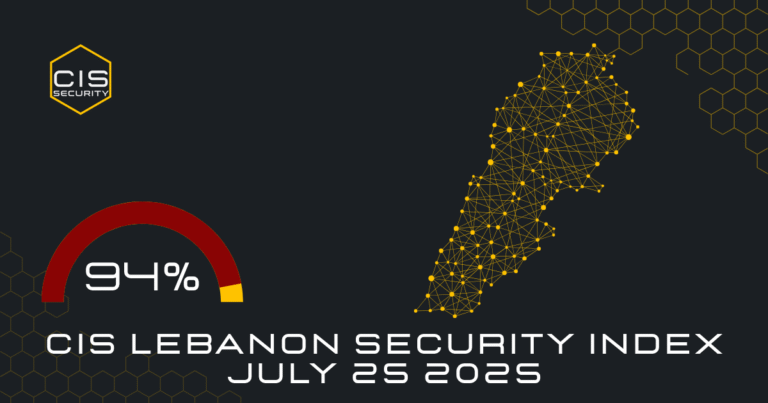
📊 TODAY’S LEBANON SECURITY INDEX READING
INDEX LEVEL: 🔴 CRITICAL
TODAY’S OVERALL INDEX: 85/100
TREND ANALYSIS: ⚠️ AOUN DOUBLES DOWN ON ARMY CONTROL – MONDAY STRIKES CONTINUE PATTERN
🚨 BREAKING: PRESIDENT AFFIRMS STATE MONOPOLY AS ISRAELI STRIKES PERSIST
CRITICAL DEVELOPMENTS – TUESDAY, JANUARY 20, 2026:
PRESIDENT AOUN’S TUESDAY STATEMENT: President Joseph Aoun held a press conference Tuesday, emphasizing his commitment to disarm Hezbollah and implement the state’s monopoly on arms. He declared “what you see, not what you hear” regarding army operations south of the Litani River, stressing that only the Lebanese Army is operating in the region despite Hezbollah leader Qassem’s contrary claims.
MONDAY’S TRIPLE STRIKE DAY: The Israeli military conducted three separate strike operations on Monday (January 19), killing at least one Hezbollah member in Zibqin area. The IDF targeted military structures used for drills, tunnel shafts for storing weapons, and launch sites across southern Lebanon, describing them as responses to “repeated ceasefire violations” by Hezbollah.
MULTIPLE VILLAGE STRIKES: Israeli airstrikes Monday targeted Wadi Burghoz, Ansar’s outskirts, al-Mahmoudiyeh, al-Mourouj, Zarariyeh, Kfar Melki, Nahr al-Shita, and Buslaya – all north of the Litani River. Lebanon’s National News Agency reported “a series of Israeli strikes” on at least five villages, demonstrating continued operations beyond the traditional southern zone.
QASSEM’S SATURDAY DEFIANCE: Hezbollah chief Sheikh Naim Qassem declared Saturday the decision to disarm the group is an “Israeli-American demand” and “It is a far-fetched dream” that Hezbollah would hand over its weapons. He emphasized Lebanon has implemented all ceasefire obligations while Israel has committed to nothing.
PRO-AOUN MINISTER’S OPTIMISM: Despite Qassem’s remarks, a pro-Aoun minister said Monday that arms monopolization is on track, signaling confidence in the government’s ability to proceed with phase two despite Hezbollah’s rhetorical resistance.
10,000+ VIOLATIONS DOCUMENTED: The UN Interim Force in Lebanon (UNIFIL) has documented more than 10,000 ceasefire violations from Israel – 7,500 in the country’s airspace and 2,500 on the ground since the November 2024 ceasefire agreement.
BERRI DIPLOMATIC ENGAGEMENT: Parliament Speaker Nabih Berri described his Tuesday meeting with Saudi Foreign Minister Prince Faisal bin Farhan as “excellent,” indicating active regional diplomatic coordination on Lebanon’s crisis.
300+ KILLED SINCE CEASEFIRE: Israel has killed more than 300 people in Lebanon since the November 2024 ceasefire, including at least 127 civilians, according to UN reporting from November with casualties continuing to mount through January.
🌡️ COMPREHENSIVE GOVERNORATE-BY-GOVERNORATE SECURITY ASSESSMENT
BEIRUT 🏙️
Index Reading: 81/100 🔴
Status: Critical with Presidential Leadership Asserting Authority. The capital experiences cautious optimism as President Aoun’s Tuesday press conference demonstrates firm commitment to state arms monopoly despite Hezbollah’s Saturday defiance and Monday’s continued Israeli strikes.
Aoun’s statement “what you see, not what you hear” directly challenges Qassem’s narrative, emphasizing that only the Lebanese Army operates south of the Litani River. This represents the clearest presidential assertion of state authority since the crisis began.
Berri’s “excellent” meeting with Saudi Foreign Minister bin Farhan Tuesday signals continued regional backing for the Lebanese government’s position. The coordination between President Aoun, Parliament Speaker Berri, and Gulf allies creates framework for sustained pressure on Hezbollah.
However, Monday’s triple Israeli strike operations demonstrate that military pressure continues regardless of political developments. The pattern of 10,000+ documented violations creates ongoing insecurity despite governmental efforts.
Business community monitors with cautious optimism, noting Aoun’s firm stance and regional support while remaining concerned about continued Israeli operations. A pro-Aoun minister’s Monday statement that arms monopolization remains on track despite Qassem’s rhetoric provides some confidence.
Israeli drones continue surveillance over Beirut and southern suburbs, maintaining psychological pressure. Economic activities proceed under shadow of ongoing crisis but with marginally improved confidence in governmental direction.
Key Factor: President Aoun’s Tuesday assertion of state authority and “what you see not what you hear” messaging directly challenging Hezbollah narrative while Monday strikes demonstrate continued Israeli military pressure.
MOUNT LEBANON 🏞️
Index Reading: 77/100 🔴
Status: Critical with Cautious Optimism. The governorate experiences relief at President Aoun’s firm Tuesday stance on state arms monopoly, though concern remains about Hezbollah’s continued defiance and Israeli strike pattern.
Christian communities view Aoun’s presidency and firm statements as representing their interests in establishing true state authority. His Tuesday press conference reinforces confidence that the government will not back down despite Hezbollah rhetoric.
The pro-Aoun minister’s Monday statement that arms monopolization proceeds on track despite Qassem’s Saturday remarks suggests governmental confidence in managing Hezbollah resistance. This provides reassurance to Mount Lebanon populations fearing civil conflict.
Business operations continue with improved confidence following presidential clarity. Monday’s strikes north of Litani River demonstrate Israeli willingness to support governmental disarmament efforts militarily, creating complex security dynamics.
Infrastructure development proceeds cautiously. The region continues hosting displaced populations while monitoring for signs of escalation between government and Hezbollah or expanded Israeli operations.
Key Factor: Christian political base strongly supporting Aoun’s firm Tuesday stance while cautiously optimistic that combined governmental pressure and regional support can manage Hezbollah resistance without civil violence.
NORTH LEBANON 🌊
Index Reading: 79/100 🔴
Status: Critical with Diplomatic Opportunities. Tripoli and surrounding areas monitor developments with interest in President Aoun’s firm stance and Berri’s positive Saudi engagement while remaining concerned about economic vulnerability.
Berri’s “excellent” meeting Tuesday with Saudi Foreign Minister bin Farhan creates opportunities for economic support contingent on disarmament progress. The port city’s commerce requires stability and international confidence that governmental firmness may provide.
Monday’s multiple village strikes demonstrate continued Israeli operations creating regional insecurity. However, the pattern of strikes supporting governmental disarmament efforts rather than opposing them creates different dynamic than previous escalations.
Economic conditions remain vulnerable but governmental clarity and regional diplomatic support provide hope for eventual stability enabling reconstruction and development. The 22 cooperation agreements with Jordan represent potential regional engagement if security improves.
Cross-border dynamics with Syria remain stable. The fundamental political crisis shows signs of potential resolution through combined presidential leadership, regional pressure, and Israeli military support for disarmament.
Key Factor: Berri’s positive Saudi diplomatic engagement combined with presidential firmness creating potential for economic support if disarmament proceeds despite Monday strikes demonstrating continued security challenges.
AKKAR 🌲
Index Reading: 80/100 🔴
Status: Critical – Border Security with Political Clarity. The Syrian border situation remains stable as Lebanese Armed Forces maintain operations while President Aoun’s Tuesday statement provides clarity on governmental direction despite Hezbollah resistance.
Cross-border security operations continue effectively. LAF benefits from clear presidential backing for state authority assertion, reducing institutional uncertainty about confronting Hezbollah presence.
The region watches governmental-Hezbollah dynamics closely. Monday’s pro-Aoun minister statement that monopolization proceeds on track despite rhetoric suggests confidence that LAF can execute phase two with presidential and regional support.
Greek military aid delivered earlier this month strengthens LAF capabilities. Presidential clarity about state monopoly provides institutional confidence despite Monday strikes demonstrating continued Israeli pressure.
Key Factor: LAF operations benefiting from clear presidential authority assertion Tuesday while border security maintained and institutional confidence improved despite ongoing strike pattern.
BEQAA VALLEY 🍇
Index Reading: 88/100 🔴
Status: CRITICAL – Hezbollah Stronghold Under Dual Pressure. The valley faces intense pressure from both governmental disarmament demands and Israeli military operations. Monday strikes targeted multiple locations north of Litani demonstrating expanded Israeli operations.
Qassem’s Saturday speech declaring arms handover a “far-fetched dream” reflects Beqaa Valley resistance to phase two disarmament extending beyond Litani. However, pro-Aoun minister’s Monday confidence suggests government believes it can proceed.
Agricultural operations face ongoing disruption from strike pattern. Monday’s attacks on Ansar, Zarariyeh, and other northern locations demonstrate Israeli willingness to operate throughout Lebanese territory supporting disarmament pressure.
International development projects remain suspended pending security resolution. The combination of presidential pressure, regional support, and Israeli military operations creates unprecedented squeeze on Hezbollah presence.
Key Factor: Dual pressure from Aoun government supported by Saudis and Israeli strikes creates historic challenge to Hezbollah in core areas, with Monday operations demonstrating continued military dimension.
BAALBEK-HERMEL 🕌
Index Reading: 87/100 🔴
Status: CRITICAL – Core Stronghold Facing Existential Pressure. This region experiences maximum tension as Hezbollah’s heartland faces governmental disarmament demands backed by regional powers and supported by Israeli military operations.
Qassem’s Saturday declaration that disarmament is “Israeli-American demand” and weapons handover a “far-fetched dream” resonates strongly in communities viewing arms as defensive necessity. However, Aoun’s Tuesday firmness signals no governmental retreat.
Infrastructure faces threats from expanded strike pattern. Monday operations across multiple locations north of Litani demonstrate Israeli capacity to support governmental pressure throughout Hezbollah core areas.
The regional security dynamics create profound concerns for communities dependent on Hezbollah presence. However, pro-Aoun minister’s Monday confidence suggests government calculations that resistance can be managed.
Key Factor: Hezbollah’s Saturday defiant rhetoric confronting unprecedented governmental firmness backed by Saudi support and Israeli military operations creating historic pressure on core stronghold.
KESERWAN-JBEIL 🏛️
Index Reading: 73/100 🔴
Status: Critical – Relief at Presidential Clarity. The coastal governorate experiences improved confidence following President Aoun’s Tuesday assertion of state authority, though remaining concerned about Hezbollah resistance and Israeli operations.
Tourism infrastructure benefits from governmental clarity potentially enabling eventual recovery. Business operations continue with cautiously improved outlook based on presidential firmness and regional support.
The region’s Christian populations strongly support Aoun’s Tuesday stance directly challenging Hezbollah narrative. Monday strikes demonstrate continued Israeli pressure but also Israeli support for governmental disarmament efforts.
Economic planning remains challenging but presidential clarity reduces one dimension of uncertainty. Communities hope combined governmental pressure and regional backing can manage Hezbollah without civil violence.
Key Factor: Christian base experiencing relief at Aoun’s firm Tuesday stance and Saudi diplomatic support while Monday strikes demonstrate complex security dynamics of disarmament process.
SOUTH LEBANON 🌴
Index Reading: 88/100 🔴
Status: CRITICAL – Monday Triple Strikes Continue Violation Pattern. The south experienced three separate Israeli strike operations Monday, with at least one killed in Zibqin. Multiple villages targeted including those north of Litani River.
President Aoun’s Tuesday statement that “only the army operates south of the Litani” directly contradicts Hezbollah claims and Israeli accusations, asserting state control despite continued strikes. This creates complex dynamics where government claims success while Israel claims insufficient progress.
The Lebanese Armed Forces’ claimed completion of phase one disarmament has not ended Israeli operations. Monday’s strikes on training facilities, tunnel shafts, and launch sites demonstrate Israel maintains that Hezbollah infrastructure persists.
Israel maintains five strategic hilltop positions inside Lebanese territory despite ceasefire requirements. Aoun’s call for Israeli withdrawal creates deadlock where both sides cite other’s violations.
Civilian populations experienced Monday strikes across multiple locations. The pattern of 300+ killed since ceasefire and 10,000+ violations continues despite governmental assertions of army-only operations.
Key Factor: Monday’s triple Israeli strike operations continuing pattern of 300+ deaths and 10,000+ violations while Aoun asserts Tuesday that only army operates in region, creating competing narratives about security situation.
NABATIEH ⛪
Index Reading: 86/100 🔴
Status: Critical – Monday Strikes Continue Despite Army Control Claims. The governorate experienced Monday strikes on multiple locations as part of broader Israeli operations across southern Lebanon.
Infrastructure restoration efforts face continued disruption. President Aoun’s Tuesday assertion that only LAF operates south of Litani conflicts with Israeli claims of ongoing Hezbollah presence requiring strikes.
Civilian populations balance reconstruction needs with Monday’s demonstration that strikes continue regardless of governmental statements. The 10,000+ documented violations create ongoing insecurity.
Hezbollah’s Saturday position that disarmament discussions impossible under Israeli violations resonates in areas experiencing Monday strikes. However, pro-Aoun minister’s Monday confidence suggests government believes disarmament proceeds.
Key Factor: Monday Israeli strikes on multiple locations demonstrating continued operations despite Aoun’s Tuesday assertion of army-only control south of Litani, creating competing security narratives.
🎯 CRITICAL SECURITY INTELLIGENCE BRIEF – AOUN ASSERTS AUTHORITY
🔥 CURRENT HIGH-RISK AREAS:
Priority Level 1 – Monday Strike Locations:
- Zibqin Area – One killed Monday in third strike of day
- Wadi Burghoz – Targeted Monday in multi-location operation
- Ansar Outskirts – Struck Monday north of Litani
- Al-Mahmoudiyeh – Monday strike location
- Zarariyeh – Hit Monday along with four other villages
- Kfar Melki – Monday target north of Litani
- Nahr al-Shita – Struck Monday in expanded operation
- Buslaya – Targeted Monday demonstrating geographic range
- Al-Mourouj – Monday strike location
- All Southern Training Sites – IDF claims targeting drill facilities
Priority Level 2 – Ongoing Tension Zones: 11. Israeli-Occupied Positions – Five hilltop locations inside Lebanon 12. Beirut Political Centers – Aoun-Qassem rhetorical confrontation 13. Areas North of Litani – Phase two disarmament battleground 14. Tunnel Shaft Locations – Targeted Monday as weapon storage sites 15. Launch Site Areas – Struck Monday as attack staging areas
✅ RELATIVELY LOWER RISK (BUT STILL CRITICAL):
Tuesday No-Strike Areas:
- Keserwan-Jbeil – No Monday strikes, presidential clarity providing relief
- Northern Coastal Areas – Berri diplomatic engagement positive
- Syrian Border Areas – Cross-border security maintained
- Central Beirut – Aoun press conference demonstrating governmental control
⚠️ TUESDAY’S COMPETING NARRATIVES:
President Aoun Position (Tuesday):
- Only Lebanese Army operates south of Litani River
- “What you see, not what you hear” regarding security control
- Commitment to disarm Hezbollah and state arms monopoly
- Calls for Israeli withdrawal from occupied positions
Hezbollah Position (Saturday):
- Arms handover is “far-fetched dream”
- Disarmament is “Israeli-American demand”
- Lebanon implemented all obligations, Israel committed to nothing
- Cannot discuss weapons while violations continue
Israeli Position (Monday Operations):
- Hezbollah continues ceasefire violations requiring strikes
- Training facilities, tunnels, launch sites justify operations
- Lebanese Army efforts insufficient despite phase one completion
- Hezbollah rearming faster than disarming
Pro-Aoun Minister (Monday):
- Arms monopolization on track despite Qassem rhetoric
- Governmental confidence in proceeding with phase two
- Presidential backing and regional support enabling progress
📱 CURRENT SECURITY GUIDANCE – TUESDAY ASSESSMENT
🏠 GUIDANCE FOR RESIDENTS:
CURRENT TUESDAY ENVIRONMENT: Lebanon experiences cautious governmental confidence following President Aoun’s firm Tuesday assertion of state authority, pro-Aoun minister’s Monday optimism about monopolization progress, and Berri’s positive Saudi engagement, despite Hezbollah’s Saturday defiance and Monday’s triple Israeli strike operations demonstrating continued military pressure.
TUESDAY DEVELOPMENTS:
- Aoun Press Conference: “What you see not what you hear” challenging Hezbollah narrative
- Monday Triple Strikes: IDF killed at least one in Zibqin, targeted eight villages
- Pro-Government Confidence: Minister says monopolization on track despite rhetoric
- Berri-Saudi Meeting: “Excellent” diplomatic engagement signaling regional support
- Competing Claims: Government says only army operates vs Israeli strikes continue
IMMEDIATE SAFETY CONSIDERATIONS:
- Strike Pattern Continues: Monday operations demonstrate no Israeli pause despite claims
- Monitor Warnings: Evacuation orders can come with limited notice
- Political Rhetoric: Aoun-Qassem confrontation could trigger demonstrations
- Emergency Preparedness: Maintain supplies given 10,000+ violation pattern
🏢 BUSINESS OPERATIONS GUIDANCE:
TUESDAY ASSESSMENT:
- Presidential Clarity: Aoun’s firm stance provides governmental direction
- Regional Support: Saudi diplomatic engagement signals international backing
- Monday Strikes: Demonstrate continued military dimension despite progress claims
- Ministerial Confidence: Pro-Aoun official optimistic about phase two
OPERATIONAL CONSIDERATIONS:
- Presidential firmness and regional backing improve long-term outlook
- Monday strike pattern demonstrates short-term security challenges persist
- Emergency evacuation plans remain essential given Monday operations
- Political clarity enables better planning despite ongoing military pressure
🚗 TRAVEL ADVISORY – TUESDAY STATUS:
CURRENT TRAVEL CONDITIONS: Tuesday features improved governmental clarity through Aoun’s assertion and ministerial confidence statements, but Monday’s triple strike operations demonstrate continued security risks with 300+ killed since ceasefire and 10,000+ violations documented.
TUESDAY TRAVEL ASSESSMENT:
- No Strikes Today: But Monday pattern shows continued operational tempo
- Southern Areas: Exercise extreme caution following Monday eight-village strikes
- Monitor Warnings: Israeli evacuation orders preceded some but not all Monday strikes
- Political Clarity: Presidential firmness doesn’t eliminate military dimension
📊 TUESDAY, JANUARY 20, 2026 SECURITY ANALYSIS
Today’s Assessment: Presidential Firmness Confronts Hezbollah Defiance Amid Continued Strikes
Aoun’s Stance: “What you see not what you hear” – only army operates south Litani
Qassem’s Position: Arms handover “far-fetched dream,” disarmament is foreign demand
Monday Reality: Three strike operations, eight villages, one killed, infrastructure targeted
Critical Analysis: Tuesday, January 20, 2026, marks a pivotal confrontation between President Joseph Aoun’s assertion of state authority and Hezbollah leader Sheikh Naim Qassem’s defiant rejection of disarmament, while Monday’s triple Israeli strike operations demonstrate the continuing military dimension of Lebanon’s security crisis.
President Aoun held a press conference Tuesday emphasizing his commitment to disarm Hezbollah and implement the state’s monopoly on arms. Most significantly, he declared “what you see, not what you hear” regarding operations south of the Litani River, directly challenging Hezbollah’s narrative by insisting that only the Lebanese Army operates in the region.
This represents the clearest presidential confrontation with Hezbollah’s claims since the crisis began. Aoun stressed Tuesday that he is committed to disarming Hezbollah and implementing the state’s monopoly on arms, saying “We … only army operating south of Litani” in response to both Qassem’s rhetoric and Israeli accusations.
The statement directly contradicts Hezbollah leader Qassem’s Saturday televised speech declaring that the decision to disarm the group is an “Israeli-American demand” and “It is a far-fetched dream” that Hezbollah would hand over its weapons. Qassem emphasized that Lebanon has implemented all its ceasefire obligations while Israel has committed to nothing.
However, a pro-Aoun minister stated Monday that arms monopolization remains on track despite Qassem’s remarks, demonstrating governmental confidence in proceeding with disarmament efforts regardless of Hezbollah’s rhetorical resistance.
Monday’s Israeli operations provide the military backdrop to this political confrontation. The military killed a Hezbollah terrorist on Monday in the Zibqin area in southern Lebanon, the IDF said in a statement. This represents the third strike announcement in one day against Hezbollah targets, demonstrating sustained operational tempo.
The Israeli strikes Monday targeted multiple villages across southern Lebanon. Israeli airstrikes targeted Monday Wadi Burghoz, Ansar’s outskirts, al-Mahmoudiyeh, and al-Mourouj, with the Israeli army claiming it struck Hezbollah targets in south Lebanon. The National News Agency reported strikes on at least five additional villages including Zarariyeh, Kfar Melki, Nahr al-Shita, and Buslaya, all north of the Litani River.
The IDF said that the main target of Monday’s strikes was a series of military structures used by Hezbollah for drills and training exercises. The operations also targeted tunnel shafts used for storing weapons and launch sites, with the military claiming these sites were being used to advance attacks against Israeli forces.
The geographic pattern is significant. Many of Monday’s strikes occurred north of the Litani River, in areas where the Lebanese government is preparing to implement phase two of its disarmament plan. The timing suggests Israeli military pressure designed to support governmental efforts against Hezbollah in these contested zones.
Parliament Speaker Nabih Berri described his Tuesday meeting with Saudi Foreign Minister Prince Faisal bin Farhan as “excellent,” signaling continued regional diplomatic coordination. This Gulf engagement represents critical support for the Aoun government’s position, creating external pressure on Hezbollah beyond the military dimension.
The fundamental security situation remains dire despite political developments. The UN Interim Force in Lebanon (UNIFIL) has documented more than 10,000 ceasefire violations from Israel – 7,500 in the country’s airspace and 2,500 on the ground since the November 2024 ceasefire agreement.
The human toll continues mounting. Israel has killed more than 300 people in Lebanon since the November 2024 ceasefire, including at least 127 civilians, according to UN reporting from November, with casualties continuing through January including Monday’s fatality.
The Lebanese Army announced January 8 that it had completed phase one disarmament south of the Litani River. However, Israel’s Foreign Ministry doesn’t agree, saying “extensive Hezbollah military infrastructure still exists south of the Litani River”. “Hezbollah is rearming faster than it is being disarmed,” it said, accusing the Lebanese Army of collaborating with Hezbollah, without providing evidence.
President Aoun’s Tuesday assertion that only the army operates south of the Litani directly challenges both Hezbollah’s claims of continued presence and Israeli accusations of inadequate disarmament. This creates competing narratives where the government claims success, Hezbollah claims irrelevance, and Israel claims failure – all while strikes continue.
Hezbollah’s position remains fundamentally opposed to disarmament beyond what it considers Israeli compliance. A senior Hizbollah official said that disarming the group beyond southern Lebanon would be the “the biggest crime committed by the state”. He also warned: “The path taken by the Lebanese government and state institutions will lead Lebanon to instability, chaos and perhaps even civil war… There will be no talk or dialogue about any situation north of the Litani River before Israel withdraws from all Lebanese territory, liberates the south and the prisoners, and stops its violations against Lebanon”.
The Israeli position draws support from reporting about the Trump administration. Tensions are also growing after a meeting in Florida between US President Donald Trump and Israel’s Prime Minister Benjamin Netanyahu on December 29, when the latter was reportedly given a green light to begin a new offensive against Hezbollah in Lebanon. Trump’s inauguration occurs today, January 20, potentially marking a shift in US policy toward stronger support for Israeli operations.
Israel maintains five strategic positions inside Lebanese territory despite ceasefire requirements for withdrawal. This ongoing occupation provides Hezbollah with justification for refusing further disarmament, creating a deadlock where each side cites the other’s violations.
Regional Context: President Aoun’s firmness reflects support from Saudi Arabia and other Gulf states, demonstrated through Berri’s “excellent” meeting Tuesday. The fall of the Assad regime in Syria has reduced Iran’s land bridge to Lebanon, weakening Hezbollah’s strategic position and creating space for stronger governmental action.
Competing Pressures: The Lebanese government operates under multiple competing pressures. International partners demand comprehensive disarmament. Israel conducts strikes supporting these demands. Hezbollah threatens civil conflict if pushed beyond current limits. Civilian populations suffer ongoing casualties regardless of political positioning.
Phase Two Challenge: The approaching phase two of disarmament, extending operations north of the Litani River into Hezbollah core areas, represents the critical test. Monday’s strikes in these northern areas demonstrate Israeli willingness to support governmental efforts militarily. Pro-Aoun minister’s confidence suggests governmental intention to proceed. Hezbollah’s warnings suggest potential violent resistance.
Trump Factor: Today’s Trump inauguration potentially marks policy shift toward stronger support for Israeli operations against Hezbollah. The reported December 29 “green light” could translate into sustained backing for both Israeli military pressure and Lebanese governmental disarmament efforts.
Parliamentary Elections: The approaching May 2026 parliamentary elections create additional complications. Hezbollah may seek to demonstrate strength against disarmament pressure to maintain political influence. The government may push harder now to establish facts on ground before electoral politics constrain action.
Fundamental Deadlock: Despite Tuesday’s presidential firmness, Monday’s ministerial confidence, and regional diplomatic support, the fundamental deadlock persists. Hezbollah refuses disarmament while Israeli violations continue. Israel refuses withdrawal while Hezbollah infrastructure persists. Both cite the other’s non-compliance.
Civilian Cost: Regardless of political positioning, civilian populations bear the cost. Monday’s strikes, 300+ deaths since ceasefire, 10,000+ violations, and ongoing displacement create humanitarian crisis overshadowed by political confrontation.
Week Ahead Critical: The coming days will test whether President Aoun’s Tuesday firmness, backed by regional support and Israeli military operations, can translate into actual progress on phase two disarmament, or whether Hezbollah’s Saturday defiance represents insurmountable resistance requiring either governmental retreat or dangerous escalation.
Long-term Prospects: Tuesday’s clear presidential assertion represents potential turning point if sustained, but Monday’s strikes demonstrate the violent context in which political progress must occur. The question remains whether combined governmental pressure, regional backing, and Israeli military support can overcome Hezbollah’s deep roots and existential resistance without triggering the civil conflict all sides claim to want to avoid.
🛡️ CIS SECURITY: TUESDAY OPERATIONS & CRISIS MONITORING
📡 CONTINUOUS MONITORING DURING POLITICAL-MILITARY CRISIS
CIS Security maintains 24/7 monitoring and crisis response capabilities during Tuesday’s competing narratives of presidential firmness and continued military operations, recognizing that Aoun’s political assertion and Monday’s strike reality create complex security environment requiring sustained professional vigilance.
TUESDAY SECURITY SERVICES:
Post-Monday Strike Assessment:
- Zibqin Fatality Analysis – Assessing implications of Monday’s third strike
- Eight-Village Pattern – Monitoring Monday’s geographic strike distribution
- Presidential Statement Impact – Evaluating Aoun’s authority assertion effects
- Ministerial Confidence Tracking – Assessing pro-government optimism basis
Continuous Threat Monitoring:
- Israeli Strike Pattern – Monday triple operations suggesting sustained tempo
- Hezbollah Response Tracking – Monitoring reaction to Aoun’s direct challenge
- Regional Diplomatic Developments – Following Berri-Saudi positive engagement
- Phase Two Preparation – Intelligence on north Litani disarmament planning
Operational Readiness:
- Strike Zone Response – Maintained capabilities following Monday eight villages
- Political Demonstration Monitoring – Prepared for Aoun-Qassem confrontation effects
- Evacuation Coordination – Ready for warnings as Monday pattern continues
- 24/7 Command Center – Continuous crisis monitoring despite competing narratives
SPECIALIZED TUESDAY SERVICES:
Government & Diplomatic Protection:
- Security supporting President Aoun following firm authority assertion
- Protection for pro-government ministers expressing confidence
- Diplomatic mission security during Saudi engagement period
- International organization security maintaining Lebanon operations
Business Continuity Management:
- Operations security during political clarity with military uncertainty
- Emergency response planning for phase two implementation risks
- Strike zone assessment for Monday’s eight targeted villages
- Long-term planning support based on governmental direction
Residential & Family Security:
- Enhanced home security during Aoun-Qassem political confrontation
- Tuesday monitoring for demonstration or street mobilization risks
- Emergency communication systems following Monday strikes
- Family safety protocols recognizing continued operational tempo
📞 TUESDAY COORDINATION
24/7 SECURITY HOTLINE: +961-3-539900
Continuous monitoring recognizing presidential firmness doesn’t eliminate strike risk
TUESDAY SERVICES: Ongoing threat assessment and operational readiness
CRISIS MONITORING: Real-time tracking of political and military developments
EMERGENCY RESPONSE: Immediate capabilities for strike or confrontation escalation
Tuesday Operations Centers:
- Political Intelligence: Tracking Aoun assertion vs Hezbollah defiance dynamics
- Strike Pattern Analysis: Evaluating Monday’s operations and continuation risk
- Regional Diplomacy: Monitoring Saudi backing and international support
- 24/7 Coordination: Maintained emergency response throughout crisis period
During Tuesday’s competing narratives of President Aoun’s firm authority assertion, pro-government ministerial confidence, Berri’s positive Saudi engagement, Hezbollah’s Saturday defiant rejection, and Monday’s triple strike operations, CIS Security’s continuous monitoring recognizes that political clarity improves long-term outlook while military reality maintains short-term risks requiring sustained professional vigilance and operational readiness.
⚠️ TUESDAY CRITICAL STATUS
COMPETING NARRATIVES: Tuesday, January 20, 2026 features President Joseph Aoun’s firm assertion that “what you see not what you hear” – only Lebanese Army operates south of Litani, directly challenging Hezbollah leader Qassem’s Saturday declaration that arms handover is “far-fetched dream” and disarmament is “Israeli-American demand.”
Monday Strike Reality: Three Israeli operations Monday killed at least one in Zibqin, targeted eight villages including Wadi Burghoz, Ansar, al-Mahmoudiyeh, al-Mourouj, Zarariyeh, Kfar Melki, Nahr al-Shita, and Buslaya, demonstrating continued military pressure regardless of political claims.
Governmental Confidence: Pro-Aoun minister stated Monday that arms monopolization remains on track despite Qassem’s rhetoric, while Berri described Tuesday Saudi meeting as “excellent,” signaling regional diplomatic backing for Lebanese government position.
Fundamental Crisis: 10,000+ UNIFIL-documented violations, 300+ killed since November ceasefire, Israeli occupation of five positions, and Hezbollah’s civil war warnings create deadly context where Tuesday’s political clarity confronts Monday’s military reality.
Trump Inauguration: Today’s US presidential transition potentially marks policy shift toward stronger support for Israeli operations, with reported December “green light” suggesting sustained backing for military pressure on Hezbollah.
CIS Operations: 24/7 monitoring recognizing presidential firmness improves long-term governmental direction while Monday strike pattern demonstrates short-term military risks persist requiring continuous professional security vigilance.
Critical Week Ahead: Coming days test whether Aoun’s Tuesday assertion backed by regional support and Israeli operations can translate into phase two progress, or Hezbollah’s defiance triggers governmental retreat or dangerous escalation.
🔍 PROFESSIONAL SECURITY SERVICES – CIS SECURITY LEBANON
Trusted Security Excellence Since 1990 – “Because Your Safety Isn’t Optional”
During Tuesday’s complex security environment featuring President Aoun’s firm authority assertion directly challenging Hezbollah leader Qassem’s Saturday defiant rejection, pro-government ministerial confidence in monopolization progress, Berri’s positive Saudi diplomatic engagement, Monday’s triple Israeli strike operations targeting eight villages with one killed, 10,000+ UNIFIL-documented violations, 300+ deaths since ceasefire, Trump inauguration potentially shifting US policy, and competing political narratives confronting military reality, trust CIS Security’s 35+ years of crisis management expertise providing continuous professional monitoring recognizing presidential clarity improves long-term direction while Monday pattern demonstrates short-term risks persist.
CIS SECURITY
Because Your Safety Isn’t Optional
🎯 LEBANON SECURITY INDEX™
Powered by Advanced Intelligence Partnership
Daily Security Intelligence Dashboard LIVE RAGEX Intelligence Partner FEATURED