CIS LEBANON SECURITY INDEX – July 12 2026
CIS LEBANON SECURITY INDEX – July 12 2026
Sunday, July 12, 2026
🔴 WAR DAY 133 | LARGEST ESCALATION YET: IRAN ATTACKS SIX COUNTRIES — JORDAN, KUWAIT, BAHRAIN, QATAR, OMAN, UAE | IRAN DECLARES STRAIT OF HORMUZ “CLOSED UNTIL FURTHER NOTICE” | US STRIKES ~140 IRANIAN TARGETS IN THIRD ROUND THIS WEEK | ATTACK CAME HOURS AFTER OMAN HOSTED ARAGHCHI FOR HORMUZ TALKS | MOJTABA KHAMENEI’S FIRST STATEMENT VOWS “REVENGE… MUST CERTAINLY BE CARRIED OUT”
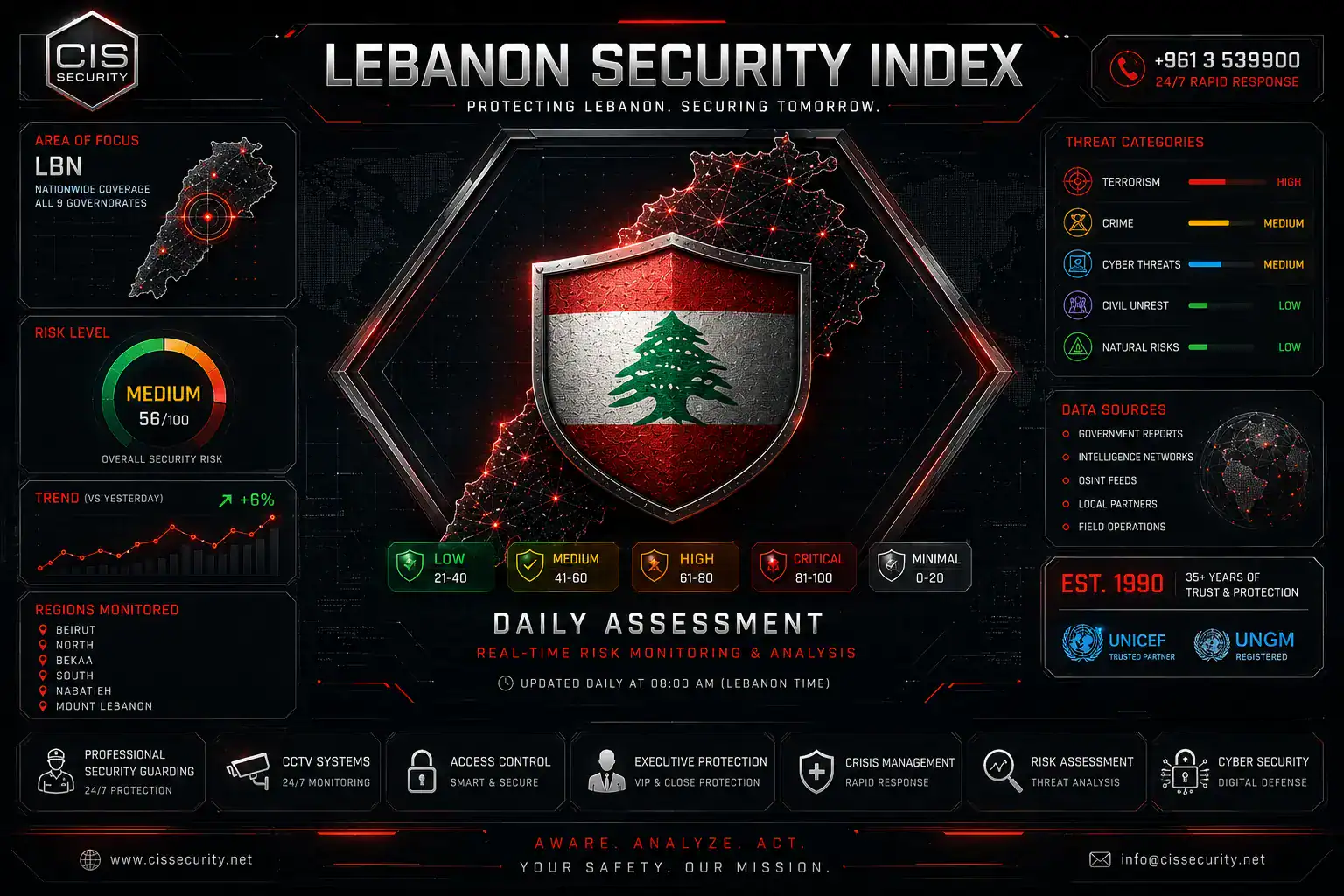
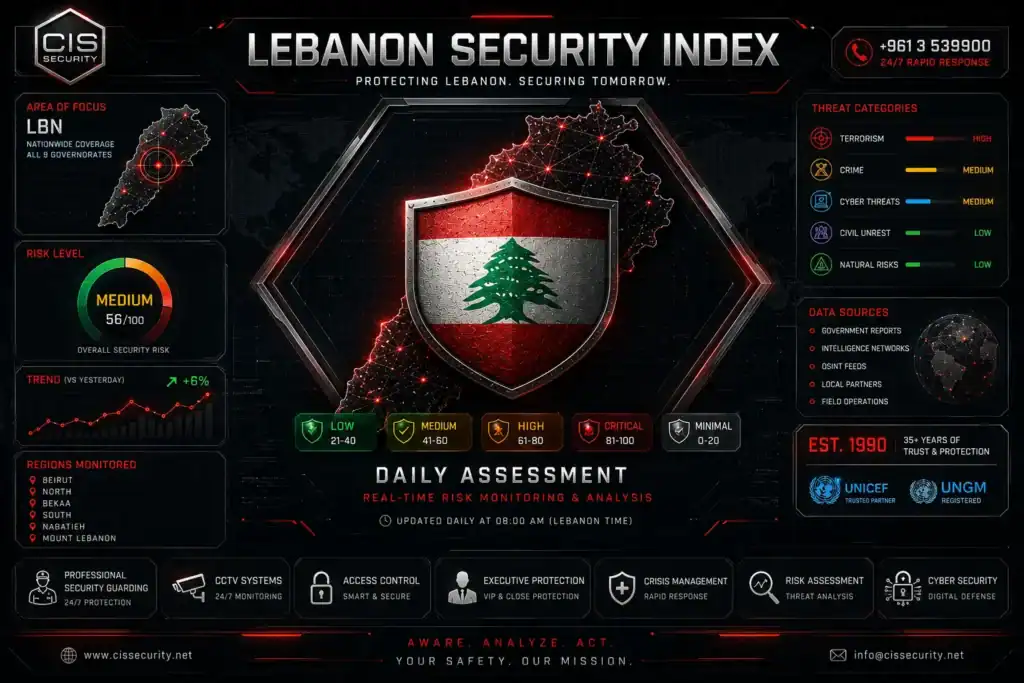
INDEX LEVEL: 🔴 CRITICAL — YESTERDAY’S STABILIZATION SIGNALS HAVE REVERSED SHARPLY OVERALL INDEX: 91/100 TREND: ⬆️⬆️⬆️ SEVERE ESCALATION, HIGHEST OF THIS ENTIRE REPORTING PERIOD — CIS must revise yesterday’s assessment. The diplomatic momentum noted in Saturday’s report — Araghchi’s scheduled Oman visit, the US withdrawal of stealth jets from Israel, continued technical talks — did not hold. Just hours after Oman hosted Iran’s foreign minister for talks specifically addressing the Strait of Hormuz, Iran’s Revolutionary Guards attacked a Cyprus-flagged container ship near the Omani coast, setting it ablaze and forcing its crew to abandon ship, with one crew member reported missing. The US response was immediate and, by a wide margin, the largest of the week: US Central Command says it struck approximately 140 Iranian military sites — missile and drone facilities, ammunition depots, radar and air-defense sites — in what is now the third round of US strikes on Iran this week. Iran’s retaliation, in turn, was unprecedented in scope: the IRGC claims to have struck US-linked military facilities in Jordan (Prince Hassan Air Base), Kuwait (Patriot air-defense system, ammunition depot, radar site), Bahrain (communications and radar systems), Qatar (Al Udeid Air Base, for the second time this week), and Oman (Port of Duqm carrier-support and refueling facilities), while the UAE — not previously targeted since May — reported its air defenses actively engaging incoming missiles and drones. Air-raid sirens sounded across Bahrain, Qatar, and the UAE; explosions were heard in Doha. Iran’s Persian Gulf Strait Authority formally declared the Strait of Hormuz “closed until further notice, and until the end of American interventions in this region” — though the UK’s UKMTO maritime authority states the southern shipping route remains open and has in fact been expanded for two-way traffic, indicating Iran’s closure claim is contested rather than fully enforced. New Supreme Leader Mojtaba Khamenei issued his first public statement since his father’s funeral, vowing that revenge for the killing “is the will of our nation and must certainly be carried out.” South Lebanon itself saw no dramatic new incident today — IDF operations continued at a routine pace — but this relative calm is now entirely overshadowed by the most severe single-day widening of the broader regional war CIS has tracked in this entire series.
⛔ EXECUTIVE SUMMARY — SUNDAY JULY 12, 2026 (WAR DAY 133)
DIPLOMACY FAILS WITHIN HOURS: ATTACK ON SHIP COMES RIGHT AFTER OMAN HOSTS ARAGHCHI
Iran’s Revolutionary Guards attacked a Cyprus-flagged container ship transiting the Strait of Hormuz on a route hugging the Omani coastline, according to US Central Command, causing “significant engineroom damage” and leaving one civilian crew member missing. The vessel’s crew abandoned ship and moved to a lifeboat, per the UK’s UKMTO maritime authority. Iran characterized the strike as “warning shots” against a vessel that had ignored instructions to use an approved shipping corridor; the US called it a deliberate attack on a civilian ship.
Critically, this occurred just hours after Oman hosted Iranian Foreign Minister Abbas Araghchi for talks specifically intended to address Strait of Hormuz security — the same visit CIS flagged yesterday as a positive diplomatic signal. The Oman News Agency issued a statement condemning the attack, explicitly noting it came shortly after hosting the Iranian delegation. Oman separately said it and Iran had agreed to continue discussing the Strait of Hormuz “at the technical and political levels,” but notably, Iran offered no statement committing to keep the strait open to all shipping — the central US demand CIS reported yesterday.
CIS assessment: This represents a significant diplomatic failure, occurring within the same news cycle as the visit meant to de-escalate the exact dispute at hand. CIS revises its Saturday assessment accordingly: the diplomatic track, while still nominally active, has proven unable to prevent continued military action even in its most immediate, specific form (talks the same day as an attack in the same waterway).
THIRD ROUND OF US STRIKES: ~140 IRANIAN TARGETS, THE LARGEST YET
US Central Command announced it had completed a third round of strikes against Iran this week, targeting approximately 140 Iranian military sites — missile and drone facilities, ammunition depots, and air-defense and radar installations — a significant increase in scale from the roughly 80–90 targets struck in the prior two rounds earlier this week. Iranian state media reported explosions in Bandar Abbas, Sirik, Jask, and on Qeshm Island, as well as in Khuzestan province, with no immediate reports of Iranian casualties from this specific round, though Iran’s Health Ministry has said the cumulative toll from this week’s earlier rounds of US strikes stands at 17 killed and 115 wounded.
CIS assessment: The scale of this third strike round — nearly double the size of Wednesday and Thursday’s rounds — indicates the US is not moderating its response despite this week’s brief diplomatic overtures. This is the most significant single set of US strikes on Iran CIS has tracked in this entire reporting period.
IRAN RETALIATES AGAINST SIX COUNTRIES — THE BROADEST ATTACK YET
Iran’s IRGC claims to have struck US-linked military facilities across five countries in a single coordinated wave, with a sixth (the UAE) separately reporting it intercepted incoming fire:
- Jordan: IRGC claims it destroyed the command-and-control center and MQ-9 drone hangars at Prince Hassan Air Base.
- Kuwait: IRGC says it used explosive drones to strike a Patriot air-defense system, an ammunition depot, and a radar site linked to US forces; Kuwait’s military says it is actively intercepting hostile aerial targets.
- Bahrain: Iran’s army claims drone strikes targeted a US communications system and radar site; air-raid sirens activated across the country.
- Qatar: IRGC claims a second round of retaliatory ballistic missile strikes hit Al Udeid Air Base, targeting its fighter jet maintenance center and command headquarters; Qatar’s military says it intercepted the incoming fire, and the country’s Interior Ministry raised its security threat level to “high” for the second time in a single day, urging residents to remain indoors.
- Oman: IRGC describes a “heavy and surprise” attack on logistics support centers and refueling platforms used by US aircraft carriers at the Port of Duqm, which it says were “destroyed.”
- UAE: The UAE Ministry of Defense said its air-defense systems were actively engaging incoming missiles and drones, marking the first time the UAE has been targeted since early May. Explosions were heard across the country, caused by interception activity.
A second commercial vessel in the Strait of Hormuz was separately struck and disabled, per IRGC claims, which have not been independently verified.
CIS assessment: This is, by a clear margin, the broadest single-day expansion of the conflict’s geographic footprint CIS has tracked. Six countries beyond Iran and Israel/Lebanon were directly targeted or engaged in active air-defense operations within hours of each other — a scale of simultaneous regional engagement not seen at any prior point in this series. Notably, Israel did not claim any of the intercepting fire, which several reports suggest may have originated from the Gulf Arab states themselves as a deterrent message to Iran, rather than from Israeli or US assets.
IRAN DECLARES HORMUZ “CLOSED”; UK MARITIME AUTHORITY DISPUTES THE CLAIM
Iran’s Persian Gulf Strait Authority formally declared: “the Strait of Hormuz will be closed until further notice and until the end of American interventions in this region.” However, the UK’s UKMTO maritime security authority states that, despite Iran’s claim, the southern shipping route remains available and has in fact been expanded to support two-way traffic — indicating Iran’s closure declaration is, in practical terms, being contested and only partially enforced, consistent with the pattern CIS has observed throughout this conflict of Iranian closure declarations not fully halting maritime traffic. Saudi Arabia condemned what it called Iran’s “destabilising behaviour and repeated attacks in the region.”
Iran’s top negotiator, parliament speaker Mohammad Bagher Ghalibaf, posted an image of Article 5 of the MOU — the provision addressing the reopening of the Strait of Hormuz — highlighting the phrase “the Islamic Republic of Iran will make arrangements,” and declared the era of “one-sided deals” was over, warning that countries must honor their commitments or “pay the price.” Separately, an adviser to Iran’s supreme leader, Mohsen Rezaee, said the Strait of Hormuz is “more important than dozens of atomic bombs,” vowing Iran would protect it.
CIS assessment: The gap between Iran’s formal closure declaration and the actual, ongoing maritime traffic reported by UKMTO is an important distinction — CIS advises against treating Iran’s rhetorical claims about the strait’s status as a literal description of on-the-water conditions, while still recognizing the genuinely elevated risk to any vessel transiting the area.
NEW SUPREME LEADER’S FIRST STATEMENT: “REVENGE… MUST CERTAINLY BE CARRIED OUT”
Supreme Leader Ayatollah Mojtaba Khamenei — silent and unseen in public since succeeding his father in February — issued his first public statement following his father’s funeral, vowing that Iranians would avenge Ali Khamenei’s killing in the war’s opening strikes on February 28. “[Revenge] is the will of our nation and must certainly be carried out,” the statement, carried on Iranian state television, reads.
Separately, unnamed US officials speaking Friday — before this latest round of escalation — suggested that the earlier resumption of strikes this week resulted from the actions of “a rogue faction of Iranian hard-liners” attempting to sabotage the broader ceasefire, an attribution theory CIS notes but cannot independently verify.
CIS assessment: The new Supreme Leader’s first public statement being an explicit vow of “revenge” — issued the same day as this week’s largest coordinated regional attack — undercuts any near-term expectation of Iranian de-escalation at the highest political level, regardless of what technical-level talks with Oman or Qatar may separately produce.
📅 KEY TIMELINE — JULY 11–12
| Date | Event |
|---|---|
| July 11 | Araghchi visits Oman for scheduled Hormuz talks; Qatar emir and Pakistan PM discuss regional security; CNN reports possible Iran nuclear-site reconstruction at Parchin; US withdraws stealth jets from Israeli airbase |
| July 12 (overnight/today) | Iran’s IRGC attacks Cyprus-flagged container ship near Oman’s coast, hours after the Araghchi-Oman meeting. US launches third round of strikes this week (~140 targets). Iran’s Persian Gulf Strait Authority declares Hormuz “closed until further notice.” Iran retaliates against Jordan, Kuwait, Bahrain, Qatar, Oman, and the UAE within hours. Air-raid sirens sound across Bahrain, Qatar, UAE. Mojtaba Khamenei issues first public statement, vows revenge “must certainly be carried out.” IDF sends erroneous missile-attack warning to some Israeli phones |
🗺️ JULY 12 GOVERNORATE-BY-GOVERNORATE ASSESSMENT
| Governorate | Status | Detail |
|---|---|---|
| South Lebanon (general) | 🟠 ELEVATED, NO DRAMATIC NEW INCIDENT | Routine IDF operations continued (551st Brigade); overshadowed by severe regional escalation |
| South Lebanon — all previously flagged high-risk zones | 🔴 CONTINUE PRIOR CLASSIFICATION | No change from prior days’ guidance; no new specific incidents reported today |
| South Lebanon — two pilot withdrawal zones | 🟡 STILL UNCONFIRMED | No independent confirmation the withdrawal has begun |
| Beqaa / Bekaa Valley | 🟠 ELEVATED | No new major strikes specifically reported today |
| South Beirut / Dahiyeh | 🟠 ELEVATED — POLITICAL TENSION | Monitor for reaction to the dramatic widening of the regional war |
| Beirut (general) | 🟡 CALM BUT WATCHFUL | Normal operations continue; Rome talks (July 15–16) approaching amid a much more volatile regional backdrop |
| Mount Lebanon | ✅ CALM | Normal operations |
| North Lebanon | ✅ CALM | Normal operations |
| Akkar | ✅ CALM | Normal operations |
🚗 JULY 12 TRAVEL STATUS
| Zone | Status |
|---|---|
| All previously flagged south Lebanon high-risk zones | 🔴 CONTINUE TO AVOID per prior guidance — no change |
| Two pilot withdrawal zones | 🟡 DO NOT ASSUME CHANGE — still unconfirmed |
| Buffer zone (general) | ❌ ACTIVELY ENFORCED — do not approach |
| South Lebanon (general) | 🟠 HEIGHTENED CAUTION — continue minimizing non-essential travel |
| Bekaa Valley, Dahiyeh/South Beirut | 🟠 ELEVATED |
| Beirut (non-Dahiyeh), Mount Lebanon, North Lebanon | ✅ Calm |
| Masnaa Border Crossing | ✅ OPEN |
| Rafic Hariri Airport | ✅ OPERATING — monitor for potential regional airspace disruptions given the scale of today’s escalation |
| Strait of Hormuz | 🔴 SEVERE — Iran claims closure; UKMTO says southern route remains open but the entire waterway carries extreme active-conflict risk; avoid transit entirely |
| Jordan, Kuwait, Bahrain, Qatar, Oman, UAE | 🔴 ALL SIX DIRECTLY STRUCK OR ENGAGED TODAY — avoid all non-essential travel to military-adjacent areas in these countries pending stabilization |
📊 JULY 12 STATISTICS — WAR DAY 133
| Metric | Figure | Source |
|---|---|---|
| Lebanon killed (cumulative, per OCHA/Lebanese government) | 4,230+ (last confirmed update June 25) | UN OCHA / UN Security Council Report |
| Lebanon injured (cumulative) | 12,179+ | UN OCHA, as of June 25 |
| Iranian military sites struck by US (3rd round, today) | ~140 | CENTCOM |
| Iranians killed by US strikes (cumulative, this week, per Iran Health Ministry) | 17 (115 wounded) | Iran Health Ministry spokesperson Hossein Kermanpour |
| Countries directly struck or engaged by Iran today | 6 (Jordan, Kuwait, Bahrain, Qatar, Oman, UAE) | Multiple wire services |
| Commercial vessels struck in Hormuz (this incident) | 1 confirmed (Cyprus-flagged container ship; 1 crew member missing) + 1 additional claimed by IRGC, unverified | CENTCOM / UKMTO |
| UAE strike status | First time targeted since early May 2026 | AP / NPR |
| Total war duration | 133 days (since March 2) | CIS calculation |
🔑 KEY STATEMENTS — JULY 11–12, 2026
| Actor | Statement |
|---|---|
| Iran’s Persian Gulf Strait Authority | “The Strait of Hormuz will be closed until further notice and until the end of American interventions in this region” |
| UKMTO | Despite Iran’s claim, “the southern route remains available and has been expanded to support two-way traffic” |
| Oman News Agency | “The Sultanate of Oman affirms its condemnation and denunciation of this attack” |
| Iran negotiator Mohammad Bagher Ghalibaf | The era of “one-sided deals” is over; countries must honor commitments or “pay the price” |
| Supreme Leader Mojtaba Khamenei (first public statement) | Revenge for his father’s killing “is the will of our nation and must certainly be carried out” |
| Adviser to Iran’s supreme leader, Mohsen Rezaee | The Strait of Hormuz is “more important than dozens of atomic bombs” |
| Saudi Arabia | Condemns Iran’s “destabilising behaviour and repeated attacks in the region” |
| Unnamed US officials (Friday, prior to this round) | Attribute earlier strike resumption to “a rogue faction of Iranian hard-liners” attempting to sabotage the ceasefire |
🛡️ CIS SECURITY — JULY 12 ASSESSMENT & GUIDANCE
Trusted Security Excellence Since 1990 | “Because Your Safety Isn’t Optional”
CIS POSTURE: LEVEL 6 — CRITICAL ESCALATION ALERT (RAISED from Level 5)
CIS is raising its posture back to Level 6 — Critical Escalation Alert, reversing yesterday’s moderation. Today’s developments — the failure of same-day diplomacy in Oman, the largest US strike round of the week, and Iran’s retaliation against six countries simultaneously — represent the most severe single-day escalation of the broader regional war CIS has tracked throughout this entire reporting period. While south Lebanon itself saw no dramatic new incident today, CIS assesses that the scale of today’s regional widening materially increases uncertainty for the days ahead across the entire region, including Lebanon.
WHY TODAY’S DEVELOPMENTS MATTER FOR YOUR SAFETY
- The failure of diplomacy within hours of the Araghchi-Oman meeting is a stark reminder that scheduled talks do not guarantee any pause in military action, even on the exact issue under discussion. CIS advises against reading any single diplomatic meeting as a reliable predictor of near-term calm.
- The scale of Iran’s retaliation — six countries engaged within hours — indicates a substantially expanded Iranian willingness and capability to conduct simultaneous, geographically dispersed attacks. This raises the baseline risk profile for the entire region, not just the immediate parties to the Hormuz dispute.
- The new Supreme Leader’s first public statement being an explicit, unconditional vow of revenge removes any expectation that a change in Iranian leadership might produce near-term de-escalation.
- The erroneous IDF missile-attack warning sent to Israeli phones today, while a false alarm, illustrates the genuinely heightened alert posture now in effect across the region — CIS advises residents and clients to expect continued elevated vigilance and occasional false alarms as a feature of the current environment, not a sign of any specific new threat to Lebanon itself.
- Although Lebanon was not directly involved in today’s events, the scale of this regional widening increases the overall unpredictability of the conflict CIS has been tracking since March, and cannot be assumed to leave the Lebanon theater unaffected in the coming days.
ZONE-BY-ZONE GUIDANCE — JULY 12
ALL PREVIOUSLY FLAGGED SOUTH LEBANON HIGH-RISK ZONES: Continue to avoid; no change in guidance.
ALL OF SOUTH LEBANON: Continue minimizing non-essential travel.
REGIONAL TRAVEL ADVISORY (beyond Lebanon): CIS strongly advises against non-essential travel to military-adjacent areas in Jordan, Kuwait, Bahrain, Qatar, Oman, and the UAE, all of which were directly struck or actively engaged today.
DAHIYEH, BEKAA VALLEY: Maintain elevated caution.
BEIRUT (general), MOUNT LEBANON, NORTH LEBANON, AKKAR: Calm, normal operations continue, though CIS advises heightened general vigilance given the scale of today’s regional developments.
WHAT CIS IS WATCHING — THE WEEK AHEAD
- Does this represent a peak in the current escalation cycle, similar to the pattern seen earlier this week (severe escalation followed by partial stabilization), or does it mark a more sustained shift toward broader regional war?
- Do any of the six countries struck or engaged today take further independent action that could widen the conflict’s footprint even further?
- Does the actual flow of maritime traffic through the Strait of Hormuz change materially, despite Iran’s closure declaration and UKMTO’s contrary assessment?
- Does Lebanon remain insulated from this week’s broader regional widening, or does the escalation eventually manifest in the south Lebanon theater as well?
- Do the July 15–16 Rome talks on the Lebanon-specific framework proceed as planned against this dramatically more volatile regional backdrop?
📞 EMERGENCY CONTACTS — JULY 12, 2026
CIS Security 24/7: +961-3-539900 | info@cissecurity.net | www.cissecurity.net Lebanese Army South Lebanon Liaison: +961-8-802-510 US Embassy Emergency: +1-202-501-4444 | BeirutACS@state.gov Lebanese Red Cross: 1760 Civil Defence: 125 ISF: 112 National Mental Health Lifeline: 1564 (24/7 — confidential)
⚠️ FINAL ASSESSMENT — WAR DAY 133, JULY 12, 2026
Today represents the most severe single-day escalation of the broader regional war CIS has tracked throughout this entire reporting period, and it arrived within hours of the diplomatic signals CIS highlighted only yesterday as genuinely encouraging.
The sequence of events — Oman hosting Iran’s foreign minister for Hormuz-specific talks, followed within hours by an Iranian attack on a commercial vessel in the same waterway, followed by the largest US strike round of the week, followed by coordinated Iranian retaliation against six separate countries — illustrates how quickly and completely this conflict’s diplomatic and military tracks can diverge. CIS revises its Saturday assessment accordingly: the stabilization signals identified then, while genuine at the time, did not prove durable even for 24 hours.
The scope of today’s Iranian retaliation is without precedent in this conflict: Jordan, Kuwait, Bahrain, Qatar, Oman, and the UAE were all directly struck or actively engaged in air-defense operations within a matter of hours, with the UAE drawn back into the conflict for the first time since May. Iran’s formal declaration that the Strait of Hormuz is “closed until further notice,” while contested by UK maritime authorities who report the southern route remains open and has been expanded, nonetheless signals a hardening of Iran’s public posture. The new Supreme Leader Mojtaba Khamenei’s first public statement — an unequivocal vow of revenge — further undercuts any expectation of near-term de-escalation from Tehran’s senior leadership.
South Lebanon itself was not directly implicated in today’s events, and IDF operations there continued at a routine, unremarkable pace. But CIS cannot respond to a regional escalation of this scale by wholly ignoring its potential to affect the Lebanon theater, given how tightly interconnected this conflict’s fronts have proven throughout this reporting series. CIS is raising its posture back to Level 6 — Critical Escalation Alert and will monitor extremely closely for any sign of the escalation either stabilizing or spreading further, including into Lebanon specifically, in the days ahead.
+961-3-539900 | info@cissecurity.net | cissecurity.net CIS Security — Because Your Safety Isn’t Optional — Est. 1990
CIS Lebanon Security Index™ | Sunday, July 12, 2026 | WAR DAY 133 Sources: Al Jazeera liveblog, “Iran attacks Bahrain, Jordan, Kuwait, Oman and Qatar after US bombings” (July 12, 2026); The Express Tribune, “US strikes Iran, Tehran says Strait of Hormuz closed, Gulf states hit” (July 12, 2026 — Prince Hassan Air Base, Al Udeid Air Base, Port of Duqm details); Gulf News liveblog, “US launches fresh strikes on Iran as IRGC closes Strait of Hormuz” (July 12, 2026 — UKMTO statement on southern route, Ghalibaf Article 5 post, Saudi condemnation, Qatar threat-level raise); NPR, “US attacks Iran over ship being hit in Strait of Hormuz; Tehran lashes out again at Gulf Arab states” (July 12, 2026 — Mojtaba Khamenei first statement, Oman-Iran continued talks, “rogue faction” attribution, casualty figures 17 killed/115 wounded); Free Malaysia Today, “Iran strikes Gulf neighbours after new US attacks” (July 12, 2026 — vessel details, explosions reported locations); ClickOnDetroit/AP, “United Arab Emirates warns public of incoming missile and drone attack…” (July 12, 2026); Times of Israel liveblog July 12, 2026 (Oman News Agency condemnation, Rezaee “dozens of atomic bombs” quote, Lindsey Graham death, IDF erroneous missile warning); 2026 Strait of Hormuz crisis, Wikipedia (background context); UN Security Council Report, “Lebanon, July 2026 Monthly Forecast” (OCHA figures as of 25 June update). All Lebanon casualty figures from Lebanese Ministry of Public Health, National News Agency, UN OCHA, and Wikipedia tracking. All diplomatic and military statements from named officials or sourced reporting, primarily Al Jazeera, NPR, Gulf News, Express Tribune, and Times of Israel coverage July 11–12, 2026. Index compiled: Sunday, July 12, 2026 — Beirut time.