CIS LEBANON SECURITY INDEX – Dec 23 2025
CIS LEBANON SECURITY INDEX – Dec 23 2025
📊 TODAY’S LEBANON SECURITY INDEX READING
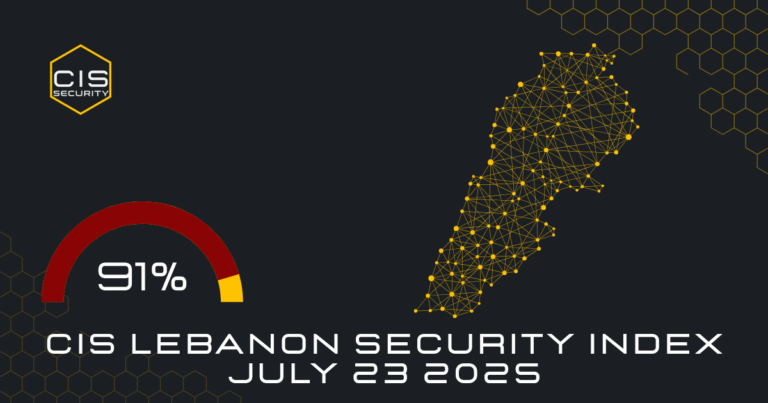
INDEX LEVEL: 🔴 CRITICAL
TODAY’S OVERALL INDEX: 79/100
TREND ANALYSIS: ⚠️ YEAR-END PUSH – DISARMAMENT DEADLINE APPROACHES AMID STRIKES & POLITICAL TENSIONS
🚨 BREAKING: CRITICAL WEEK AS HEZBOLLAH DISARMAMENT DEADLINE NEARS
CRITICAL DEVELOPMENTS – TUESDAY, DECEMBER 23, 2025:
YESTERDAY’S SIDON STRIKE: Three people were killed Monday in an Israeli drone strike on a car near Sidon in the Erkay, Maamariyyeh and Qonaytra areas, demonstrating continued Israeli military operations during the critical final week before the year-end disarmament deadline.
DISARMAMENT COMPLETION IMMINENT: Prime Minister Nawaf Salam confirmed Saturday (December 20) that the first phase of weapons consolidation south of the Litani River is “only days away from completion,” with Lebanon racing to meet the December 31 deadline as part of the US-backed ceasefire agreement.
HEZBOLLAH’S DEFIANT STANCE: Pro-Hezbollah al-Akhbar newspaper reported Monday that Hezbollah will not hand over “a single bullet” north of the Litani River, setting up a major confrontation as PM Salam stated the government is ready to move to the second phase of disarmament between the Litani and Awali rivers.
GEAGEA-QASSEM CLASH: Lebanese Forces leader Samir Geagea directly challenged Hezbollah leader Naim Qassem, stating the ceasefire agreement explicitly stipulates the elimination of illegal weapons “throughout Lebanon, not just south of the Litani,” citing UN Security Council Resolutions 1559 and 1701.
IDF ONGOING OPERATIONS: Israeli forces say they killed over 380 Hezbollah operatives since the ceasefire, conducted hundreds of strikes, and completed over 1,200 raids in southern Lebanon. The IDF’s 91st Division killed four alleged militants in southern Lebanon over the past week.
FIVE-PHASE DISARMAMENT PLAN: Lebanon’s plan calls for sequential disarmament: (1) South of Litani River, (2) Between Litani and Awali rivers, (3) Beirut and Mount Lebanon, (4) Beqaa Valley, (5) Remaining regions including northern Lebanon.
ISRAELI SETTLEMENTS EXPANSION: Israel’s cabinet approved 19 new settlements in the occupied West Bank on Sunday, bringing the total to 69 new settlements over the past three years under Netanyahu’s government, further complicating regional dynamics.
LAF RESOURCE CHALLENGES: Despite disarmament progress, the Lebanese Armed Forces remain cash-strapped and depend heavily on US aid. Western and Arab countries have pledged support as the army works to establish state monopoly on weapons.
🌡️ COMPREHENSIVE GOVERNORATE-BY-GOVERNORATE SECURITY ASSESSMENT
BEIRUT 🏙️
Index Reading: 75/100 🔴
Status: Critical with Governmental Determination. The capital serves as the center of intense political and diplomatic maneuvering during the final week before the December 31 disarmament deadline. President Joseph Aoun and Prime Minister Nawaf Salam demonstrate unwavering commitment to establishing state monopoly on weapons despite Hezbollah’s defiance.
PM Salam’s Saturday announcement that phase one is “days away from completion” signals governmental confidence in meeting the deadline south of the Litani, while his statement that Lebanon is “ready to move to the second phase” demonstrates intent to continue disarmament throughout Lebanese territory regardless of Hezbollah opposition.
The government manages complex political dynamics between pro-disarmament Christian and Sunni parties (Lebanese Forces, Kataeb, Future Movement) and Hezbollah-Amal resistance. The Shia bloc’s previous cabinet walkout over disarmament votes demonstrates the political tensions surrounding this issue.
Monday’s Sidon strike killing three people reminds Beirut policymakers that Israeli military operations continue despite diplomatic efforts, with Israel maintaining pressure on Lebanon to complete disarmament and justifying strikes as necessary to prevent Hezbollah rearmament.
The Lebanese Armed Forces headquarters coordinates the historic disarmament operations while managing resource constraints. Despite depending heavily on US aid, the LAF has successfully established control over most areas south of the Litani River, with Western and Arab countries pledging additional support.
Economic activities continue with awareness that successful disarmament could unlock reconstruction funding and international assistance. The electricity situation shows gradual improvement under governmental authority, while businesses monitor whether the year-end deadline will be met.
Key Factor: Week remaining before December 31 deadline creating governmental urgency to complete phase one while preparing for Hezbollah resistance to phase two disarmament north of Litani.
MOUNT LEBANON 🏞️
Index Reading: 71/100 🟡
Status: Elevated – Strong Anti-Hezbollah Stance. The governorate, home to Lebanese Forces leader Samir Geagea and Kataeb leader Samy Gemayel, represents the strongest political support for complete Hezbollah disarmament throughout all Lebanese territory.
Geagea’s direct challenge to Hezbollah leader Naim Qassem reflects Mount Lebanon Christian communities’ determination to eliminate what they view as a parallel armed authority undermining Lebanese sovereignty. His citation of UN Security Council Resolutions 1559 and 1701 emphasizes constitutional and international legal foundations for comprehensive disarmament.
The Kataeb Party echoes these positions, with Samy Gemayel calling direct negotiations with Israel “necessary” and stating “what was impossible has become possible,” reflecting shifting political calculations following Hezbollah’s military weakening by Israeli operations.
Business operations proceed normally with optimism that successful disarmament will enhance stability and unlock reconstruction assistance. Tourism sector maintains steady activity while monitoring whether the government can deliver on disarmament commitments despite Hezbollah resistance.
The region continues hosting displaced populations from southern areas, with successful disarmament potentially enabling safe returns and reducing Mount Lebanon’s burden. Infrastructure improvements proceed under stable governmental framework.
Key Factor: Strongest political support for comprehensive disarmament providing governmental backbone while Hezbollah’s defiance on phase two creates concerns about potential internal conflict if government proceeds.
NORTH LEBANON 🌊
Index Reading: 73/100 🟡
Status: Elevated – Year-End Phase Monitoring. Tripoli and surrounding areas are designated for phase five of the disarmament plan, meaning northern regions won’t face weapons consolidation pressures until after Beirut, Mount Lebanon, and Beqaa Valley phases complete.
The port city continues commercial operations with interest in how disarmament proceeds, as successful weapons monopolization could enhance northern stability and economic prospects. Cross-border coordination with Syria remains stable despite regional changes following Assad regime fall.
Economic conditions show gradual improvement under stable governmental framework, while the disarmament deadline creates questions about Lebanon’s ability to deliver on commitments. International reconstruction assistance depends partly on successful disarmament implementation.
Infrastructure projects proceed under governmental authority with international support. The region monitors whether the Lebanese Armed Forces can successfully complete phase one south of Litani by December 31 deadline, setting precedent for subsequent phases.
Key Factor: Phase five designation providing time buffer while observing governmental capability to manage Hezbollah resistance in earlier phase regions determining northern Lebanon’s future trajectory.
AKKAR 🌲
Index Reading: 74/100 🟡
Status: Elevated – Border Security Focus. The Syrian border situation remains stable with enhanced Lebanese Armed Forces coordination. The LAF’s focus on southern disarmament operations has not diminished northern border security effectiveness.
Cross-border security operations proceed effectively with the LAF maintaining comprehensive national coverage despite concentrating resources on Hezbollah disarmament efforts. Humanitarian coordination with Syrian authorities continues normally.
The region benefits from governmental stability and LAF presence, with successful disarmament potentially freeing military resources for enhanced border security and sovereignty protection across all Lebanese frontiers.
Key Factor: Border security maintained during LAF disarmament operations demonstrating army’s capability to manage multiple simultaneous missions across Lebanese territory.
BEQAA VALLEY 🍇
Index Reading: 77/100 🔴
Status: Critical – Phase Four Designation. The valley faces future disarmament as phase four of the five-phase plan, following completion of southern regions, Beirut-Mount Lebanon consolidation. Hezbollah’s al-Akhbar newspaper statement that the group won’t hand over “a single bullet” north of Litani applies directly to Beqaa strongholds.
Agricultural operations continue with heightened political tensions over future disarmament requirements. The valley hosts significant Hezbollah infrastructure and support base, making phase four implementation potentially the most challenging after phase two resistance between Litani and Awali rivers.
International development projects proceed under enhanced security protocols, while the approaching deadline creates questions about how the government will manage Hezbollah’s stated refusal to disarm in northern regions including the Beqaa.
The region’s strategic importance makes disarmament critical to establishing complete governmental authority, while Hezbollah’s entrenchment creates potential for serious confrontation when phase four begins.
Key Factor: Phase four designation placing Beqaa disarmament after southern regions, Beirut-Mount Lebanon, with Hezbollah’s stated refusal to surrender any weapons north of Litani creating major future challenge.
BAALBEK-HERMEL 🕌
Index Reading: 79/100 🔴
Status: Critical – Hezbollah Stronghold Dynamics. This region represents one of Hezbollah’s strongest support bases and hosts significant group infrastructure. The phase four and five disarmament requirements create the most challenging governmental authority establishment prospects.
Infrastructure improvements continue under governmental authority, while Hezbollah’s defiant stance on weapons north of Litani creates ongoing political tensions. The group’s August threat to the Lebanese state “not to move against it” demonstrates potential resistance levels.
The region monitors phase one completion south of Litani as precedent for future operations, with Hezbollah’s ability to resist or cooperate determining whether disarmament proceeds peacefully or creates internal conflict.
Key Factor: Hezbollah stronghold status making disarmament most challenging in later phases while group’s stated refusal to surrender any weapons north of Litani creating potential confrontation when government phases reach this region.
KESERWAN-JBEIL 🏛️
Index Reading: 67/100 🟡
Status: Elevated – Lowest Security Concern. The coastal governorate maintains Lebanon’s most stable security environment with lowest index reading. The region faces phase three disarmament alongside Beirut and Mount Lebanon, though Hezbollah presence is minimal in these predominantly Christian areas.
Tourism infrastructure continues normal operations with optimism that successful disarmament will enhance Lebanon’s international reputation and security environment. Business operations proceed with positive momentum from governmental determination to meet deadlines.
The region benefits from strong local support for disarmament, with minimal Hezbollah infrastructure making phase three implementation less challenging than southern or Beqaa operations.
Key Factor: Minimal Hezbollah presence and strong local disarmament support making phase three consolidation less challenging while region serves as model for stable, state-controlled security environment.
SOUTH LEBANON 🌴
Index Reading: 82/100 🔴
Status: Critical – Phase One Completion Imminent. The south remains at the center of Lebanon’s historic disarmament efforts with PM Salam’s confirmation that phase one is “days away from completion” before the December 31 deadline.
The Lebanese Armed Forces have successfully established control over most areas south of the Litani River, with nearly 10,000 troops deployed and comprehensive operations ongoing. The LAF has closed 11 smuggling crossing points and continues discovering Hezbollah infrastructure, though Israeli forces killed over 380 alleged Hezbollah operatives since the ceasefire.
Monday’s Sidon strike killing three people demonstrates ongoing Israeli military operations despite phase one nearing completion. Israel questions the LAF’s effectiveness and continues targeting alleged Hezbollah sites, with the IDF conducting over 1,200 raids in southern Lebanon since the ceasefire.
Israeli forces maintain five strategic hilltop positions inside Lebanese territory despite ceasefire requirements for complete withdrawal. This ongoing occupation creates challenges for Lebanon’s sovereignty restoration efforts while Israel uses continued presence to monitor Hezbollah activities.
The UN peacekeeping force UNIFIL continues operations supporting LAF deployment and ceasefire monitoring, though Israeli strikes continue despite international presence. Civilian populations experience ongoing security concerns from both Israeli operations and disarmament activities.
Key Factor: Phase one completion “days away” per PM Salam creating governmental confidence while Monday’s Sidon strike and ongoing Israeli operations demonstrate security challenges persist despite disarmament progress.
NABATIEH ⛪
Index Reading: 80/100 🔴
Status: Critical – Phase Two Preparation. The governorate sits between the Litani and Awali rivers, making it the primary focus for phase two disarmament immediately following December 31 phase one completion south of Litani.
PM Salam’s statement that the government is “ready to move to the second phase” applies directly to Nabatieh, while Hezbollah’s al-Akhbar announcement that the group won’t hand over “a single bullet” north of Litani creates direct confrontation prospects.
Infrastructure restoration continues under governmental framework, while phase two designation places Nabatieh at the immediate center of post-deadline disarmament efforts. The region faces being the first test of government’s ability to proceed despite Hezbollah resistance.
Civilian populations balance reconstruction efforts with awareness that phase two operations beginning in early 2026 could create security tensions or potential confrontations between LAF and Hezbollah forces.
Key Factor: Phase two designation placing Nabatieh at immediate center of post-deadline disarmament while Hezbollah’s stated refusal creates potential for first major confrontation when government proceeds north of Litani.
🎯 CRITICAL SECURITY INTELLIGENCE BRIEF – FINAL WEEK BEFORE DEADLINE
🔥 CURRENT HIGH-RISK AREAS:
Priority Level 1 – Critical Week Operations:
- South of Litani River – Phase one completion “days away” with year-end deadline approaching
- Sidon District – Monday’s drone strike killed three, ongoing Israeli targeting
- Between Litani and Awali Rivers (Nabatieh) – Phase two starting January 2026 with Hezbollah resistance expected
- Israeli-Occupied Positions – Five strategic hilltops maintained inside Lebanon
- Beirut Government District – Political center managing disarmament deadline and Hezbollah defiance
Priority Level 2 – Post-Deadline Monitoring: 6. Beqaa Valley – Phase four designation with strongest Hezbollah resistance expected 7. Baalbek-Hermel – Hezbollah stronghold facing later-phase disarmament 8. Israeli Strike Zones – Ongoing operations throughout Lebanon despite ceasefire 9. LAF Deployment Areas – Army establishing control while resource-constrained 10. Political Tension Sites – Christian-Shia confrontation over disarmament scope
✅ RELATIVELY STABLE ZONES (WITH CONTINUED VIGILANCE):
Improved Stability Areas:
- Keserwan-Jbeil – Lowest security concerns, minimal Hezbollah presence
- Mount Lebanon – Strong disarmament support, stable political environment
- Northern Coastal Areas – Phase five designation providing time buffer
- Central Beirut – Governmental authority consolidated, diplomatic activity center
⚠️ YEAR-END DEADLINE ASSESSMENT:
Phase One Status (South of Litani):
- PM Salam: “Only days away from completion”
- LAF: Nearly 10,000 troops deployed, control established
- Israel: Over 380 alleged Hezbollah operatives killed since ceasefire
- Deadline: December 31, 2025 (8 days remaining)
Phase Two Confrontation Looming (Between Litani and Awali):
- PM Salam: “State ready to move to second phase”
- Hezbollah: “Won’t hand over a single bullet north of Litani”
- Geagea: “Ceasefire requires disarmament throughout Lebanon”
- Timeline: Beginning January 2026 immediately after phase one completion
📱 CURRENT SECURITY GUIDANCE – FINAL WEEK BEFORE DEADLINE
🏠 GUIDANCE FOR RESIDENTS:
CRITICAL DEADLINE WEEK: Lebanon enters the final week before the December 31, 2025 deadline for completing Hezbollah disarmament south of the Litani River under the US-backed ceasefire agreement.
CURRENT SECURITY ENVIRONMENT:
- Phase One Completion: PM Salam confirms “only days away” from meeting deadline
- Monday’s Strike: Three killed in Israeli drone attack near Sidon
- Hezbollah Defiance: Group refuses to surrender any weapons north of Litani
- Political Confrontation: Geagea directly challenges Qassem on disarmament scope
POST-DEADLINE DYNAMICS:
- Phase Two Starting: Government ready to begin disarmament between Litani and Awali rivers
- Hezbollah Resistance Expected: Group’s stated refusal creating confrontation prospects
- Israeli Operations Continuing: Over 380 alleged operatives killed since ceasefire
- LAF Resource Challenges: Army depends on US aid while expanding operations
🏢 BUSINESS OPERATIONS GUIDANCE:
DEADLINE WEEK OPERATIONS:
- Governmental Confidence: PM Salam’s statement creating optimism about meeting commitment
- Reconstruction Potential: Successful disarmament could unlock international assistance
- Security Concerns: Monday’s Sidon strike demonstrating ongoing Israeli operations
- Political Uncertainty: Hezbollah’s defiance creating questions about phase two feasibility
OPERATIONAL CONSIDERATIONS:
- Monitor December 31 deadline for phase one completion confirmation
- Assess governmental capability to proceed with phase two despite Hezbollah resistance
- Navigate political tensions between pro-disarmament and pro-Hezbollah factions
- Prepare for potential January 2026 phase two operations affecting Nabatieh region
🚗 TRAVEL ADVISORY – DEADLINE WEEK:
CURRENT TRAVEL STATUS: Final week before disarmament deadline creating heightened political tensions while Israeli military operations continue despite ceasefire framework and Lebanese governmental progress.
TRAVEL CONSIDERATIONS:
- Southern Areas: Phase one disarmament operations ongoing, Monday’s Sidon strike demonstrating risks
- Sidon District: Exercise caution following Monday’s drone attack killing three
- Between Litani and Awali: Prepare for phase two operations beginning January 2026
- Beirut: Normal operations with political tensions over disarmament scope
- Border Crossings: Standard procedures maintained during critical deadline week
📊 TUESDAY, DECEMBER 23, 2025 SECURITY ANALYSIS
Today’s Assessment: Eight Days to Disarmament Deadline Amid Strikes and Defiance
Governmental Determination: PM Salam confirms phase one “days away” from completion
Hezbollah Resistance: Group refuses to surrender “a single bullet” north of Litani
Israeli Operations: Monday’s Sidon strike killing three demonstrates continued violations
Critical Analysis: Tuesday, December 23, 2025, finds Lebanon in the critical final week before the December 31 deadline for completing Hezbollah disarmament south of the Litani River, with Prime Minister Nawaf Salam expressing confidence in meeting this historic commitment while Hezbollah openly defies plans for subsequent disarmament phases.
PM Salam’s Saturday statement that “the first phase of the weapons consolidation plan related to the area south of the Litani River is only days away from completion” signals governmental determination to meet the year-end deadline established under the US-backed ceasefire agreement signed November 27, 2024.
The five-phase disarmament plan represents Lebanon’s most comprehensive attempt to establish state monopoly on weapons since the 2006 Israel-Hezbollah war: (1) South of Litani River (deadline: December 31, 2025), (2) Between Litani and Awali rivers, (3) Beirut and Mount Lebanon, (4) Beqaa Valley, (5) Remaining northern regions.
The Lebanese Armed Forces have made significant progress establishing control south of the Litani, deploying nearly 10,000 troops, closing 11 smuggling crossing points, and working with UNIFIL peacekeepers to monitor ceasefire implementation. This represents the LAF’s largest deployment in southern Lebanon in decades and demonstrates growing governmental authority.
However, Monday’s Israeli drone strike near Sidon killing three people demonstrates that Israeli military operations continue despite Lebanese disarmament efforts. The IDF claims to have killed over 380 Hezbollah operatives, conducted hundreds of strikes, and completed over 1,200 raids in southern Lebanon since the November 2024 ceasefire.
Israel maintains five strategic hilltop positions inside Lebanese territory despite ceasefire requirements for complete withdrawal. Israeli officials publicly question the LAF’s effectiveness and state they will act “as necessary” if Lebanon fails to adequately disarm Hezbollah, justifying continued strikes as preventing group rearmament.
The most significant development is Hezbollah’s open defiance of phase two disarmament. Pro-Hezbollah al-Akhbar newspaper reported Monday that the group “will not hand over a single bullet north of the Litani River,” directly challenging PM Salam’s statement that “the state is ready to move to the second phase” between the Litani and Awali rivers.
This sets up a major confrontation beginning January 2026 when the government intends to proceed with phase two in the Nabatieh region. Hezbollah leader Naim Qassem has attempted to argue that the ceasefire agreement applies only south of the Litani, a claim Lebanese Forces leader Samir Geagea forcefully rejected.
Geagea issued a direct statement to Qassem explaining that the ceasefire agreement’s preamble “affirms the full implementation of United Nations Security Council Resolution 1701,” which in turn requires implementing previous resolutions including UNSC Resolutions 1559 and 1680 that explicitly call for disarming all non-state armed groups throughout Lebanon.
“The ceasefire agreement explicitly stipulates the elimination of illegal weapons throughout Lebanon, not just south of the Litani,” Geagea stated, adding that Lebanese public opinion surveys consistently show majority support for dissolving all armed organizations including Hezbollah and Palestinian groups across all Lebanese territory.
The political dynamics reveal deep divisions within Lebanon. President Joseph Aoun, PM Salam, Lebanese Forces leader Geagea, Kataeb leader Samy Gemayel, and Druze leader Walid Jumblatt form a united pro-disarmament front representing Christian, Sunni, and Druze communities. This “March 14” coalition sees Hezbollah disarmament as essential for Lebanese sovereignty and reconstruction.
Opposing them are Hezbollah and its Shia ally Amal Movement led by Parliament Speaker Nabih Berri. The Shia bloc previously walked out of cabinet meetings over disarmament votes and conditioned their return on reversing those decisions. When Army Chief Rodolphe Haykal presented disarmament plans to the cabinet, Shia ministers left the session.
Hezbollah justifies retaining weapons by arguing that Israeli strikes demonstrate Lebanon needs the group for defense. The militia leader Naim Qassem said disarming “would be a mistake while Israel continues its air strikes on the country.” However, this creates a circular logic where Hezbollah’s weapons provoke Israeli strikes, which Hezbollah then cites as justification for retaining weapons.
The Lebanese Armed Forces face significant resource challenges despite their operational successes. The LAF is cash-strapped and depends heavily on US aid, with the army also suffering from Lebanon’s six-year economic meltdown. Western and Arab countries have pledged support, but the LAF requires substantial assistance to complete the multi-phase disarmament operation.
Regional dynamics complicate the situation. Iran voiced support for Hezbollah through Foreign Minister Abbas Araghchi, who said disarmament efforts “wouldn’t work” and that “the power of resistance has proven itself in the field.” Tehran views Hezbollah as crucial to its regional deterrence network.
Conversely, the United States under President Trump has intensified pressure on Lebanon to disarm Hezbollah, with US Senator Graham urging military action if Hezbollah and Hamas remain armed. The Trump administration facilitated direct Lebanese-Israeli civilian talks and envisions a “Trump economic zone” along the border free of Hezbollah and heavy weapons.
Gulf states, particularly Saudi Arabia and the UAE, strongly support disarmament as they oppose Iranian influence in Lebanon and see this as a rare opportunity to eliminate Tehran’s military proxy while Hezbollah is weakened. These wealthy states are indispensable for post-war reconstruction, giving them significant leverage.
Sunday’s Israeli cabinet approval of 19 new settlements in the occupied West Bank further complicates regional dynamics. Israel has established a record 69 new settlements over the past three years under Netanyahu’s government, with Finance Minister Smotrich stating: “We are blocking the establishment of a Palestinian terrorist state on the ground.”
This settlement expansion undermines prospects for the two-state solution and demonstrates Israeli government priorities that complicate Lebanese-Israeli relations even as civilian negotiators discuss economic cooperation and border issues.
The critical question for the coming week is whether Lebanon will actually meet the December 31 deadline for phase one completion south of the Litani. PM Salam’s confidence suggests the government believes it will, but Israeli skepticism and continued strikes create uncertainty.
More importantly, the post-deadline period beginning January 2026 will test whether Lebanon can proceed with phase two despite Hezbollah’s stated refusal. If the government backs down, the entire disarmament plan collapses and Lebanon fails to meet ceasefire commitments. If the government proceeds, potential confrontation between LAF and Hezbollah forces could trigger internal conflict.
The Lebanese Forces’ Samir Geagea warned in August that indecision could lead to a “very bad summer,” hinting at domestic instability or civil conflict if the state doesn’t act decisively. The Kataeb Party echoed these concerns, holding Hezbollah fully responsible for any security or political deterioration if the group resists state authority.
Hezbollah’s Position: The group argues it needs weapons while Israeli strikes continue, but refuses to acknowledge that its armed presence is what triggers those strikes under Israeli doctrine. Hezbollah’s August threat to the Lebanese state “not to move against it” demonstrates the group’s willingness to confront governmental authority rather than submit to constitutional order.
International Pressure: The United States, Gulf states, France, and other Western nations are closely monitoring whether Lebanon meets the December 31 deadline. Success could unlock billions in reconstruction assistance; failure could result in continued Israeli military operations and international frustration with Lebanese governance.
Historical Context: The November 27, 2024 ceasefire ended 14 months of hostilities that killed more than 4,000 Lebanese, displaced 1.2 million, and caused approximately $11 billion in destruction. The disarmament provisions represent the most serious attempt to implement UN Security Council Resolution 1701 since its adoption following the 2006 war.
Long-term Prospects: Lebanon’s ability to successfully complete phase one by December 31 would represent a historic achievement demonstrating governmental authority and LAF capability. However, the real test comes in January 2026 when phase two proceeds north of the Litani despite Hezbollah’s stated refusal.
The next eight days will determine whether Lebanon can deliver on its international commitments. The subsequent weeks and months will determine whether the Lebanese state can establish complete sovereignty over its territory or whether Hezbollah’s parallel armed authority will continue undermining Lebanese statehood and prolonging the cycle of conflict with Israel.
🛡️ CIS SECURITY: DEADLINE WEEK SERVICES
⏰ FINAL WEEK BEFORE HISTORIC DISARMAMENT DEADLINE – COMPREHENSIVE PROTECTION
CIS Security provides professional services supporting Lebanon during the critical final week before the December 31, 2025 disarmament deadline, ensuring comprehensive protection amid ongoing Israeli strikes, political tensions, and Hezbollah defiance of phase two operations.
DEADLINE WEEK SPECIALIZED SERVICES:
Disarmament Operations Support:
- LAF Coordination – Professional liaison with Lebanese Armed Forces conducting phase one operations
- Southern Operations Security – Protection for areas where disarmament nearing completion
- Intelligence Assessment – Continuous monitoring of Hezbollah response to governmental actions
- Post-Deadline Planning – Security preparation for phase two beginning January 2026
Strike Zone Response:
- Sidon Area Protection – Enhanced security following Monday’s drone strike killing three
- Emergency Coordination – Rapid response capabilities for ongoing Israeli operations
- Civilian Protection – Professional services for populations in strike-prone areas
- Evacuation Planning – Contingency coordination for high-risk zones
Political Tension Management:
- Government Facility Security – Enhanced protection during critical deadline week
- Hezbollah Defiance Monitoring – Assessment of group’s resistance to phase two plans
- Christian-Shia Dynamics – Professional monitoring of internal political tensions
- International Liaison – Coordination with diplomatic missions monitoring deadline
CONTINUING SECURITY OPERATIONS:
Phase Two Preparation:
- Professional planning for January 2026 operations between Litani and Awali rivers
- Security assessment for Nabatieh region facing immediate post-deadline disarmament
- Hezbollah resistance scenario planning and contingency coordination
- LAF support services for expanded operations despite resource constraints
Comprehensive National Coverage:
- Security services throughout all governorates during critical transition period
- Protection enabling business operations despite political uncertainties
- Emergency response capabilities maintained across Lebanese territory
- Coordination with UNIFIL peacekeepers monitoring ceasefire implementation
Reconstruction Security:
- Protection for international assistance missions potentially unlocked by successful disarmament
- Security enabling economic development and reconstruction project implementation
- Professional coordination for Gulf state and Western donor engagement
- Business protection supporting Lebanon’s economic recovery efforts
📞 DEADLINE WEEK COORDINATION
SECURITY HOTLINE: +961-3-539900
Professional protection during critical final week before historic disarmament deadline
DISARMAMENT OPERATIONS SUPPORT: Coordination with LAF phase one completion efforts
STRIKE ZONE RESPONSE: Emergency services for ongoing Israeli military operations
POLITICAL TENSION MANAGEMENT: Security during Hezbollah-government confrontation
Specialized Service Centers:
- Government Protection: Enhanced security for officials managing deadline pressures
- Southern Operations: Professional support for LAF disarmament activities
- Emergency Response: Rapid deployment for strikes and security incidents
- Phase Two Planning: Preparation for January 2026 Nabatieh operations
During Lebanon’s critical final week before the December 31, 2025 disarmament deadline, CIS Security provides comprehensive professional services supporting governmental efforts, protecting civilians amid ongoing strikes, managing political tensions, and preparing for phase two operations despite Hezbollah’s stated refusal to surrender any weapons north of the Litani River.
⚠️ DEADLINE WEEK OPERATIONAL NOTICE
EIGHT DAYS REMAINING: Lebanon enters critical final week before December 31, 2025 deadline for completing Hezbollah disarmament south of Litani River under US-backed ceasefire agreement.
PM SALAM CONFIDENT: Prime Minister announces phase one “only days away from completion” while stating government “ready to move to second phase” between Litani and Awali rivers.
HEZBOLLAH DEFIANCE: Pro-group al-Akhbar newspaper reports Hezbollah “won’t hand over a single bullet north of Litani,” setting up major January 2026 confrontation when government proceeds with phase two.
ONGOING STRIKES: Monday’s Israeli drone attack near Sidon killed three people, demonstrating continued military operations despite Lebanese disarmament progress toward deadline.
GEAGEA-QASSEM CLASH: Lebanese Forces leader directly challenges Hezbollah leader, citing UN resolutions requiring disarmament “throughout Lebanon, not just south of Litani.”
PROFESSIONAL SERVICES: CIS Security provides comprehensive protection supporting LAF operations, responding to strikes, managing political tensions, and preparing for post-deadline phase two implementation despite Hezbollah resistance.
CRITICAL JUNCTURE: Success meeting December 31 deadline could unlock reconstruction assistance; failure could trigger renewed Israeli operations. Phase two beginning January 2026 will test whether government can proceed despite Hezbollah defiance without internal conflict.
🔍 PROFESSIONAL SECURITY SERVICES – CIS SECURITY LEBANON
Trusted Security Excellence Since 1990 – “Because Your Safety Isn’t Optional”
During Lebanon’s critical final week before the December 31, 2025 Hezbollah disarmament deadline south of the Litani River, trust CIS Security’s 35+ years of proven expertise in governmental coordination, disarmament operations support, strike zone response, and political tension management. As Lebanon’s most reviewed security company, we provide professional services supporting the Lebanese Armed Forces’ historic phase one completion, protecting civilians amid ongoing Israeli strikes like Monday’s Sidon attack, managing Christian-Shia political dynamics, and preparing for phase two operations beginning January 2026 despite Hezbollah’s stated refusal. Our trained, uniformed, and licensed security personnel deliver 24/7 protection supporting Lebanon’s sovereignty establishment under President Aoun and PM Salam’s leadership during this transformative period.
CIS Security Deadline Week Services:
- Disarmament Operations Support – Professional coordination with LAF completing phase one by December 31
- Strike Zone Response – Emergency services for ongoing Israeli operations including Monday’s Sidon attack
- Political Tension Management – Security during Geagea-Qassem confrontation over disarmament scope
- Phase Two Preparation – Planning for January 2026 Nabatieh operations despite Hezbollah resistance
- Government Protection – Enhanced security for officials managing critical deadline pressures
- Civilian Security – Professional services for populations in disarmament and strike zones
- International Coordination – Liaison with UNIFIL, US advisors, diplomatic missions monitoring progress
Why Choose CIS During Historic Deadline Week: ✓ 35+ Years National Experience – Proven security during Lebanon’s most critical governmental initiatives
✓ LAF Partnership – Professional coordination supporting army’s disarmament operations
✓ Strike Response Expertise – Rapid deployment for Israeli operations throughout Lebanese territory
✓ Political Monitoring – Assessment of Hezbollah-government dynamics affecting security
✓ UNIFIL Coordination – Partnership with international peacekeepers monitoring ceasefire
✓ Comprehensive Services – Full-spectrum protection during transformative deadline period
Security Services: 📞 24/7 Hotline: +961-3-539900
💬 All Services: Disarmament operations, strike response, political tension, government protection
🌐 Comprehensive Coverage: www.cissecurity.net – Professional services throughout Lebanon
📧 Emergency Response: Immediate capabilities for deadline week security requirements
Serving all Lebanese governorates during the critical final week before December 31, 2025 disarmament deadline with professional security supporting governmental sovereignty establishment, LAF operations, strike zone protection, and political tension management. CIS Security – Your trusted partner during Lebanon’s historic transformation as President Aoun and PM Salam work to complete phase one while preparing for Hezbollah resistance to phase two operations beginning January 2026.
📈 FIVE-PHASE DISARMAMENT PLAN ANALYSIS
PHASE ONE: SOUTH OF LITANI RIVER (DEADLINE: DECEMBER 31, 2025)
Status: “Only days away from completion” per PM Salam (December 20)
Progress Achieved:
- LAF deployed nearly 10,000 troops establishing governmental control
- 11 smuggling crossing points closed along Litani River
- Comprehensive operations in areas formerly inaccessible to army and UNIFIL
- Coordination with UNIFIL peacekeepers monitoring ceasefire implementation
- Weapons consolidation proceeding according to US-backed agreement timeline
Challenges:
- Monday’s Sidon strike killing three demonstrates ongoing Israeli operations
- IDF claims over 380 Hezbollah operatives killed since ceasefire
- Israel conducted over 1,200 raids questioning LAF effectiveness
- Five Israeli-occupied hilltop positions maintained inside Lebanon
- LAF resource constraints despite US aid and international pledges
Outlook: Governmental confidence in meeting December 31 deadline despite Israeli skepticism. Success would represent historic achievement demonstrating LAF capability and governmental authority.
PHASE TWO: BETWEEN LITANI AND AWALI RIVERS (STARTING JANUARY 2026)
Status: Government “ready to move to second phase” per PM Salam
Target Area: Nabatieh governorate and surrounding districts
Major Challenge: Hezbollah explicitly refuses to surrender “a single bullet north of Litani”
Confrontation Dynamics:
- Hezbollah claims ceasefire applies only south of Litani (disputed by Geagea)
- Pro-disarmament coalition insists UN resolutions require nationwide weapons elimination
- Potential for LAF-Hezbollah confrontation if government proceeds
- Test of whether state can establish authority despite armed resistance
- International community watching closely as measure of Lebanese sovereignty
Critical Questions:
- Will government actually proceed despite Hezbollah’s stated refusal?
- Can LAF manage confrontation without triggering internal conflict?
- Will international pressure force Hezbollah compliance?
- What happens if government backs down after completing phase one?
Outlook: Most critical test of disarmament plan. Success or failure determines whether Lebanon can establish state weapons monopoly or Hezbollah’s parallel armed authority continues.
PHASE THREE: BEIRUT AND MOUNT LEBANON
Status: Planned for post-phase two completion
Target Areas: Capital district, Keserwan-Jbeil, Mount Lebanon governorate
Advantages:
- Minimal Hezbollah infrastructure in predominantly Christian regions
- Strong local political support for disarmament from Lebanese Forces, Kataeb
- Population generally supportive of state weapons monopoly
- Less confrontational environment than southern or Beqaa operations
Challenges:
- Some Hezbollah presence in Beirut southern suburbs (Dahieh)
- Palestinian refugee camps hosting armed groups
- Symbolic importance of capital weapons consolidation
- Potential for Hezbollah to stage resistance even with limited presence
Outlook: Easier implementation than phases two, four, or five due to minimal Hezbollah presence and strong local support. Success depends on phase two establishing precedent.
PHASE FOUR: BEQAA VALLEY
Status: Planned for mid-to-late 2026
Target Area: Entire Beqaa governorate including Hezbollah strongholds
Major Challenge: Second-strongest Hezbollah support base after Baalbek-Hermel
Confrontation Potential:
- Extensive Hezbollah infrastructure and weapons storage
- Strong local support base for group’s armed presence
- Strategic importance for Hezbollah’s Syrian border access
- Potential for serious resistance to governmental authority
Agricultural Complications:
- Large rural areas complicating LAF operations
- Syrian border dynamics affecting security environment
- Historical role as Hezbollah logistics and training area
- Population with mixed views on disarmament necessity
Outlook: Phase four represents second-most challenging disarmament operation after phase two. Success requires establishing clear governmental authority pattern in earlier phases.
PHASE FIVE: NORTHERN LEBANON AND REMAINING AREAS
Status: Final phase completing nationwide disarmament
Target Areas: North Lebanon, Akkar, remaining districts
Advantages:
- Minimal Hezbollah presence in predominantly Sunni northern regions
- Strong local opposition to Hezbollah in Tripoli and Akkar
- Syrian refugee presence creating local support for state security
- Phase five lessons learned from earlier operations
Challenges:
- Palestinian refugee camps with armed presence
- Syrian border dynamics affecting northern security
- Ensuring comprehensive nationwide coverage
- Demonstrating state monopoly on weapons fully established
Outlook: Final phase completion would represent historic achievement establishing Lebanese state sovereignty over entire national territory for first time since 1970s.
🌍 INTERNATIONAL DIMENSIONS & REGIONAL DYNAMICS
UNITED STATES POSITION:
Trump Administration Priorities:
- Strong pressure on Lebanon to disarm Hezbollah completely
- Vision of “Trump economic zone” along border free of weapons
- Facilitation of direct Lebanese-Israeli civilian negotiations
- US military aid essential for LAF operations but conditional
Congressional Pressure:
- Senator Lindsey Graham urging military action if Hezbollah remains armed
- Strong bipartisan support for Lebanese disarmament efforts
- Congressional appropriations for LAF assistance tied to progress
- Monitoring December 31 deadline as measure of Lebanese commitment
US Leverage:
- Financial assistance essential for cash-strapped LAF operations
- Diplomatic mediation between Lebanon and Israel
- International coalition building supporting disarmament
- Potential sanctions relief or application depending on progress
GULF STATES SUPPORT:
Saudi Arabia:
- Strong support for disarmament eliminating Iranian influence
- Financial assistance pledged for LAF and reconstruction
- Historical rivalry with Hezbollah creating alignment with Lebanese government
- Monitoring progress as condition for bilateral relations normalization
United Arab Emirates:
- Significant reconstruction funding pledged conditional on disarmament
- Opposition to Iranian proxy presence throughout region
- Economic development proposals for post-disarmament Lebanon
- Diplomatic coordination with Western nations supporting plan
Qatar:
- More cautious approach balancing regional relationships
- Humanitarian assistance not conditional on disarmament
- Mediation offers between Lebanese factions
- Monitoring internal Lebanese dynamics carefully
Kuwait:
- Support for Lebanese stability and sovereignty
- Financial assistance for LAF modernization
- Coordination with Gulf Cooperation Council positions
- Large Lebanese expatriate community interests
IRANIAN OPPOSITION:
Tehran’s Position:
- Foreign Minister Araghchi: Disarmament “wouldn’t work”
- View Hezbollah as crucial regional deterrence component
- Oppose efforts to eliminate “resistance axis” capabilities
- Limited ability to prevent disarmament given own challenges
Iranian Leverage Constraints:
- Economic sanctions limiting financial support capacity
- Domestic protests weakening regime authority
- Syrian ally Assad regime weakened by civil war
- Israeli strikes degrading Iranian regional capabilities
Hezbollah Autonomy:
- Group making independent decisions on Lebanese territory
- Iranian influence remains but not absolute control
- Financial and weapons support continuing but constrained
- Hezbollah’s Lebanese identity competing with Iranian loyalty
ISRAELI CALCULATIONS:
Netanyahu Government Position:
- Skepticism about LAF effectiveness and Lebanese commitment
- Continued strikes justified as preventing Hezbollah rearmament
- Demands for complete disarmament before ceasing operations
- Five occupied positions maintained for monitoring
Military Operations:
- Over 380 alleged Hezbollah operatives killed since ceasefire
- Monday’s Sidon strike killing three civilians
- Over 1,200 raids conducted in southern Lebanon
- Hundreds of airstrikes targeting alleged weapons sites
Strategic Goals:
- Eliminate Hezbollah military capabilities permanently
- Establish border security without armed presence
- Economic cooperation conditional on complete disarmament
- Avoid renewed war while maintaining pressure
Contradictions:
- Strikes undermine ceasefire Lebanese trying to implement
- Civilian casualties creating Lebanese anger at both Israel and Hezbollah
- Occupied positions violating same ceasefire demanding Lebanese compliance
- Economic cooperation discussions while conducting military operations
EUROPEAN UNION ENGAGEMENT:
France:
- Historical Lebanon ties creating strong engagement
- Financial and military assistance for LAF operations
- Diplomatic coordination with US on disarmament timeline
- UNIFIL contingent monitoring ceasefire implementation
Germany:
- Military aid for LAF including training and equipment
- Reconstruction assistance conditional on stability
- Support for UN resolutions implementation
- Maritime border mediation between Lebanon and Israel
Italy:
- Large UNIFIL contingent supporting peacekeeping
- Economic development assistance proposals
- Cultural and historical Lebanon connections
- Coordination with EU positions on disarmament
European Commission:
- Reconstruction funding pledged for post-conflict Lebanon
- Conditional assistance tied to sovereignty establishment
- Monitoring December 31 deadline and subsequent phases
- Coordination with member states on comprehensive approach
🔮 OUTLOOK & SCENARIOS – POST-DEADLINE PERIOD
SCENARIO ONE: SUCCESSFUL PHASE ONE, PHASE TWO PROCEEDS (OPTIMISTIC – 30% PROBABILITY)
January-March 2026:
- Lebanon successfully meets December 31 deadline for phase one completion
- International community provides positive reinforcement and assistance
- Government proceeds with phase two despite Hezbollah opposition
- LAF establishes control between Litani and Awali rivers peacefully
- Hezbollah accepts governmental authority avoiding confrontation
April-December 2026:
- Phases three (Beirut/Mount Lebanon) and four (Beqaa) proceed systematically
- Israeli strikes decrease as disarmament demonstrates genuine progress
- Gulf reconstruction funding flows unlocking economic recovery
- Political reconciliation begins between pro-disarmament and Hezbollah factions
- Lebanon emerges as regional success story of conflict resolution
Long-term (2027+):
- Phase five completes establishing state weapons monopoly nationwide
- Lebanese-Israeli relations normalize with economic cooperation
- Hezbollah transforms into purely political party
- Economic recovery accelerates with international investment
- Regional stability enhanced by Lebanese success model
Requirements for Scenario One:
- Strong governmental determination maintaining momentum
- International pressure forcing Hezbollah compliance
- Iranian inability or unwillingness to provoke confrontation
- Israeli restraint allowing Lebanese process to proceed
- Gulf funding materializing as promised for reconstruction
SCENARIO TWO: SUCCESSFUL PHASE ONE, PHASE TWO STALEMATE (REALISTIC – 50% PROBABILITY)
January-March 2026:
- Lebanon meets December 31 deadline for phase one completion
- Government announces phase two but faces strong Hezbollah resistance
- LAF deploys to Nabatieh but avoids direct confrontation
- Stalemate develops with neither side willing to escalate
- International pressure increases on both Lebanese government and Hezbollah
April-December 2026:
- Phase two remains incomplete with partial control established
- Israeli strikes continue citing insufficient disarmament progress
- Political crisis deepens between governmental and Hezbollah factions
- Economic recovery stalled pending complete disarmament
- Lebanon stuck between sovereignty goals and internal resistance
Long-term (2027+):
- Prolonged stalemate with Hezbollah retaining significant capabilities north of Litani
- Continued Israeli operations maintaining pressure
- Economic situation deteriorates without reconstruction assistance
- Political paralysis preventing progress on other national priorities
- Lebanon trapped in cycle of incomplete sovereignty and ongoing conflict
Most Likely Outcome: This scenario reflects current dynamics where government demonstrates some capability but faces insurmountable Hezbollah resistance without willingness to trigger civil conflict.
SCENARIO THREE: PHASE ONE DEADLINE MISSED OR INCOMPLETE (PESSIMISTIC – 15% PROBABILITY)
December 2025-January 2026:
- Lebanon fails to meet December 31 deadline for phase one
- PM Salam’s confidence proves premature or overstated
- International disappointment and criticism of Lebanese governance
- Israeli operations intensify citing Lebanese non-compliance
- Gulf states withhold reconstruction funding pending commitment
February-December 2026:
- Governmental credibility damaged by deadline failure
- Hezbollah emboldened by government’s inability to deliver
- Israeli strikes increase targeting broader Hezbollah infrastructure
- Economic collapse accelerates without international assistance
- Political crisis potentially forcing governmental resignation
Long-term (2027+):
- Disarmament plan abandoned as unworkable
- Hezbollah maintains parallel armed authority
- Cycle of Israeli strikes and Hezbollah responses continues
- Economic emigration accelerates especially among Christians
- Lebanon remains failed state unable to establish sovereignty
Requirements for Avoiding Scenario Three:
- LAF must demonstrate progress sufficient for deadline extension if needed
- Governmental collapse must be prevented despite challenges
- International community maintaining engagement despite setbacks
- Alternative approaches developed if five-phase plan proves unworkable
SCENARIO FOUR: INTERNAL CONFLICT ERUPTS (WORST CASE – 5% PROBABILITY)
January-March 2026:
- Government proceeds with phase two despite Hezbollah opposition
- LAF-Hezbollah confrontation erupts in Nabatieh or elsewhere
- Casualties on both sides trigger escalation
- Christian-Shia sectarian tensions explode
- Lebanon descends into civil conflict
April-December 2026:
- Internal fighting spreads beyond initial confrontation zone
- Regional powers intervene supporting respective factions
- Israel exploits chaos for extensive operations against Hezbollah
- Humanitarian crisis with renewed displacement
- International peacekeeping intervention considered
Long-term (2027+):
- Prolonged civil conflict destroying Lebanese state
- Partition scenarios discussed dividing Lebanon
- Massive emigration especially among minorities
- Regional destabilization spreading from Lebanese collapse
- Decades of recovery required from new civil war
How to Prevent Scenario Four:
- Careful governmental management avoiding unnecessary provocation
- International mediation between Lebanese factions
- Hezbollah calculation that confrontation too costly
- Creative compromise solutions allowing face-saving
- Regional powers restraining respective Lebanese allies
CIS LEBANON SECURITY INDEX™ – Professional security intelligence for informed decision-making during Lebanon’s historic final week before December 31, 2025 disarmament deadline. Updated Tuesday, December 23, 2025, based on comprehensive research and real-time monitoring of governmental progress, Hezbollah defiance, ongoing Israeli strikes, and international pressure during this transformative period for Lebanese sovereignty.
CIS SECURITY
Because Your Safety Isn’t Optional
🎯 LEBANON SECURITY INDEX™
Powered by Advanced Intelligence Partnership
Daily Security Intelligence Dashboard LIVE RAGEX Intelligence Partner FEATURED