CIS LEBANON SECURITY INDEX - July 14 2026
Tuesday, July 14, 2026
🔴 WAR DAY 135 | NINE-DAY CATCH-UP: US-IRAN CEASEFIRE COLLAPSES OVER STRAIT OF HORMUZ — THREE NIGHTS OF US STRIKES ON IRAN, IRAN HITS BAHRAIN/JORDAN/OMAN/KUWAIT | LEBANON FRONT ITSELF STAYS QUIET — NO HEZBOLLAH ROCKET FIRE — BUT ISRAELI STRIKES/DEMOLITIONS CONTINUE DAILY | NETANYAHU'S "CHRISTIAN VILLAGES WANT ANNEXATION" CLAIM UNANIMOUSLY DENIED, DENOUNCED AS "LIAR" | SIXTH ROUND OF ISRAEL-LEBANON TALKS OPENS IN ROME | IRAN TELLS HEZBOLLAH/BERRI: LEBANON WITHDRAWAL NOW EQUAL PRIORITY TO HORMUZ | 4,300+ KILLED IN LEBANON SINCE MARCH 2
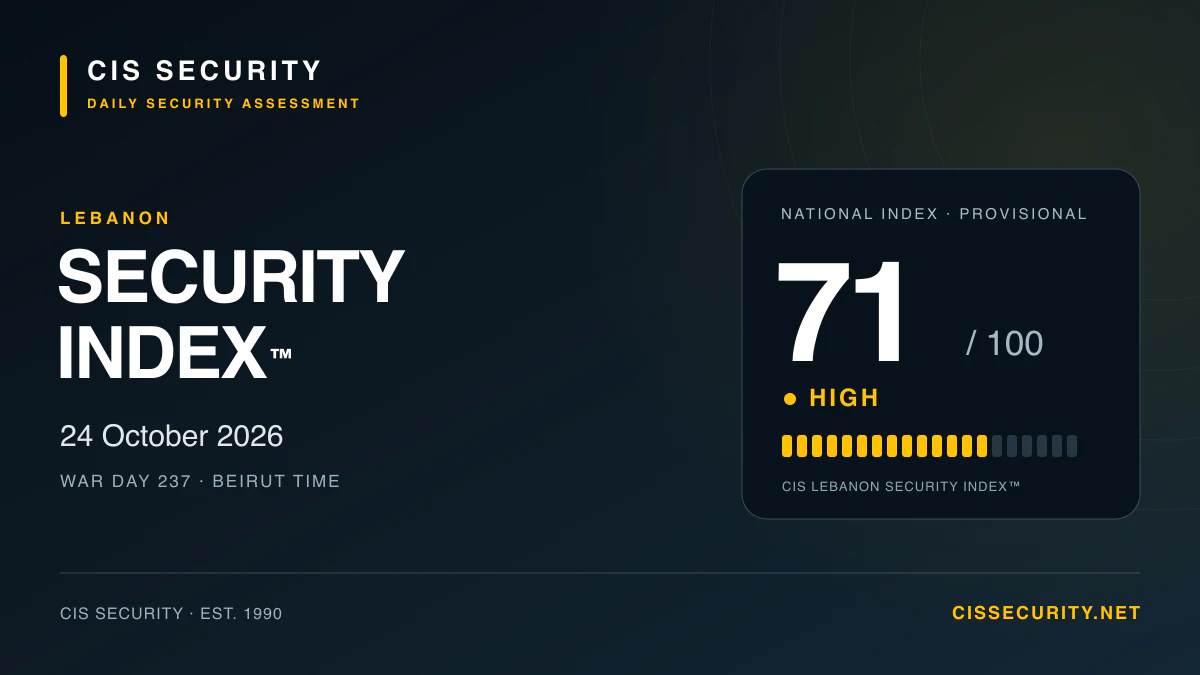
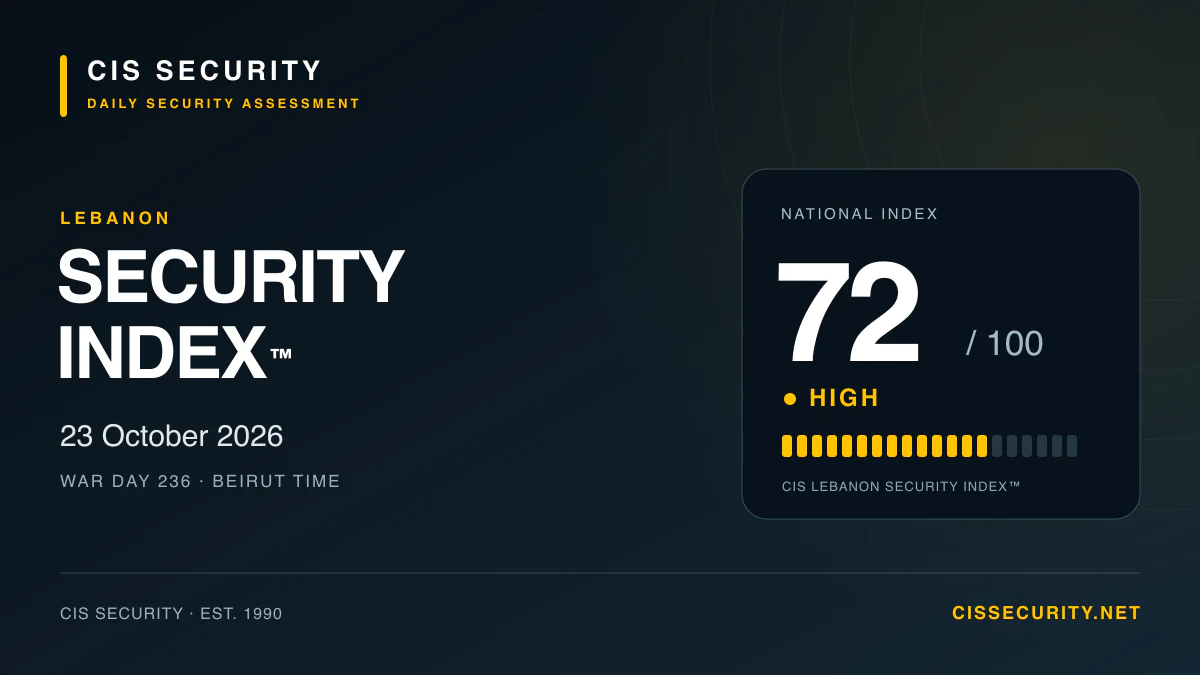
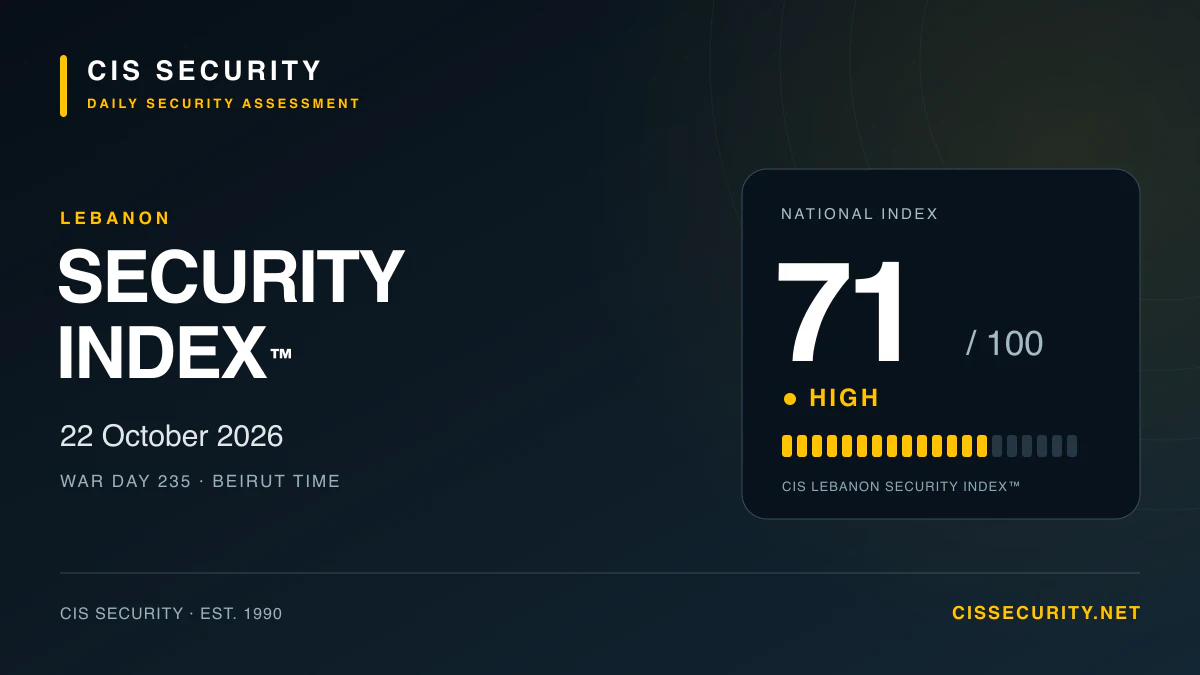
INDEX LEVEL: 🔴 HIGH-CRITICAL — REGIONAL WAR REIGNITED, LEBANON FRONT DISTINCT BUT AT RISK OVERALL INDEX: 70/100 TREND: ⬆️ RISING — THE REGIONAL PICTURE HAS DETERIORATED SHARPLY SINCE OUR LAST UPDATE, EVEN THOUGH THE LEBANON-SPECIFIC FRONT HAS NOT (YET) REIGNITED IN THE SAME WAY. Over the past nine days, the US-Iran Memorandum of Understanding — the same MOU that enabled the June 26 Lebanon framework and June 21 ceasefire — has effectively collapsed. Iran attacked commercial tankers in the Strait of Hormuz on July 6–7, prompting the US to strike roughly 80–90 Iranian targets over two consecutive nights (July 8–9), reimpose oil sanctions, and declare the MOU "over." A full week of relative calm followed the Khamenei funeral (which concluded July 9 in Mashhad), but the ceasefire finally broke down completely on July 13: the US launched a third night of strikes across Iran, Iran retaliated with missile and drone attacks on US-aligned Gulf states — hitting Bahrain, Jordan, Oman, and Kuwait, and striking two UAE tankers in Omani waters, killing one crew member — and Trump announced the US is "taking over" the Strait of Hormuz, reimposing a naval blockade and proposing a 20% transit toll. Crucially, CIS's monitoring finds no confirmed Hezbollah rocket or missile fire into Israel during this renewed Iran-US exchange — the Lebanon ceasefire is, for now, holding on the rocket-fire dimension even as the wider region convulses. However, Israeli strikes, demolitions, and shelling inside south Lebanon have continued almost daily throughout the period regardless, including a July 6 drone strike that killed four civilians in a vehicle near Nabatieh, and July 13 shelling/demolitions in Kfartebnit, Haddatha, and Bint Jbeil. A sixth round of US-mediated Israel-Lebanon talks opened Tuesday in Rome — a lower-profile venue than the Washington signing — with analysts warning "the chances of a breakthrough...are quite limited." Politically, Netanyahu's July 5 claim that Lebanese Christian villages had "asked to be annexed" to Israel was unanimously and furiously denied by all 15 named border villages, Parliament Speaker Berri, and Lebanese analysts who called it a deliberate "seditious" attempt to sow discord — and Iran has separately signaled to Hezbollah and Berri that it now treats a full Israeli withdrawal from Lebanon as equal in priority to the Hormuz standoff itself.
⛔ EXECUTIVE SUMMARY — TUESDAY JULY 14, 2026 (WAR DAY 135)
THE BIG PICTURE: THE REGIONAL WAR HAS REIGNITED — BUT NOT (YET) IN LEBANON ITSELF
This is the most important single fact CIS has to report since our last full update on July 4: the broader 2026 Iran war, which had been under a fragile 60-day MOU-based ceasefire since June 17, has effectively collapsed, and active US-Iran hostilities have resumed at a scale not seen since the initial February–March war. The proximate cause is a dispute over control of the Strait of Hormuz — specifically Clause 5 of the MOU, which required Iran to use "best efforts" for safe passage of commercial vessels. Iran interpreted this as preserving its authority to approve or reject specific vessel routes; the US insists it means unrestricted passage. When Iran attacked commercial tankers transiting a US-backed alternative route on July 6–7, Washington responded with major strikes.
Timeline of the collapse:
- July 6–7: Iran attacks three commercial tankers in the Strait of Hormuz.
- July 8: CENTCOM strikes "over 80 targets" in Iran overnight. At the NATO summit in Ankara, Trump declares the MOU "over," calls Iranian leaders "scum" and "sick people," though he says talks "might" continue. Brent crude jumps 6% to $78/barrel; European stocks fall 1.6%.
- July 9: A second, larger wave of US strikes hits Tehran directly and expands to the north and south of Iran, including strikes near Bushehr's nuclear power plant; at least 14 killed over two days. Iran files a formal complaint with the UN Security Council, calling the strikes a "war crime." Parliament Speaker Ghalibaf warns: "if you strike, you'll get hit." The US reimposes oil sanctions effective July 7 (Iran had been granted a 60-day sanctions waiver under the MOU).
- July 9: Khamenei's six-day funeral procession concludes with burial in Mashhad. A relative lull follows.
- July 13: Ceasefire fully collapses. The US launches a third night of strikes across Iran (Bandar Abbas, Kish, Qeshm, Abu Musa). Trump notifies Congress that "limited" military action has resumed. Iran retaliates directly against US-aligned Gulf states — missile/drone strikes hit Bahrain, Jordan, Oman, and Kuwait; Iran claims to have struck and disabled two "rogue supertankers"; the UAE says Iranian missiles hit two of its tankers in Omani waters, killing one crew member. The IRGC claims to have attacked 85 US military sites regionally, including Bahrain's Fifth Fleet HQ and Kuwait's Ali Al-Salem Air Base, claiming eight destroyed (CIS cannot independently verify this claim). Saudi Arabia and the Houthis resume exchanging strikes, ending a de facto truce. Trump announces the US will "take over" the Strait of Hormuz, resume its naval blockade of Iranian ports, and charge a 20% toll on all cargo transiting the strait "for security."
- July 14 (today): A further round of US strikes hits Bushehr; Iran's military vows it will not allow US "interference" in Hormuz management; Bahrain says it intercepted multiple Iranian attacks; Yemen's government says it struck Sanaa airport to prevent an Iranian plane landing, and the Houthis struck Abha airport in Saudi Arabia in retaliation.
CIS assessment: This is a regional war, not merely a Hormuz shipping dispute. President Aoun on Tuesday "deplored Iran's attacks against several Gulf states and Jordan" — a notable diplomatic distancing by Beirut from Tehran at a moment when Iran is simultaneously telling Hezbollah that ending the Lebanon war is a priority (see below). For CIS clients, the most important immediate question is whether this reignited Iran-US war draws Hezbollah back into direct rocket fire against Israel, which — as of this writing — has not happened.
LEBANON-SPECIFIC: NO CONFIRMED HEZBOLLAH ROCKET FIRE, BUT ISRAELI STRIKES CONTINUE DAILY
CIS's review of the past nine days finds no confirmed reports of Hezbollah rocket, missile, or drone fire into Israel despite the dramatic regional escalation — a genuinely important, if fragile, data point. One Israel-focused briefing (Jewish Dallas, July 9) noted explicitly that "no rockets or missiles have been targeted at Israel" from Lebanon during this period, and that Israel's Home Front Command has not imposed any special restrictions or precautions — normal life is continuing in northern Israel. Analysts quoted in the same briefing warned, however, that "if US-Iran hostilities continue to escalate... Hezbollah could come under renewed pressure from Tehran to resume more active operations against Israel."
That said, Israeli strikes, shelling, and demolitions inside Lebanon have continued at a steady pace throughout this period, independent of the Hormuz crisis, consistent with the pattern CIS has documented since the June 26 framework:
- July 6: An Israeli drone strike hit a vehicle in Nabatieh al-Fawqa, killing four civilians — a school principal, her mother, a foreign domestic worker, and a Syrian citizen — as they returned from checking on their family home. Israel said it was targeting Hezbollah operatives.
- July 6: Israel's military chief, Lieutenant General Eyal Zamir, visited troops near Beaufort Castle and vowed the army would "continue to operate decisively to remove threats from Lebanese territory."
- July 13: The Israeli army shelled Kfartebnit and detonated houses in Haddatha and Bint Jbeil — three separate locations struck or demolished in a single day.
CIS notes an updated casualty figure: Lebanese authorities now report more than 4,300 people killed by Israeli strikes and the ground invasion since the war began March 2 — up from the 4,246–4,250 range reported in our July 4 update, confirming a continued, if slower, casualty accumulation even amid the nominal framework and ceasefire.
NETANYAHU'S "CHRISTIAN VILLAGES WANT ANNEXATION" CLAIM — UNANIMOUSLY DENIED, CALLED DELIBERATE PROVOCATION
In a July 5 Fox News interview ("The Sunday Briefing"), Prime Minister Netanyahu claimed: "Christian villages in Lebanon, some of them have actually asked to be annexed to Israel, because we protect them against the Hezbollah, Hezbollah fanatics who want to kill them, and we do the same things with Christians everywhere." He extended the claim to Druze and even some Sunni and Shiite Muslims, saying "they'd like to free Lebanon." He named no specific villages and offered no evidence.
The response in Lebanon was immediate, unanimous, and cross-sectarian:
- 13–15 Christian-majority border villages (including Rmeish, in the districts of Marjeyoun and Bint Jbeil) issued a joint statement — some before, some after Netanyahu's claim — reaffirming their "loyalty to their national identity" and "attachment to their Lebanese flag."
- Rmeish mayor Hanna al-Amil called the idea "absolutely out of the question" and stated flatly: "No village in the South has made such a request."
- Beirut MP Melhem Khalaf (Greek Orthodox) said Netanyahu "does not have the right to speak on behalf of Christians."
- Karim Emile Bitar, professor at Saint Joseph University of Beirut, told Al Jazeera the claims "reflect his cynicism and the fact that he's a pathological liar," adding that Lebanese MPs and officials personally called every mayor in the south and found "absolutely no truth in these statements. It is completely a fabricated claim."
- Speaker Nabih Berri praised the villages' statements and warned Lebanese citizens against "Israeli political misinformation" aimed at "sow[ing] discord among border communities," while separately urging Beirut to halt "the systematic destruction and ongoing demolition of villages."
- President Aoun said on July 6 that the Israeli occupation "undermines the legitimacy of the Lebanese state."
CIS assessment: Regardless of intent, the claim's practical effect was to unify Lebanese political and religious factions — including ones otherwise divided over the framework agreement — in public rejection, and to reinforce Beirut's narrative that Israel is attempting sectarian divide-and-rule tactics, a strategy analysts compared to Israel's approach to the Druze community in Syria's Suwayda region in 2025.
SIXTH ROUND OF ISRAEL-LEBANON TALKS OPENS IN ROME — LOW EXPECTATIONS
Ambassador-level talks between Israel and Lebanon opened Tuesday, July 14, at the US Embassy in Rome — the sixth round of the US-mediated process, and a marked shift from the high-profile Washington venue of the June 26 signing. Italian police maintained a security perimeter outside the embassy. Karim Bitar told AFP: "The chances of a breakthrough in Rome are quite limited... What we might see instead is a kind of opportunity to show that the process is still in place... despite the opposition and obstacles that are beginning to emerge."
Speaker Berri, asked about the talks, struck a conditionally open but skeptical tone: "Let them show me a real achievement, not an illusion... I haven't seen anything yet." He added: "I would certainly be pleased if they could achieve withdrawal, the return of the displaced, the release of captives, and reconstruction, because what matters to me in the end is achieving the desired outcome." He reiterated his rejection of the framework's "pilot zones," warning that under the current structure, "completing withdrawal would take two years," and that most proposed pilot zones "are not occupied" — meaning, he suggested, their real purpose may be to "embroil the [Lebanese] army in internal confrontations and instigate strife that serves only the Israeli enemy."
Separately, Berri reportedly told associates that "the vast majority of Muslims oppose [the framework], while it enjoys the support of no more than half of the Christians" (per Al-Akhbar, sourced to Berri's circle) — the first specific sectarian breakdown of Lebanese public opinion on the deal to be attributed to Berri. He also told Druze leader Walid Jumblat that US-Iranian communication channels remain open despite the tensions, and that the Lebanese issue would again become a distinct agenda item in those channels.
Other Lebanese political voices weighed in Monday-Tuesday: Industry Minister Hajj Hassan called the framework an "Israeli-Israeli agreement" — implying it serves only Israeli interests dressed as a bilateral deal — while President Aoun urged Netanyahu to "change approach" if he really wants peace.
IRAN TO HEZBOLLAH AND BERRI: LEBANON WITHDRAWAL NOW EQUAL PRIORITY TO HORMUZ
In a notable signal about how Tehran is sequencing its priorities amid the reignited regional war, Iranian leadership sent a "new message" to Speaker Berri and Hezbollah's leadership on Sunday, July 12 (reported by Al-Akhbar). According to sources briefed on the message, Tehran informed Qatari and Pakistani mediators that "ending the war on Lebanon and completing the Israeli withdrawal are priorities that are equal in importance to the issue of the Strait of Hormuz, as well as implementing the memorandum of understanding signed with the United States."
CIS assessment: This is a significant statement of Iranian intent — explicitly placing Lebanon's war-ending and Israeli withdrawal on the same priority tier as the far more acute, currently live Hormuz confrontation. It suggests Tehran does not want the Lebanon track to be forgotten or indefinitely deferred while the broader US-Iran conflict dominates headlines, and may also reflect Iranian interest in using progress (or lack thereof) on Lebanon as a bargaining chip in the wider negotiation.
📊 UPDATED KEY FIGURES — AS OF JULY 14, 2026
| Metric | Figure | Source |
|---|---|---|
| Lebanon killed (cumulative, since March 2) | More than 4,300 | Lebanese authorities, via Naharnet/AFP (July 13) |
| Displaced Lebanese returned home (since June 22 ceasefire) | More than 640,000 | United Nations, via Al Jazeera (July 6) |
| Lebanon displaced at war's peak | More than 1 million (>20% of population, per Lebanese Health Ministry) | — |
| Homes destroyed in south Lebanon | Over 40,000 | Wikipedia/UN tracking |
| Area covered by Israeli evacuation orders | ~1,470 sq km (14% of Lebanon's territory) | Wikipedia, citing Reuters |
| US strikes on Iran, single night (July 8–9) | ~80–90 targets | CENTCOM |
| Deaths in Iran from July 8–9 US strikes | At least 14 (incl. 1 IRGC member) | Al Jazeera |
| Iranian counter-strike claims (IRGC) | 85 US regional sites targeted, 8 claimed destroyed (unverified) | IRGC statement, via Asia Times |
| UAE tanker crew killed (July 13) | 1 | UAE government, via CNN |
| Oil price reaction (Brent, July 8) | +6% to $78/barrel | Al Jazeera |
| Proposed US Hormuz transit toll | 20% of cargo value | Trump, via Naharnet |
| Khamenei funeral period | July 4–9 (concluded, burial in Mashhad) | Times of Israel |
📌 WHAT CIS IS WATCHING THIS WEEK
- Does the reignited Iran-US war pull Hezbollah back into direct rocket fire against Israel? This remains the single most important variable for CIS clients in Lebanon. As of today, the Lebanon ceasefire is holding on this specific dimension, but Iran's own signaling (see above) suggests real pressure and attention on the Lebanon file continues.
- Does the Rome round of talks produce anything beyond symbolic continuity, given analysts' low expectations, or does it collapse/stall entirely given the deteriorating regional backdrop?
- Does Iran's blockade/tanker war with the US further escalate — and does it draw in Israel directly (Israel has so far avoided involvement in the renewed US-Iran strikes)?
- Does the political fallout from Netanyahu's Christian-villages claim have any lasting effect on Lebanon's internal sectarian cohesion, or does it, as intended by critics' framing, simply reinforce unity against perceived Israeli manipulation?
- Does Berri's sectarian breakdown claim ("vast majority of Muslims oppose, no more than half of Christians support") get independently corroborated or disputed by other polling?
- Do the Saudi-Houthi and Bahrain/Jordan/Oman/Kuwait exchanges with Iran escalate into a wider Gulf conflict that could further strain the fragile "no war, no peace" equilibrium currently holding in south Lebanon?
🛡️ CIS SECURITY — JULY 14 ASSESSMENT & GUIDANCE
Trusted Security Excellence Since 1990 | "Because Your Safety Isn't Optional"
CIS POSTURE: LEVEL 5 — SEVERE ALERT (maintained)
CIS maintains its Level 5 — Severe Alert posture. While the Lebanon-specific rocket-fire dimension has not escalated in the past nine days, the collapse of the broader US-Iran ceasefire materially raises the risk of a wider regional flashpoint that could draw Hezbollah back into direct confrontation with Israel with very short notice. Continued daily Israeli strikes, shelling, and demolitions inside south Lebanon (Nabatieh, Kfartebnit, Haddatha, Bint Jbeil, and the broader security zone) mean on-the-ground risk in these specific areas remains unchanged from our prior assessment.
ZONE-BY-ZONE GUIDANCE
NABATIEH / NABATIEH AL-FAWQA: Avoid — site of the July 6 fatal drone strike on a civilian vehicle. KFARTEBNIT / HADDATHA / BINT JBEIL: Avoid — shelled/demolished as recently as July 13. BEAUFORT CASTLE / ALI TAHER RIDGE: Avoid — continued active Israeli military presence and operations. BORDER/CHRISTIAN VILLAGES (RMEISH, MARJEYOUN, BINT JBEIL DISTRICTS): Elevated caution advised — heightened political sensitivity following the Netanyahu annexation claim; no reports of new violence but continued rhetorical targeting increases risk of local friction. SECURITY ZONE / BUFFER ZONE (GENERAL): Do not approach under any circumstances. DAHIYEH, BEKAA VALLEY: Maintain elevated caution given the reignited regional war. BEIRUT (general), MOUNT LEBANON, NORTH LEBANON, AKKAR: Calm, normal operations continue; CIS advises heightened general situational awareness given the volatile regional backdrop. AIR/SEA TRAVEL VIA GULF ROUTES: CIS advises clients to check current status before any travel routed near the Strait of Hormuz, given the active US blockade, Iranian tanker attacks, and strikes on Bahrain/Jordan/Oman/Kuwait.
📞 EMERGENCY CONTACTS — JULY 14, 2026
CIS Security 24/7: +961 3 539900 | info@cissecurity.net | www.cissecurity.net Lebanese Army South Lebanon Liaison: +961-8-802-510 US Embassy Emergency: +1-202-501-4444 | BeirutACS@state.gov Lebanese Red Cross: 1760 Civil Defence: 125 ISF: 112 National Mental Health Lifeline: 1564 (24/7 — confidential)
⚠️ FINAL ASSESSMENT — WAR DAY 135, JULY 14, 2026
The most consequential development of the past nine days did not happen in Lebanon at all — it happened over the Strait of Hormuz.
The collapse of the US-Iran MOU, and the resumption of active US-Iran hostilities on a scale not seen since February-March, fundamentally changes the strategic backdrop against which the Lebanon framework must now be assessed. The same MOU and ceasefire architecture that made the June 26 Trilateral Framework possible has itself broken down. That the Lebanon front has not (yet) reignited alongside it — with no confirmed Hezbollah rocket fire and Israel's Home Front Command maintaining normal posture — is a genuinely positive data point, but CIS assesses it as fragile rather than durable, particularly given Iran's own explicit signal to Hezbollah and Berri that ending the Lebanon war remains a top-tier priority even amid the Hormuz crisis.
Meanwhile, the daily reality inside Lebanon has continued unchanged from the pattern CIS has documented since late June: Israeli strikes, shelling, and demolitions continuing across the south (Nabatieh, Kfartebnit, Haddatha, Bint Jbeil) regardless of the diplomatic calendar, a rising casualty toll now exceeding 4,300, and a political process — this week relocated to Rome — that even sympathetic analysts describe as unlikely to produce a breakthrough. Netanyahu's unsubstantiated and unanimously denied claim about Christian villages seeking annexation added a new and specifically corrosive note to the political atmosphere, even as it appears to have backfired by uniting Lebanese factions in rejection.
CIS maintains Level 5 — Severe Alert and will continue monitoring closely, with particular attention to whether the reignited regional war draws the Lebanon front back into active hostilities.
+961 3 539900 | info@cissecurity.net | cissecurity.net CIS Security — Because Your Safety Isn't Optional — Est. 1990
CIS Lebanon Security Index™ | Tuesday, July 14, 2026 | WAR DAY 135
Sources: Al Jazeera, "Why have US-Iran strikes resumed and what does it mean for peace?" (July 8, 2026); Al Jazeera, "US strikes Iran for second night – is the peace process all over now?" (July 9, 2026 — Ghalibaf quotes, casualty figures, Rubio "war crime" characterization); Al Jazeera, "US conducts new wave of strikes on Iran as ceasefire falters" (July 8, 2026 — MOU Clause 5 dispute); Al Jazeera, "Israeli attack on vehicle in Lebanon kills at least four" (July 6, 2026 — Nabatieh al-Fawqa strike, 4,300 killed figure, 640,000+ returnee figure); Al Jazeera, "Netanyahu's Christian comments 'aimed at sowing strife': Lebanese analysts" (July 7, 2026 — full Bitar/Khalaf quotes); Al Jazeera Lebanon/Israel tags (July 4–8, 2026 headline roundup); ABC News, "How the US-Iran ceasefire and MOU broke down — a timeline" (July 10, 2026); CNN, "July 13, 2026 - US resumes strikes while Iran says it struck two tankers in Strait of Hormuz" (live coverage — Trump Hugh Hewitt quotes, third-night strikes, UAE tanker/casualty, Saudi-Houthi truce end, 20% toll); Asia Times, "US-Iran ceasefire collapse all about control of Hormuz" (July 9/14, 2026 — Trita Parsi analysis, IRGC 85-site claim); Naharnet, "Netanyahu claims some Lebanese Christian villages 'asked to be annexed' by Israel" (July 6, 2026); Naharnet, "Berri hails stances of Christian border towns after Netanyahu claim" (July 6, 2026); Naharnet, "Berri claims 'vast majority of Muslims', half of Christians against framework agreement" (July 13, 2026, citing Al-Akhbar); Naharnet, "Berri says won't be upset if Rome talks lead to positive outcome" (July 13, 2026); Naharnet, "Lebanon and Israel hold talks in Rome amid renewed Mideast fighting" (July 14, 2026 — Bitar AFP quote, 4,300 killed figure); Naharnet, "Iran tells Hezbollah, Berri that ending war, withdrawal are priorities in talks with US" (July 13, 2026, citing Al-Akhbar); Naharnet, "Hajj Hassan says framework agreement is an 'Israeli-Israeli agreement'" (July 13, 2026); Naharnet, "Aoun urges Netanyahu to 'change approach' if he really wants peace" (July 13, 2026); Naharnet, "Aoun condemns attacks on Gulf states and Jordan" (July 14, 2026); Naharnet, "US-Iran strikes: Latest developments" (July 13, 2026 — Trump blockade/toll quotes); Naharnet, "Bahrain says intercepted multiple Iranian attacks" (July 13-14, 2026); Naharnet, "Houthis say targeted southern Saudi airport in retaliation for Sanaa attack" (July 13, 2026); Naharnet homepage headline roundup (July 6–14, 2026 — "Israeli army shells Kfartebnit, detonates houses in Haddatha and Bint Jbeil," "In south Lebanon, Israeli army chief vows to act 'decisively' against Hezbollah," "Aoun says Israeli occupation undermines legitimacy of Lebanese state," "Fadlallah lauds Arab League chief, says Christian border towns committed to Lebanon"); The Times of Israel, "Netanyahu says some Lebanese Christian villages asked to be 'annexed' by Israel" (July 5, 2026 — full quotes); The Times of Israel liveblog, July 5 and July 14, 2026; France 24, "Some Lebanese Christian villages 'asked to be annexed to Israel', Netanyahu says" (July 5, 2026); Breitbart, "After Displacing Hundreds of Thousands, Netanyahu Claims Lebanese Christians Want Israel to Annex Their Villages" (July 6, 2026 — Berri quotes, Katz "will not withdraw" quote, 400,000 returnee figure as of that date); Jewish Dallas, "Israel Update: July 9, 2026" (Hezbollah non-involvement assessment, Home Front Command posture, Nasrallah/Hamas October 7 document release); Wikipedia, "2026 Iran war" and "2026 Lebanon war" (updated July 14, 2026); Britannica, "2026 Iran war" (updated); prior CIS reporting (June 29 – July 4, 2026) carried forward for context.
All casualty and displacement figures as reported by named officials, the United Nations, Lebanese/Israeli authorities, or wire services via the outlets above. CIS notes that Iranian claims regarding damage to US military sites (the IRGC's "85 sites, 8 destroyed" claim) are unverified and are presented here only as a reported claim, not a confirmed fact. All diplomatic and political statements from named officials or sourced reporting, July 5–14, 2026. Index compiled: Tuesday, July 14, 2026 — Beirut time.