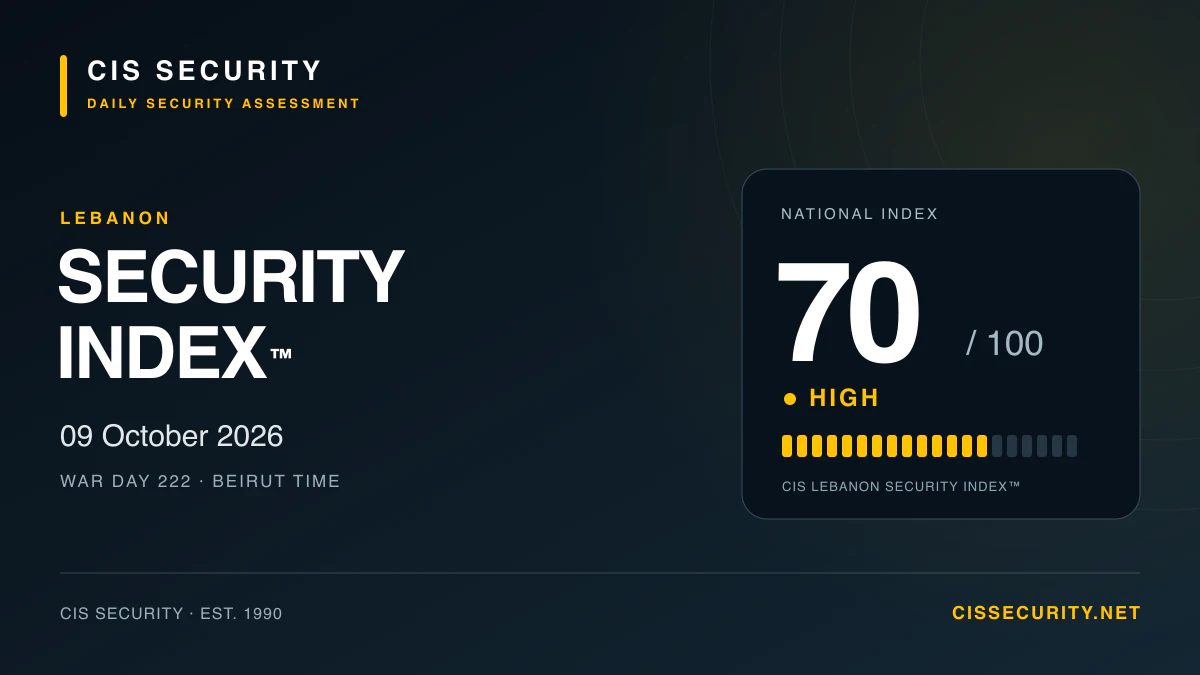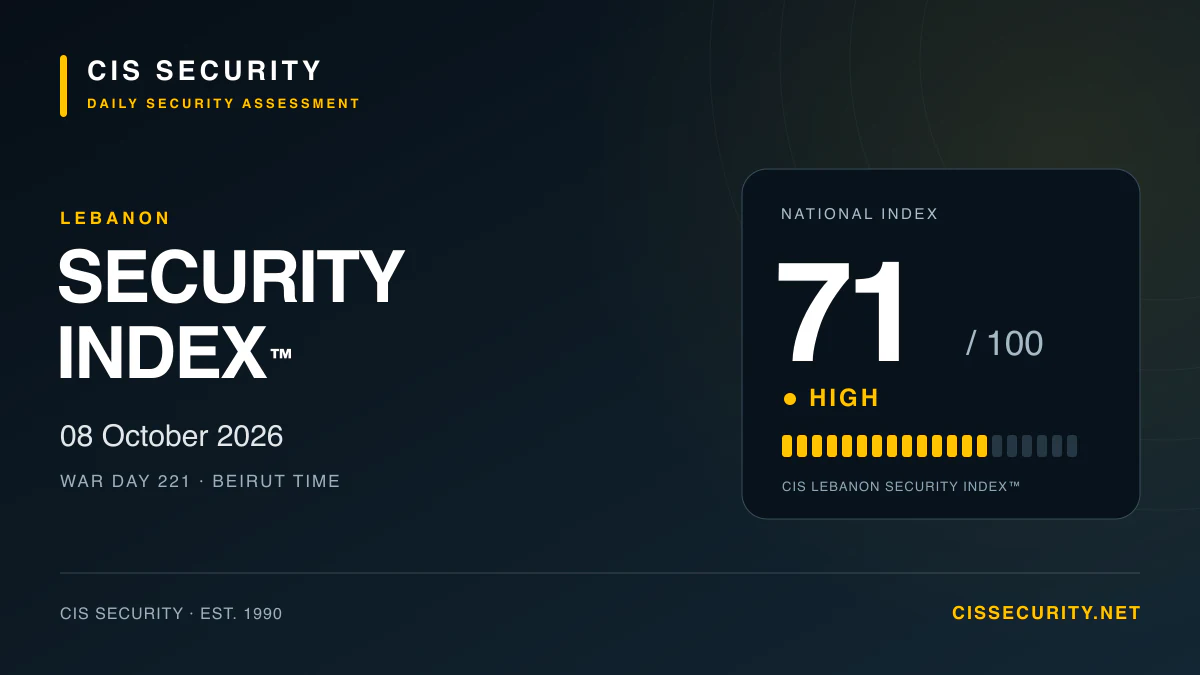
🇱🇧 CIS LEBANON SECURITY INDEX™
Friday, August 14, 2026
🔴 WAR DAY 166 | CORRECTION: DISARMAMENT-VERIFICATION COUNTRY LIST NOT YET AGREED — LEBANESE OFFICIAL DENIES REUTERS REPORT, SAYS STILL IN TALKS WITH US | 86 OF 128 LEBANESE MPs SEND LETTER TO UN SECURITY COUNCIL DEMANDING UNIFIL STAY WITH EXPANDED MANDATE | GUTERRES BACKS CONTINUED PEACEKEEPER PRESENCE | HRW: SECURITY COUNCIL WILL "SHARE BLAME" FOR ANY SECURITY VACUUM | AOUN: NEED "ALTERNATIVE FORCE" IF UNIFIL CANNOT STAY
INDEX LEVEL: 🔴 CRITICAL — THE UNIFIL WITHDRAWAL QUESTION MOVES TO THE CENTER OF LEBANON'S DIPLOMATIC AGENDA, WHILE A REPORTED DISARMAMENT-VERIFICATION BREAKTHROUGH TURNS OUT TO BE PREMATURE OVERALL INDEX: 72/100 TREND: ↔️ STABLE — CIS must open today's update with a correction to its own prior reporting. On August 12, CIS reported — based on a Reuters-sourced account relayed by an Israeli official — that Lebanon and Israel had agreed on a list of countries to verify Hezbollah's disarmament. Reuters subsequently reported, citing three sources, that this shortlist specifically comprised Britain, Italy, Switzerland, and Indonesia. However, a Lebanese official told the Times of Israel on Wednesday that there is, in fact, no such agreement, and that Beirut remains in ongoing discussions with the United States on the matter. CIS is flagging this discrepancy directly rather than letting its earlier reporting stand uncorrected: what appeared to be a resolved procedural question just two days ago is, per the most recent and most directly sourced Lebanese official comment available, still unsettled. Separately, and of potentially greater long-term significance, the question of UNIFIL's future has become the dominant diplomatic story of the week: Lebanon's UN mission, joined by 86 of the 128 members of Lebanon's parliament, sent a formal letter to the UN Security Council demanding that UNIFIL remain in place with an expanded mandate, delivered directly to Jean Arnault, the UN Secretary-General's envoy, during his visit to Beirut. UN Secretary-General António Guterres has himself now said peacekeepers will be needed in Lebanon after the current mandate expires December 31 — a position that, per Times of Israel reporting, is likely to face opposition from both the United States and Israel, whose own explanation of vote just one year ago stated flatly that "the time has come for UNIFIL's mission to end." Human Rights Watch weighed in Thursday, warning the Security Council "will share much of the blame if UNIFIL's departure creates a security vacuum that opens the door to further abuses." President Aoun struck a pragmatic, conditional tone, saying that if UNIFIL genuinely cannot stay, Lebanon needs "an alternative force" to help the Lebanese Army clear unexploded ordnance and keep pace with the framework's implementation.
⛔ EXECUTIVE SUMMARY — FRIDAY AUGUST 14, 2026 (WAR DAY 166)
CORRECTION: DISARMAMENT-VERIFICATION COUNTRY LIST NOT YET SETTLED
CIS is directly correcting an aspect of its August 12 update. That report, citing a Times of Israel account attributed to a Lebanese official, described Lebanon and Israel as having "agreed on countries that could verify Hezbollah's disarmament." Reuters subsequently reported, citing three sources, that the specific shortlist under discussion included Britain, Italy, Switzerland, and Indonesia as potential contributors to a verification mechanism potentially involving foreign troops deployed to Lebanon.
However, a Lebanese official told the Times of Israel directly on Wednesday, August 13, that there is "no such agreement," and that Beirut is "still in discussions with the United States on the matter."
CIS assessment: CIS treats this as a useful and important corrective, not merely a minor clarification. It illustrates a pattern CIS has now observed multiple times in this index — most notably with the Zawtar al-Gharbiyeh "full handover" characterization that CIS revised on August 10 after learning the Lebanese Army had only secured the village's northern zone — in which initial diplomatic reporting on procedural progress proves, on closer or more current sourcing, to be more preliminary than first described. CIS will continue to treat reports of "agreement" on specific mechanisms with appropriate caution until confirmed by an on-record government statement from both parties, rather than sourced-but-unnamed officials on one side alone.
THE CENTRAL STORY OF THE WEEK: UNIFIL'S FUTURE, AND THE FIGHT TO KEEP IT
Eighty-six of Lebanon's 128 members of parliament — a clear majority — signed a letter delivered to the UN Security Council via Jean Arnault, the officer-in-charge of the UN Special Coordinator's Office for Lebanon (UNSCOL), during his visit to Beirut this week. The letter calls for UNIFIL to continue operations "in a manner that contributes to supporting stability, protecting civilians and assisting the Lebanese state in extending its authority over its entire territory," according to signatory Ibrahim Mneimneh. Independent MP Najat Saliba, another signatory, told The National (in remarks CIS first referenced from mid-July but which remain directly relevant): "We need this neutral observer to document the presence and violations of all these agreements from the part of Israel and Hezbollah."
UN Secretary-General António Guterres has now personally weighed in, saying peacekeepers will be needed in Lebanon after the mandate expires — a position the Times of Israel describes as "likely to face opposition from the United States and Israel." In June, Guterres had already proposed three options to the Security Council, ranging from nearly 2,000 to more than 5,500 UN personnel, to monitor the ceasefire and support the Lebanese Armed Forces. That same month, France and Italy separately proposed launching a post-UNIFIL coalition — a plan CIS has tracked since late June — explicitly framed around preventing Lebanon's territory from becoming "a foothold for regional escalation."
Human Rights Watch formally called on the Security Council Thursday to keep an international force in southern Lebanon, with UN advocacy director Louis Charbonneau stating: "The Security Council should not leave Lebanese civilians unprotected. The council will share much of the blame if UNIFIL's departure creates a security vacuum that opens the door to further abuses." HRW noted the August 2025 decision to wind down UNIFIL's mandate predates the March 2026 escalation and the subsequent displacement of hundreds of thousands of civilians and Israeli occupation of large swaths of southern Lebanon — meaning, in HRW's assessment, the underlying facts that justified the original wind-down decision have since changed materially. Denmark's UN ambassador Christina Markus Lassen, holding the Council's rotating August presidency, has said the Council should revisit its decision to terminate UNIFIL's mandate given the current situation. China's UN envoy Fu Cong made a similar call in May, noting there is "no real ceasefire in place."
President Aoun, for his part, struck a pragmatic tone: he said that if UNIFIL cannot ultimately stay, Lebanon needs "an alternative force" to "assist the Lebanese army in clearing the southern regions, removing unexploded ordnance, and keeping pace with the implementation" of the framework agreement — a formulation that does not insist on UNIFIL specifically, but insists on some form of continued international support regardless of the specific institutional vehicle.
CIS notes important scale context: UNIFIL currently comprises roughly 7,500 personnel from nearly 50 countries, and has been in place since 1978 — with the Council's approved wind-down resolution calling for operations to continue through December 31, 2026, followed by a full year of withdrawal.
CIS assessment: This is, in CIS's assessment, now the single most consequential unresolved diplomatic question shaping Lebanon's medium-term security trajectory — arguably more significant than any individual round of Rome talks, because it concerns the institutional architecture that will exist (or not exist) to monitor and report on whatever comes after the current framework's implementation, however that unfolds. The breadth of support for keeping UNIFIL — a clear parliamentary majority in Lebanon, HRW, apparently Guterres himself, and at least two Security Council members (Denmark, China) explicitly calling to revisit the wind-down decision — represents a genuinely significant coalition. But it runs directly against the explicit, on-record US position from August 2025 ("this is the last time we will support an extension of UNIFIL... the time has come for UNIFIL's mission to end"), a position CIS has no indication has changed. Given the US's central mediating role in every other aspect of the framework CIS has tracked throughout this index, CIS assesses continued US opposition as likely to prove decisive regardless of the breadth of support for extension elsewhere.
📊 UPDATED KEY FIGURES — AS OF AUGUST 14, 2026
| Metric | Figure | Source |
|---|---|---|
| Lebanese MPs who signed the UNIFIL extension letter | 86 of 128 (majority) | The National / HRW / Times of Israel |
| UNIFIL personnel currently deployed | ~7,500, from nearly 50 countries | Times of Israel |
| UNIFIL's founding year | 1978 | Multiple sources |
| Guterres's proposed post-mandate options (personnel range) | ~2,000 to 5,500+ | UN Secretary-General's June proposal |
| UNIFIL mandate end date (operations) | December 31, 2026 | UN Security Council Resolution (August 2025) |
| Lebanon killed (cumulative, since March 2) | More than 4,300 | Arab News, citing Lebanese authorities |
| Reported (but denied) disarmament-verification shortlist | Britain, Italy, Switzerland, Indonesia | Reuters (3 sources) — subsequently disputed by Lebanese official |
📌 WHAT CIS IS WATCHING — IMMEDIATELY
- Does the US position on UNIFIL's wind-down shift at all in response to the 86-MP letter and Guterres's own stated position, or does Washington's August 2025 stance hold firm?
- Does an actual, confirmed disarmament-verification country list emerge, given today's correction that no such agreement currently exists despite earlier reporting?
- Does France and Italy's proposed post-UNIFIL coalition gain further definition as the practical alternative Aoun has signaled Lebanon would accept if UNIFIL itself cannot be extended?
- Does the Security Council take up Denmark's and China's calls to formally revisit the wind-down decision, and if so, when?
- Does the underlying security situation — strikes, demolitions, casualties — continue at the elevated pace CIS has documented throughout early August, reinforcing the practical case HRW and Lebanese MPs are making for continued international monitoring?
🛡️ CIS SECURITY — AUGUST 14 ASSESSMENT & GUIDANCE
Trusted Security Excellence Since 1990 | "Because Your Safety Isn't Optional"
CIS POSTURE: LEVEL 5 — SEVERE ALERT (maintained)
CIS maintains Level 5 — Severe Alert. While today's developments are primarily diplomatic and institutional in nature rather than reflecting a new incident on the ground, the UNIFIL debate directly concerns the future availability of independent, on-the-ground monitoring and reporting capacity in south Lebanon — capacity CIS itself has relied upon throughout this index (UNIFIL's own August 3 and August 10 data on projectile counts and airspace violations being among the most authoritative single sources CIS has cited). Any reduction in that monitoring capacity would materially affect the quality of information available to CIS and its clients going forward, independent of the underlying security situation itself.
ZONE-BY-ZONE GUIDANCE
CIS's zone-by-zone guidance from its August 12 update remains unchanged and in effect: continue to avoid Nabatieh, Mansouri, Kfar Tebnit, Wadi al-Salouqi, Nabatieh al-Fawqa, Zawtar al-Sharqiya, and the broader security/buffer zone; exercise continued caution in Zawtar al-Gharbiyeh given its only-partial (northern-zone) handover status; maintain elevated caution in Dahiyeh and the Bekaa Valley; normal operations continue in Beirut (general), Mount Lebanon, North Lebanon, and Akkar.
📞 EMERGENCY CONTACTS — AUGUST 14, 2026
CIS Security 24/7: +961 3 539900 | info@cissecurity.net | www.cissecurity.net Lebanese Army South Lebanon Liaison: +961-8-802-510 US Embassy Emergency: +1-202-501-4444 | BeirutACS@state.gov Lebanese Red Cross: 1760 Civil Defence: 125 ISF: 112 National Mental Health Lifeline: 1564 (24/7 — confidential)
⚠️ FINAL ASSESSMENT — WAR DAY 166, AUGUST 14, 2026
Today's update is, in an important sense, about the limits of diplomatic reporting itself — including CIS's own.
The disarmament-verification country list CIS reported as settled just two days ago has, on further and more current sourcing, turned out not to be settled at all. CIS would rather correct this promptly and transparently than allow an inaccurate impression of procedural progress to stand uncorrected in its record. This is not a small point: throughout this index, CIS has repeatedly found that initial characterizations of diplomatic "breakthroughs" — the July 21 pilot-zone handover, the July 14-15 Rome round's "productive and positive" framing, and now this verification-country report — have needed subsequent revision once more complete information became available. CIS's operating assumption going forward will continue to be that any single-sourced report of an "agreement" should be treated as provisional until confirmed on the record by both governments involved.
The UNIFIL question, by contrast, is not a matter of correcting a factual error — it is a genuinely live, high-stakes, and still-unresolved institutional debate that will shape Lebanon's security architecture for years regardless of how the current framework's implementation proceeds. A clear parliamentary majority, a formal UN Secretary-General position, and explicit statements from at least two Security Council members all now favor some form of continued or expanded international presence. Whether this coalition can overcome the United States' firm, publicly stated 2025 position that UNIFIL's mission should end will likely be determined well before December 31 — and CIS assesses this as one of the single most important structural questions for Lebanon's medium-term stability that clients should be tracking, independent of the day-to-day incident reporting that has dominated most of CIS's coverage this month.
CIS maintains Level 5 — Severe Alert and will continue monitoring both the UNIFIL debate and the underlying security situation closely.
+961 3 539900 | info@cissecurity.net | cissecurity.net CIS Security — Because Your Safety Isn't Optional — Est. 1990
CIS Lebanon Security Index™ | Friday, August 14, 2026 | WAR DAY 166
Sources: The Times of Israel liveblog, "Aug 13: Settler leader says Qusra siege 'not our way,' condemns violence" (August 13, 2026 — full verification-list correction, Guterres statement, 86-MP letter detail, UNIFIL personnel/founding-year figures); The Times of Israel liveblog entry, "Human Rights Watch says UN must keep peacekeepers in Lebanon" (August 13, 2026 — full HRW background, Guterres three-option proposal, France/Italy coalition detail); Human Rights Watch, "UN: Keep International Force in Lebanon to Protect Civilians" (August 13, 2026 — full Charbonneau quote, Christina Markus Lassen/Denmark quote, China's Fu Cong statement, August 2025 mandate-extension context); Free Malaysia Today, "HRW says UN must keep peacekeepers in Lebanon" (August 14, 2026); Arab News, "HRW says UN must keep peacekeepers in Lebanon" (August 14, 2026 — 4,300+ killed figure, France/Italy coalition quote); The National, "Lebanese MPs urge UN to extend peacekeeping mission" (July 24, 2026, referenced for background — full Mneimneh/Saliba quotes); Defense News, "UNIFIL's final months: Uncertainty persists in Lebanon over what comes next" (August 3, 2026, referenced for background — Jean Arnault delegation detail, UNIFIL spokesperson Kandice Ardiel quote); US Mission to the United Nations, "Explanation of Vote on the UN Security Council Mandate Renewal of the UN Interim Force in Lebanon (UNIFIL)" (August 2025, referenced for background — full US position quotes); UN News, "Security Council: UN peacekeeping mission in Lebanon extended for a 'final time'" (September 2025, referenced for background — mandate details, France's penholder role); FDD Overnight Brief, August 13, 2026 (Reuters-sourced verification-list shortlist detail: Britain, Italy, Switzerland, Indonesia); prior CIS reporting (July 4–August 12, 2026) carried forward for context.
CIS explicitly notes it is correcting its own August 12, 2026 report regarding a disarmament-verification country agreement, based on more current and directly-sourced reporting indicating no such agreement has in fact been reached. All other diplomatic and political statements are attributed to named officials or sourced reporting, August 11–14, 2026. Index compiled: Friday, August 14, 2026 — Beirut time.