🇱🇧 CIS LEBANON SECURITY INDEX™
Tuesday, August 4, 2026
🟠 WAR DAY 156 | SEVENTH ROUND OF LEBANON-ISRAEL TALKS OPENS IN ROME WITH "UNPRECEDENTEDLY LARGE" LEBANESE DELEGATION | QASSEM SAYS NEGOTIATIONS BRING "SHAME, HUMILIATION," CALLS AOUN "BIASED AND DIVISIVE" | SIXTH ANNIVERSARY OF BEIRUT PORT BLAST: JUSTICE MINISTER SAYS INDICTMENT EXPECTED WITHIN 60-90 DAYS | SALAMEH TRANSFERRED TO HOSPITAL AS HEALTH DETERIORATES | REGIONALLY: TRUMP SAYS IRAN FACES "LAST CHANCE BEFORE DECAPITATION," HORMUZ DEAL "COULD COME LITERALLY BY TOMORROW"
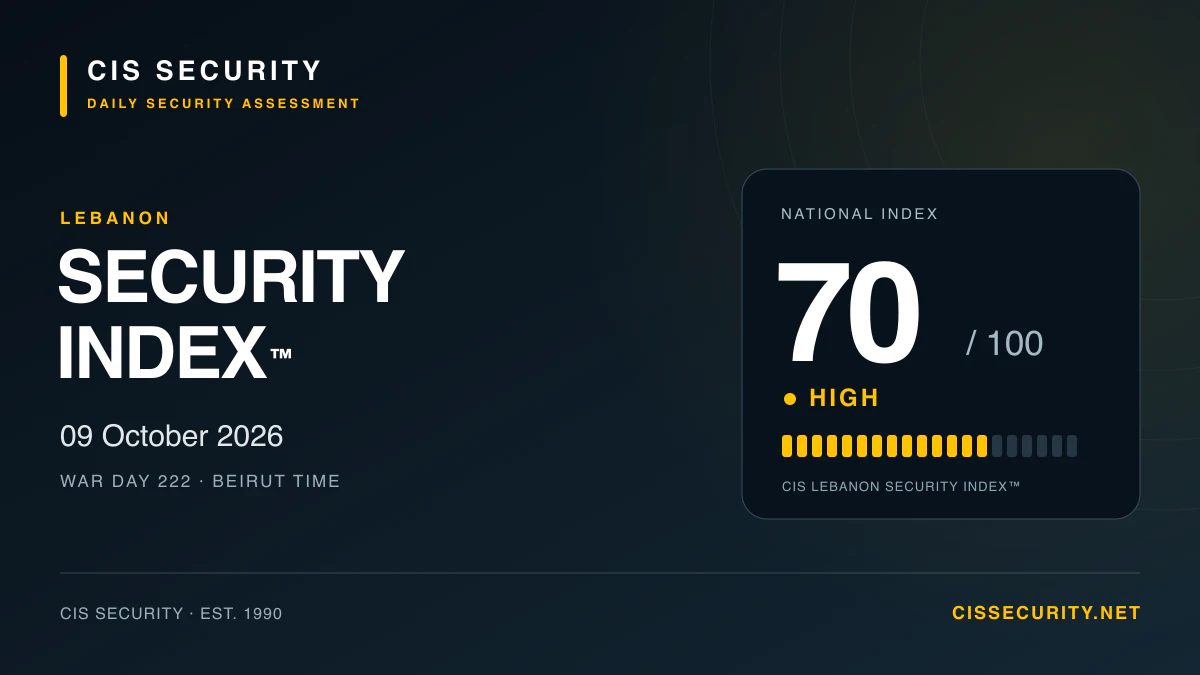
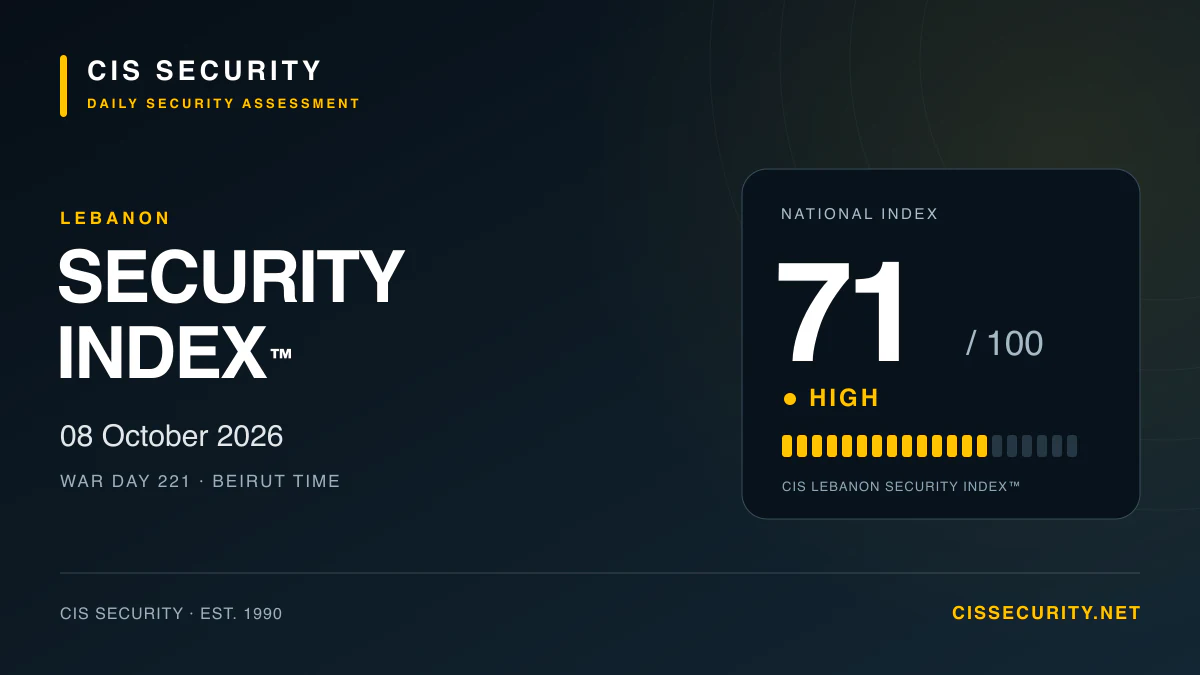
INDEX LEVEL: 🟠 HIGH — DIPLOMATIC TRACK ADVANCES WHILE UNDERLYING TENSIONS PERSIST OVERALL INDEX: 70/100 TREND: ⬇️ EASING (LEBANON TRACK, CAUTIOUSLY) — CIS is moderating its assessment slightly today, from 73 to 70, while maintaining the HIGH band. The two days since CIS's last full update have not produced a repeat of the direct-contact incident Israel described on Saturday, nor any new demolition on the scale of Friday's Beaufort Ridge operation. Instead, the past 48 hours have been dominated by the diplomatic and political track: Lebanon and Israel opened a seventh round of U.S.-sponsored talks in Rome on Tuesday, with Beirut sending what sources describe as an unprecedentedly large political and military delegation, and discussions scheduled to run through Thursday. At the same time, CIS is not reading this as a resolution of underlying tensions. Hezbollah leader Sheikh Naim Qassem used a televised address on the eve of the talks to call the negotiations a source of "shame, humiliation, and successive compromises" for Lebanon and to directly attack President Joseph Aoun as "biased and divisive" — a marked escalation in Hezbollah's public posture toward the head of state himself, rather than toward the negotiating framework alone. Lebanon's National News Agency also continued to log near-daily Israeli strikes, phosphorus munitions, and drone activity in the south over the same period, confirming the ceasefire violations pattern CIS has tracked without interruption throughout this index. CIS therefore assesses the Lebanon track as easing in intensity from the acute escalatory cycle of July 31–August 2, but not de-escalating in the structural sense — the core disputes (disarmament, full withdrawal, and now open friction between Hezbollah's leadership and the presidency) remain fully unresolved heading into Thursday's scheduled close of the Rome round.
⛔ EXECUTIVE SUMMARY — TUESDAY AUGUST 4, 2026 (WAR DAY 156)
SEVENTH ROUND OF ROME TALKS OPENS WITH LARGEST-EVER LEBANESE DELEGATION
Lebanon and Israel held a fresh round of U.S.-sponsored talks in Rome on Tuesday, with Beirut seeking Israel's phased withdrawal from the country's south. Convoys carrying both delegations arrived in the morning at the U.S. Embassy in the Italian capital, where discussions are scheduled to run until Thursday, August 6 — this is the seventh round of Washington-mediated talks since Hezbollah drew Lebanon into the regional war in March.
Sources told Asharq al-Awsat that Lebanon's delegation, led by former ambassador Simon Karam, is "unprecedentedly large" in both political and military composition. It includes Lebanon's Ambassador to Washington Nada Hamadeh Moawad; the Army Command's Director of Operations, Brig. Gen. George Rizkallah, leading a team of five specialized officers; the legal advisor to the Presidency, Dr. Antoine Sfeir; and maritime-affairs expert Najib Masihi, who was part of the Lebanese team that reached the earlier maritime border demarcation agreement with Israel under President Michel Aoun's tenure. Sources described Sfeir's and Masihi's inclusion as a "precaution" — suggesting Lebanon is preparing for the talks to touch on legal and maritime dimensions beyond the immediate withdrawal/disarmament framework.
At negotiations in Washington in June, Israel and Lebanon had agreed to a framework deal involving Hezbollah's disarmament, a gradual Israeli withdrawal from the south, and Lebanese Army deployment to the region starting in test "pilot zones." After talks last month, Israel's military withdrew from the outskirts of Zawtar al-Gharbiyeh, one of the first pilot zones, and the Lebanese Army has since deployed there and allowed residents to inspect their homes and businesses. A U.S. State Department official told AFP this week's discussions would "include expanding the pilot zone process, resolving all outstanding border issues, and working on a comprehensive peace and security agreement."
Italian Foreign Minister Antonio Tajani urged both sides Monday to "continue in a constructive spirit, identifying shared solutions that will allow for the full implementation of the framework agreement." U.S. Ambassador to Lebanon Michel Issa struck a more cautious note, warning that "moving too quickly risks jeopardizing the very civilians this process is meant to protect" and that "both sides must agree on a clear, workable process before proceeding."
CIS assessment: The scale and composition of Lebanon's delegation — spanning diplomatic, military, legal, and maritime expertise — signals that Beirut is treating this round as substantively broader than prior sessions, potentially extending into border and maritime issues beyond the core withdrawal/disarmament file. CIS reads Ambassador Issa's explicit caution about "moving too quickly" as a meaningful signal that Washington itself is managing expectations downward for this round, consistent with the incremental, single-village pace of the pilot-zone process to date. CIS will report any outcome from Rome as soon as confirmed; as of this writing the talks remain in progress with no results yet announced.
QASSEM ESCALATES RHETORIC: NEGOTIATIONS BRING "SHAME AND HUMILIATION," AOUN NOW "BIASED AND DIVISIVE"
Hezbollah leader Sheikh Naim Qassem said in a televised address Tuesday, on the eve of the Rome round, that direct negotiations between Lebanon and Israel would bring "nothing but shame, humiliation, and successive compromises" for Lebanon. In the same address, Qassem directly criticized President Joseph Aoun, saying he "has not acted as an arbiter, nor as a unifying figure, but has become biased and divisive, which is incompatible with his role and with Lebanon's strength."
CIS assessment: CIS flags this as a notable sharpening of Hezbollah's public rhetoric. Throughout this index, Qassem has consistently opposed the negotiating framework and disarmament in principle; today's statement goes further by attacking the president personally and by name, on the very day Lebanon's negotiating delegation was in Rome. Combined with Qassem's continued refusal to accept disarmament, this indicates that whatever progress emerges from the Rome talks, it will do so against a backdrop of open and hardening confrontation between Hezbollah's leadership and the presidency — a dynamic CIS assesses as a structural, not transient, risk to the framework's implementation. Separately and on a different note, Qassem also said Tuesday he has "no objection to meeting with Syrian authorities," a comparatively conciliatory regional signal CIS will continue to monitor for any follow-through.
SIXTH ANNIVERSARY OF BEIRUT PORT BLAST: FAMILIES DEMAND JUSTICE, INDICTMENT EXPECTED WITHIN 60-90 DAYS
Tuesday marked the sixth anniversary of the August 4, 2020 Beirut port explosion, which killed more than 220 people, injured more than 6,500, and devastated large parts of the capital. Families of victims gathered at the port Tuesday to demand accountability. "Until now, we haven't gotten justice. There has been no accountability and nobody has been arrested," Hiyam al-Bikai, whose son Ahmad was killed in the blast, told AFP at the commemoration. "This is an extremely painful anniversary. Our pain has not stopped and our wound has not healed."
President Aoun had urged the judiciary Monday to issue the long-delayed indictment, calling it "a necessity that can no longer be delayed" and stating that justice "is not just a legal procedure, but a right owed by the living to the martyrs and their families." Prime Minister Nawaf Salam wrote on X that "there can be no settlement at the expense of justice, even if it is sometimes delayed," vowing "no cover for any official, no matter their position."
Justice Minister Adel Nassar told AFP from Tuesday's commemoration that the case — which involves roughly 70 defendants including current and former politicians, security and military officials, and civil servants, per investigating judge Tarek Bitar's completed probe — remains with the public prosecutor. Nassar said: "We expect that within a period of 60 to 90 days, he will refer the case back to the investigating judge, who will then issue the indictment act," which would pave the way for a trial to begin. No one is currently in custody in Lebanon over the blast.
CIS assessment: This is a domestic governance and accountability story running in parallel to, not directly connected with, the war-track developments CIS otherwise reports — but it bears directly on institutional trust and rule-of-law perception among the client base CIS serves, particularly in Beirut. CIS notes the case has been stalled by political and legal obstruction since 2023, and that today's 60-90 day estimate from the Justice Minister is the most concrete timeline given publicly to date. CIS will treat any actual indictment, when issued, as a significant governance milestone and will report it accordingly.
SALAMEH TRANSFERRED TO HOSPITAL AS HEALTH DETERIORATES
Former central bank governor Riad Salameh was transferred to hospital Monday after his health deteriorated further, continuing the situation CIS first reported developing late last week. Salameh, 76, remains under police guard and is formally considered "in custody" per the judicial arrangement CIS reported August 1-2.
CIS assessment: No material change to CIS's prior assessment of this case beyond the continued deterioration in Salameh's reported health; CIS will note any prosecutorial decision or change in custody status as it develops.
REGIONAL: TRUMP SAYS IRAN FACES "LAST CHANCE BEFORE DECAPITATION," HORMUZ DEAL "COULD COME LITERALLY BY TOMORROW"
President Trump told reporters at the White House Monday that Iran was facing a "last chance before decapitation," while confirming that talks with Tehran on reopening the Strait of Hormuz and on denuclearization remain ongoing despite Iran's own foreign ministry publicly denying that any negotiation is underway. "We are talking right now," Trump said, adding a reopening deal on Hormuz "could come literally by tomorrow," while denuclearization "could take a little while."
Trump said he had agreed to continue pursuing talks at the request of Saudi Arabia, the UAE, Qatar, and other regional partners — consistent with CIS's August 2 reporting on the Saudi Crown Prince's direct appeal for de-escalation. Iranian foreign ministry spokesman Esmaeil Baqaei maintained that Tehran's negotiations are "with Oman" on Strait passage specifically, not with Washington, and that discussions are progressing toward "an understanding on a route acceptable to both sides" — while explicitly denying this constitutes reopening the Strait. Early Tuesday, Britain's UKMTO maritime security agency reported a cargo vessel was struck by an "unknown projectile" in the Strait of Hormuz off Oman's coast, underscoring that the underlying blockade and associated risk to shipping remain active despite the diplomatic movement.
Trump also repeated his now-familiar pattern from the past week: having threatened to hit Iran "very hard" with strikes on energy infrastructure, he again pulled back over the weekend, saying the "perimeters" of a deal were there.
CIS assessment: CIS continues to treat the Iran track as genuinely distinct from, and currently more volatile than, the Lebanon track — moving between threatened "decapitation" strikes and reported deal "perimeters" within the same 72-hour window, with an active projectile strike on shipping reported even as diplomacy continues. CIS's core operational conclusion for Lebanon remains unchanged from August 2: this regional volatility has not, to date, produced any confirmed spillover into the Lebanon-specific military or diplomatic track, which is proceeding on its own — comparatively steadier, if still unresolved — trajectory via the Rome talks.
📊 UPDATED KEY FIGURES — AS OF AUGUST 4, 2026
| Metric | Figure | Source |
|---|---|---|
| Rome talks round | 7th round of Washington-mediated Lebanon-Israel talks since March | US State Dept / AFP |
| Rome talks schedule | Tuesday, August 4 – Thursday, August 6, 2026 | AFP |
| Beirut port blast anniversary | 6 years (August 4, 2020) | AFP |
| Port blast deaths / injuries | 220+ killed, 6,500+ injured | AFP / Lebanese authorities |
| Port blast case defendants (Bitar probe) | ~70, incl. current/former politicians, security & military officials, civil servants | AFP |
| Expected timeline to indictment referral | 60-90 days | Justice Minister Adel Nassar |
| Cumulative Lebanon deaths (war, per Lebanese authorities) | More than 4,300 | Lebanese Health Ministry, via AFP |
| Lebanon-Israel war duration (as of today) | ~5 months | AFP |
| US-Iran war duration (as of today) | Since February 28, 2026 | AFP |
📌 WHAT CIS IS WATCHING — IMMEDIATELY
- What outcome, if any, emerges from the Rome talks by their scheduled close on Thursday, August 6 — particularly whether the pilot-zone process is formally expanded beyond Zawtar al-Gharbiyeh, as the State Department indicated is on the agenda.
- Whether Qassem's sharpened personal criticism of President Aoun produces any further institutional friction between Hezbollah's leadership and the presidency, and whether it is followed by any change in Hezbollah's operational posture.
- Whether the Justice Ministry's 60-90 day indictment timeline for the Beirut port blast case holds, given the case's multi-year history of political and legal obstruction.
- Salameh's hospital condition and any resulting change to his custody status.
- Whether the reported Hormuz "deal by tomorrow" materializes, and whether Tuesday's projectile strike on a cargo vessel is confirmed as connected to the blockade — and whether any of this regional movement begins to intersect visibly with the Lebanon file.
🛡️ CIS SECURITY — AUGUST 4 ASSESSMENT & GUIDANCE
Trusted Security Excellence Since 1990 | "Because Your Safety Isn't Optional"
CIS POSTURE: LEVEL 4 — HIGH ALERT (stepped down from Level 5)
CIS is stepping its posture down from Level 5 — Severe Alert to Level 4 — High Alert, reflecting the absence of any new large-scale demolition or direct-contact incident since Saturday, August 1, and the continuation of the diplomatic track via the Rome talks. This is a measured, partial easing — not a return to routine posture — given continued near-daily Israeli strikes and drone activity in the south, and the sharp escalation in Hezbollah-presidency rhetorical friction reported today. CIS will revisit this posture immediately if the Rome talks produce a breakdown, if Hezbollah signals any operational response to Qassem's rhetoric, or if further demolitions/strikes resume at the intensity seen July 31–August 2.
ZONE-BY-ZONE GUIDANCE
SOUTHERN "SECURITY ZONE" (ISRAELI-OCCUPIED AREAS): Continue to avoid entirely — site of the August 1 direct-engagement incident; risk of recurrence remains elevated pending Rome outcome. ALI AL-TAHER RIDGE / NABATIEH AL-FAWQA: Avoid — site of Monday's overnight Israeli airstrike (two air-to-surface missiles). YAROUN, BINT JBEIL: Elevated caution — overnight phosphorus munitions caused fires in olive and pine groves in these towns. AL-MANSOURI, BYOUT AL-SIYYAD, WADI HAMOUL (NEAR NAQOURA): Elevated caution — continued quadcopter and machine-gun fire activity reported. BEAUFORT RIDGE / BEAUFORT CASTLE AREA: Continue to avoid — unexploded ordnance risk remains from Friday, August 1's demolition. SECURITY ZONE / BUFFER ZONE / YELLOW LINE (GENERAL): Do not approach under any circumstances. DAHIYEH, BEKAA VALLEY: Maintain elevated caution. BEIRUT (general), MOUNT LEBANON, NORTH LEBANON, AKKAR: Calm, normal operations continue; note that the Beirut port area saw a large public gathering Tuesday for the anniversary commemoration — expect periodic traffic and crowd management around the port through the week.
📞 EMERGENCY CONTACTS — AUGUST 4, 2026
CIS Security 24/7: +961 3 539900 | info@cissecurity.net | www.cissecurity.net Lebanese Army South Lebanon Liaison: +961-8-802-510 US Embassy Emergency: +1-202-501-4444 | BeirutACS@state.gov Lebanese Red Cross: 1760 Civil Defence: 125 ISF: 112 National Mental Health Lifeline: 1564 (24/7 — confidential)
⚠️ FINAL ASSESSMENT — WAR DAY 156, AUGUST 4, 2026
Two days after CIS reported the first direct-contact combat incident since the June 20 ceasefire, the picture today is one of a Lebanon track that has stepped back from the immediate brink without resolving any of the disputes that produced it. The seventh round of Rome talks — opened today with what sources describe as Lebanon's largest and most broadly composed delegation of the process to date — represents a genuine, if incremental, continuation of diplomacy. Israel's earlier withdrawal from the outskirts of Zawtar al-Gharbiyeh and the Lebanese Army's subsequent deployment there remain, to date, the one concrete, verifiable achievement of the pilot-zone framework, and this week's talks are explicitly intended to test whether that model can be expanded.
At the same time, CIS is not prepared to characterize today's developments as durable de-escalation. Hezbollah's leadership used the very eve of the talks to escalate its rhetoric against the negotiations themselves and, notably, against President Aoun personally — a sharpening of internal Lebanese political conflict that CIS assesses as at least as consequential, over the medium term, as the external Israeli-Lebanese track. Israeli strikes, phosphorus munitions, and drone activity in the south continued without interruption over the past 48 hours, confirming that the ceasefire remains, as CIS has consistently characterized it throughout this index, a ceasefire in name accompanied by near-continuous low-level violation in practice.
The convergence of the Rome talks with the sixth anniversary of the Beirut port blast today is also notable from a governance-trust standpoint: victims' families' public frustration, set against the Justice Minister's new 60-90 day indictment timeline, will be a domestic accountability story CIS continues to track for its bearing on institutional confidence more broadly.
CIS is stepping its posture down to Level 4 — High Alert to reflect the past 48 hours' relative military stabilization, while maintaining a HIGH Index reading and close monitoring of the Rome talks through their scheduled Thursday close, of any Hezbollah response to today's rhetorical escalation, and of the broader regional Iran track's still-unresolved trajectory.
+961 3 539900 | info@cissecurity.net | cissecurity.net CIS Security — Because Your Safety Isn't Optional — Est. 1990
CIS Lebanon Security Index™ | Tuesday, August 4, 2026 | WAR DAY 156
Sources: Naharnet/Agence France-Presse, "Lebanon and Israel hold new round of direct talks in Rome" (Aug 4, 2026 — talks schedule, framework deal recap, pilot-zone status, Tajani and Issa quotes, PM Salam cabinet remarks); Naharnet/AFP, "Qassem says Aoun has become 'biased and divisive'" (Aug 4, 2026 — full Qassem quotes); Naharnet, "Qassem says no objection to meeting with Syrian authorities" (Aug 4, 2026); Naharnet (Asharq al-Awsat sourcing), "Lebanon to send big delegation to Rome, Italian officer likely to head verification panel" (Aug 3, 2026 — delegation composition, Karam, Moawad, Rizkallah, Sfeir, Masihi); Naharnet/AFP, "Aoun urges judiciary to issue Beirut port blast indictment" (Aug 3, 2026 — Aoun and Salam quotes, Bitar probe status); Naharnet/AFP, "Nassar says port blast indictment expected within 60-90 days" (Aug 4, 2026 — Bikai quotes, Nassar timeline, defendant count); Naharnet, "Israeli violations in Lebanon: Latest developments" (Aug 3, 2026 — al-Mansouri, Ali al-Taher, Yaroun/Bint Jbeil, Byout al-Siyyad, Wadi Hamoul incidents); Naharnet, "Salameh transferred to hospital after his health deteriorates" (Aug 3, 2026); Naharnet/AFP, "Trump says Iran facing 'last chance before decapitation'" (Aug 4, 2026 — Trump and Baqaei quotes, UKMTO Hormuz projectile report, war-duration figures); Naharnet, "Ambassador Issa: Lebanon and Israel must agree on clear, workable process" (Aug 3, 2026); prior CIS reporting (July 29 – August 2, 2026) carried forward for context, including CIS's August 2 coverage of the Beaufort Ridge aftermath, the reported direct-engagement incident, and the UNSCOL "deeply concerning" statement.
CIS notes that several developments referenced above (the precise outcome of the Rome talks, and any Hormuz agreement Trump characterized as possible "by tomorrow") remained unresolved as of this writing and will be confirmed or updated in subsequent editions as they develop. All statements are attributed to named officials or sourced reporting, August 3–4, 2026. Index compiled: Tuesday, August 4, 2026 — Beirut time.