🇱🇧 CIS LEBANON SECURITY INDEX™
Sunday, August 9, 2026
🔴 WAR DAY 161 | ISRAELI TROOPS INFILTRATE ZAWTAR AL-GHARBIYEH — THE FLAGSHIP "PILOT ZONE" — BUILD EARTHEN BARRIER; ISRAELI MILITARY DENIES EVENT DESPITE STATE MEDIA, MAYOR, AND AFP CONFIRMATION | UNIFIL RECORDS RECORD 113, THEN 120 DAILY PROJECTILES — "SHARPEST ESCALATION SINCE LATE JUNE" — ZERO FROM HEZBOLLAH | US PRIVATELY TOLD ISRAEL HEZBOLLAH DID NOT VIOLATE CEASEFIRE OVER MAJDALZOUN | DISARMAMENT-VERIFICATION SHORTLIST TAKES SHAPE (ITALY, UK, SWITZERLAND, INDONESIA REPORTED; FRANCE EXCLUDED) | REGIONALLY: IRAN ISSUES SWEEPING NEW HORMUZ DEMANDS, TANKER ATTACKED, ANOTHER SHIP HIT BY PROJECTILE
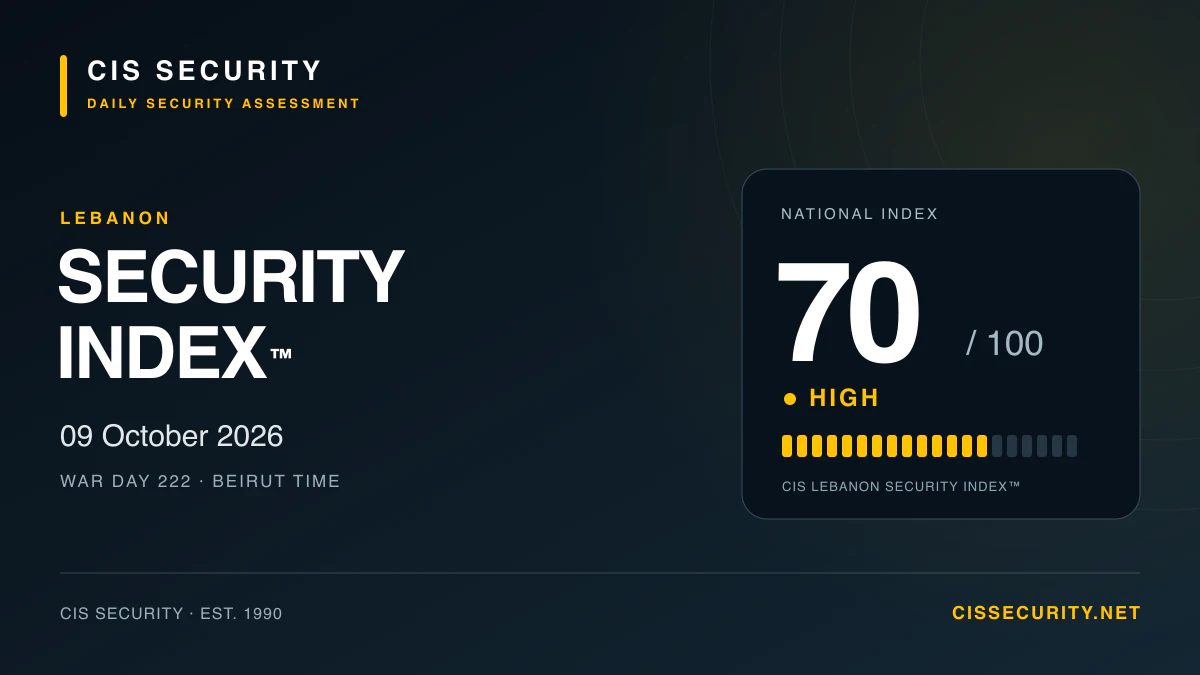
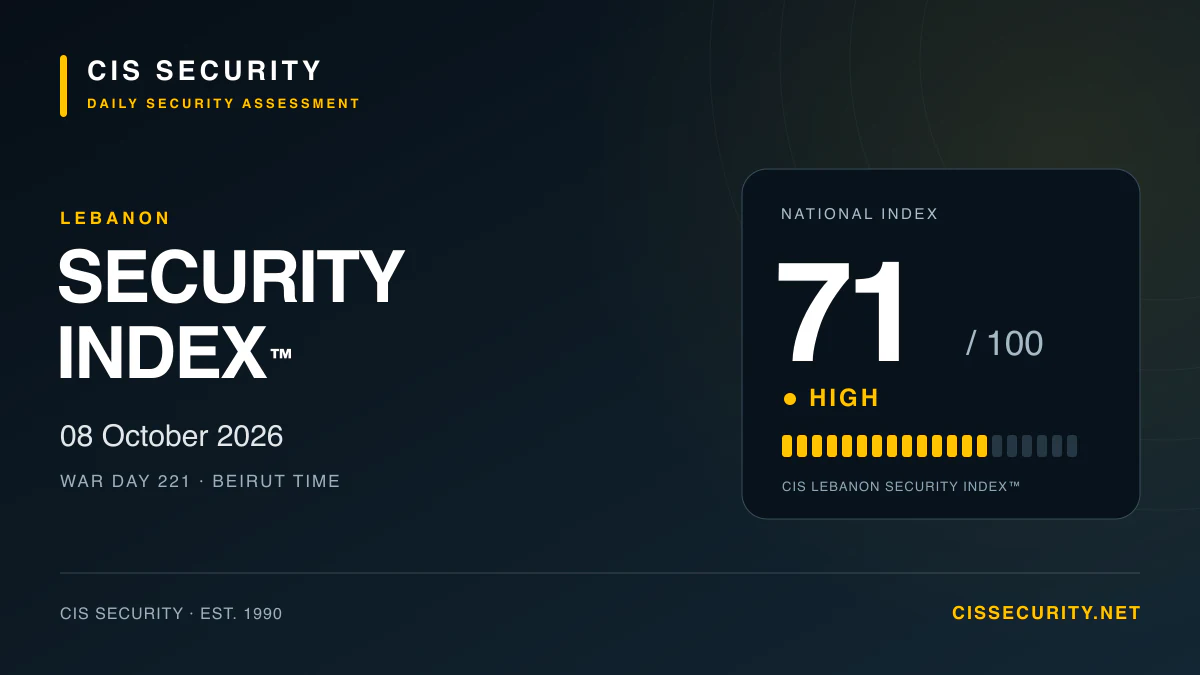
INDEX LEVEL: 🔴 HIGH-CRITICAL — RECORD SUSTAINED BOMBARDMENT CONFIRMED BY UNIFIL, COMPOUNDED BY A DIRECT INCURSION INTO THE FRAMEWORK'S SINGLE CONCRETE ACHIEVEMENT OVERALL INDEX: 75/100 TREND: ↔️ HOLDING AT SEVERE LEVEL, WITH GENUINELY MIXED SIGNALS — CIS is holding its assessment at a severely elevated level over this three-day reporting window (August 7-9), with countervailing developments pulling in different directions. On the alarming side: UNIFIL itself has now confirmed, in its own official statements, that Israel fired 113 projectiles into south Lebanon on Wednesday, August 5 — the highest daily total since June 21 — and then 120 on Thursday, August 6, surpassing Wednesday's full-day total before 4pm local time and marking, in the UN's own words, "the sharpest escalation in military activity" since the June framework agreement was signed. Critically, UNIFIL stated explicitly that it "did not detect any projectile launches by Hezbollah during the same period" — a direct, UN-sourced confirmation that the bombardment has been entirely one-directional. Compounding this, Israeli troops infiltrated Zawtar al-Gharbiyeh overnight into Saturday, August 8 — the very village that stands as the framework's sole verified achievement to date — and built a new earthen barrier blocking the town square road, according to Lebanon's state media, the local mayor, and an AFP correspondent who personally observed the barrier. The Israeli military's response, when contacted by AFP, was that it was "not aware of such an event in this area" — a denial CIS flags as directly contradicted by multiple independent sources. On the more stabilizing side, CIS has learned that the United States privately told Israel that Hezbollah did not, in fact, violate the ceasefire in the Majdalzoun incident that triggered this entire escalatory cycle, and urged Israel to avoid further retaliation out of concern for the Rome negotiations — a significant diplomatic intervention. A disarmament-verification country shortlist is also taking shape. CIS weighs all of this together: the military facts on the ground, as independently confirmed by UNIFIL and AFP, remain severe and one-sided, even as the diplomatic architecture shows signs of both correcting course and continuing to build out.
⛔ EXECUTIVE SUMMARY — SUNDAY AUGUST 9, 2026 (WAR DAY 161)
UNIFIL CONFIRMS RECORD BOMBARDMENT: 113 PROJECTILES WEDNESDAY, 120 THURSDAY — "SHARPEST ESCALATION SINCE LATE JUNE," ZERO FROM HEZBOLLAH
The UN Interim Force in Lebanon (UNIFIL) reported that the Israeli army fired 113 projectiles into southern Lebanon on Wednesday, August 5 — the highest daily total recorded since June 21 — and that the escalation continued into Thursday, when UNIFIL recorded 120 projectiles fired by Israel between midnight and 4pm local time alone, already exceeding Wednesday's full-day figure. UN deputy spokesman Farhan Haq told reporters this represented "the sharpest escalation" in military activity since the late-June trilateral framework was announced, and stated plainly that "UNIFIL did not detect any projectile launches by Hezbollah during the same period."
UNIFIL's public statement read: "Peacekeepers continue to observe daily violations of Lebanese airspace and military activities on the ground... While violence remains significantly lower than in previous months, the overall situation remains fragile," adding that "commitment to Resolution 1701, dialogue and coordination remain essential to de-escalation and key to restoring full stability in south Lebanon." Lebanon's Health Ministry reported the cumulative war toll has now reached 4,333 killed and 12,250 injured since March 2.
CIS assessment: This is among the most consequential data points CIS has reported in this index precisely because of its source: UNIFIL is a neutral, independent UN body with peacekeepers on the ground, and its explicit statement that zero Hezbollah projectiles were detected during this period removes any ambiguity about which side has driven this specific week's escalation. CIS notes the direct tension between UNIFIL's factual reporting and Israel's own public justification for its campaign (retaliation for an alleged Hezbollah ceasefire violation at Majdalzoun) — a tension sharpened further by the US intelligence assessment reported below.
US PRIVATELY TOLD ISRAEL: HEZBOLLAH DID NOT VIOLATE THE CEASEFIRE AT MAJDALZOUN
The United States conveyed a message to Israel stating that Hezbollah did not violate the ceasefire agreement, urging Israel to refrain from retaliation, in the wake of the deadly Majdalzoun blast, an Israeli security official told Israel's public broadcaster. The source added that Washington asked Israel to avoid escalation, fearing it would negatively impact the Rome negotiations, and noted that Israel's own internal assessment was that the explosive device had been planted before the ceasefire took effect — not as a fresh Hezbollah attack.
CIS assessment: This confirms and resolves the uncertainty CIS flagged explicitly in its August 6 edition, when an Israeli military source first told AP the explosive's "nature was under review." CIS now has, from an Israeli official source itself, direct confirmation that both the US and Israel's own internal assessment concluded Hezbollah did not commit a new ceasefire violation at Majdalzoun — meaning the entire retaliatory campaign of the past week (the Tebnine strike, the al-Mansouri evacuation order, the record 113/120-projectile bombardment, the strikes on Burj al-Shemali, Haddatha, Zawtar al-Sharqiyeh, Wadi al-Houjeir, and Shaqra) was launched and sustained on a premise that both Washington and Tel Aviv privately understood to be false. CIS regards this as a highly significant finding bearing directly on how this entire episode should be understood, and will continue to monitor whether Israel issues any public acknowledgment or scales back operations accordingly.
ISRAELI TROOPS INFILTRATE ZAWTAR AL-GHARBIYEH — THE FRAMEWORK'S FLAGSHIP PILOT ZONE
Israeli troops infiltrated Zawtar al-Gharbiyeh — the southern village placed under Lebanese Army control as one of the framework's two original "pilot zones" — overnight into Saturday, August 8, building an earthen barrier near the town square that blocked the road, according to Lebanon's National News Agency and the local mayor. An AFP correspondent personally saw the barrier, situated at the village's eastern entrance. Local authorities said it was unclear whether any Israeli forces remained in the area as of Saturday. NNA reported: "An Israeli occupation army force advanced into the village of Zawtar al-Gharbiyeh shortly after midnight... and erected a new earthen barrier near the town square."
Contacted by AFP, the Israeli military said it was "not aware of such an event in this area."
CIS assessment: CIS regards this as one of the most institutionally significant developments in this entire index. Zawtar al-Gharbiyeh is not an arbitrary location — it is the specific village CIS has referenced repeatedly as the framework's one verified, on-the-ground success: the site of the Lebanese Army's first pilot-zone deployment on July 21, and the location where, per CIS's prior reporting, Israeli forces had genuinely withdrawn from the outskirts and allowed residents to inspect their properties. A fresh Israeli incursion into that specific village, followed by a flat denial from the Israeli military despite state-media, mayoral, and independent AFP-correspondent confirmation, strikes directly at confidence in the entire pilot-zone concept that the Rome talks — including this week's discussions on expanding pilot zones to Khiam and Bint Jbeil — depend upon. CIS assesses this as a serious credibility test for the framework, independent of the broader bombardment campaign.
DISARMAMENT-VERIFICATION SHORTLIST TAKES SHAPE: ITALY, UK, SWITZERLAND, INDONESIA REPORTED; FRANCE EXCLUDED
Italy, Britain, Switzerland, and Indonesia may participate in a mechanism to verify Hezbollah's disarmament in the pilot zones, a diplomatic source told Al-Arabiya television. A Lebanese official separately confirmed to Reuters that Lebanon and Israel had agreed on a shortlist of countries that could send forces to verify disarmament under the U.S.-brokered agreement, with the U.S. expected to make the final selection from this list; the official declined to name all countries or specify the total number. Another Lebanese official and two foreign diplomats told Reuters that Israel and the U.S. had excluded France from the list. The shortlist was drawn up during this week's Rome meetings at the U.S. Embassy.
CIS assessment: This is a concrete structural development CIS had flagged as a talking point from Thursday's Rome conclusion ("a shortlist of those who will oversee [disarmament] has been reached") and can now report with specific candidate countries. CIS notes France's reported exclusion as diplomatically notable, given Paris's historical role as a co-guarantor alongside the US in prior Lebanon ceasefire arrangements, and will watch for any French reaction or for confirmation of the final country selection.
AL-RAHI MEETS AOUN: PRESIDENT CALLS ROME TALKS "SUCCESSFUL," SAYS "ISRAEL HAS TO COOPERATE A LITTLE"
Maronite Patriarch Beshara al-Rahi met with President Joseph Aoun on Friday, a day after the seventh round of talks concluded in Rome. Al-Rahi praised Aoun's stances as "honorable" and "patriotic," emphasizing that national unity remains paramount, and called on all Lebanese to rally behind the Lebanese state and its institutions to confront regional challenges. The Patriarch reaffirmed the Vatican's steadfast support for Lebanon's stability. Notably, al-Rahi quoted President Aoun as describing the Rome talks as "successful," while adding that "Israel has to cooperate a little."
CIS assessment: Aoun's own characterization — "successful" but requiring more Israeli cooperation — is a notably measured, diplomatically calibrated formulation given the events described above; CIS reads it as consistent with the government's continued public commitment to the process despite the week's severe on-the-ground developments and Hezbollah's parliamentary bloc's explicit call (reported in CIS's August 6 edition) for negotiations to be halted entirely.
DOMESTIC: FORMER ASSAD-ERA SYRIAN OFFICER DETAINED IN LEBANON ON DAMASCUS ARREST WARRANT
Lebanese authorities detained a former Syrian army officer following an arrest warrant from Damascus accusing him of "killing and crimes against humanity," a judicial official told AFP. Adel Issa, 67, a former officer in the Syrian army's 17th brigade under ousted leader Bashar al-Assad, was detained after visiting the Syrian embassy in Beirut for paperwork on Friday; embassy staff, upon learning of the in-absentia Damascus warrant, called on Lebanese authorities to detain him. He remains in custody, and Lebanon's public prosecutor has asked his Syrian counterpart to send the suspect's extradition file before Beirut decides whether to hand him over.
CIS assessment: This is a notable regional-judicial cooperation story, occurring in the same week Hezbollah leader Qassem told reporters he had "no objection to meeting with Syrian authorities" (CIS's August 4 edition) — together illustrating a genuinely evolving, still-forming Lebanon-Syria relationship under the new Damascus government, separate from but occurring alongside the Israel-focused developments dominating this week's index.
REGIONAL: IRAN ISSUES SWEEPING NEW HORMUZ DEMANDS; TANKER ATTACKED; ANOTHER SHIP HIT
Iran's Supreme National Security Council said Saturday that the Strait of Hormuz will not reopen until the United States "corrects its behavior," issuing a sweeping new list of demands via council secretary Mohammad Bagher Zolghadr: the US must never threaten Iran again; must permanently end the war with Iran and its regional proxies, including Hezbollah, Hamas, and the Houthis; must lift its naval blockade of Iranian ports and withdraw military forces from the region; and Iran further demands full compensation for war damages and the unconditional release of frozen Iranian funds. Iran's Revolutionary Guards separately said Sunday they would not reopen Hormuz "until the enemy accepts all our conditions," and stated that reopening has "nothing to do with the negotiations between Iran and Oman."
Iranian Foreign Minister Abbas Araghchi said Sunday there are no ongoing negotiations between Tehran and Washington, though discussions with Oman over transit and management of the strait were "approaching the final stages" — while cautioning that "changes to maritime routes... are a technical and legal matter and do not mean that the Strait of Hormuz has been reopened."
On the ground, the situation has grown more dangerous: the UAE's foreign ministry condemned an Iranian missile attack on an ADNOC (Abu Dhabi National Oil Company) tanker transiting Hormuz, and the UK Maritime Trade Operations authority reported a separate ship struck by a projectile off Oman, causing a fire that was subsequently extinguished. Oman itself condemned the attacks, warning they could affect its own negotiations with Iran over the waterway. US Vice President JD Vance told Fox News that Iran has privately told Washington it has "no plans" to impose tolls on the strait, despite earlier reporting to the contrary.
CIS assessment: This represents a marked hardening on the Iran track relative to the tentative de-escalation CIS reported August 2-4 (Trump's stated hold on strikes, the reported Araghchi/Hormuz compromise). Iran's new demand list — encompassing not just Hormuz but a "permanent end" to conflict with Hezbollah specifically among its named proxies — directly links the Iran and Lebanon tracks in a way CIS has not seen stated this explicitly before. CIS will monitor whether this rhetorical linkage translates into any operational connection between the two theaters, and continues to flag the Strait of Hormuz itself as an area of acute and rising risk to regional shipping and energy markets, with direct relevance to Lebanon's own fuel and import-dependent economy.
📊 UPDATED KEY FIGURES — AS OF AUGUST 9, 2026
| Metric | Figure | Source |
|---|---|---|
| Israeli projectiles into south Lebanon, Wed. Aug 5 | 113 — highest since June 21 | UNIFIL |
| Israeli projectiles into south Lebanon, Thu. Aug 6 (by 4pm) | 120 — highest single-day since June 21, exceeding Wed's full-day total | UNIFIL |
| Hezbollah projectile launches detected same period | 0 | UNIFIL |
| Cumulative Lebanon deaths (war, per Lebanese authorities) | 4,333 | Lebanese Health Ministry |
| Cumulative Lebanon injuries (war) | 12,250 | Lebanese Health Ministry |
| Disarmament-verification shortlist candidates (reported) | Italy, UK, Switzerland, Indonesia | Al-Arabiya / Reuters sourcing |
| Country reportedly excluded from verification list | France | Reuters (2 diplomats + Lebanese official) |
| Zawtar al-Gharbiyeh — days since LAF pilot-zone deployment | ~19 days (deployed July 21) | CIS prior reporting |
| Former Syrian officer detained (Adel Issa) — age / unit | 67, ex-17th Brigade under Assad | AFP |
📌 WHAT CIS IS WATCHING — IMMEDIATELY
- Does Israel formally acknowledge or walk back its Majdalzoun/Hezbollah attribution, now that both the US and Israel's own internal assessment reportedly concluded Hezbollah was not responsible for a new violation?
- Do Israeli forces remain in or return to Zawtar al-Gharbiyeh, and does the Lebanese Army or government issue any formal protest or demand for removal of the newly built earthen barrier?
- Does the UNIFIL-documented bombardment pattern (113 → 120 projectiles/day) continue to climb, or has it peaked — CIS will track the next UNIFIL update closely.
- Is the disarmament-verification country shortlist finalized, and does France's reported exclusion generate any diplomatic friction with Paris?
- Does Iran's hardened Hormuz posture and the escalating tanker-attack pattern begin to show any concrete spillover into the Lebanon file, given Iran's explicit new linkage of Hormuz to a "permanent end" of conflict with Hezbollah specifically?
🛡️ CIS SECURITY — AUGUST 9 ASSESSMENT & GUIDANCE
Trusted Security Excellence Since 1990 | "Because Your Safety Isn't Optional"
CIS POSTURE: LEVEL 5 — SEVERE ALERT (maintained)
CIS maintains Level 5 — Severe Alert. UNIFIL's own confirmation of record, one-sided bombardment, combined with the Zawtar al-Gharbiyeh incursion into the framework's flagship pilot zone, together represent continued and, in some respects, deepening instability, notwithstanding the positive diplomatic development of the US privately correcting the Majdalzoun record. CIS will reassess immediately upon any confirmed reduction in projectile activity or resolution of the Zawtar al-Gharbiyeh situation.
ZONE-BY-ZONE GUIDANCE
ZAWTAR AL-GHARBIYEH: Elevated caution advised, reversing CIS's more permissive guidance following the July 21 deployment — a fresh Israeli incursion and new physical barrier were confirmed as of Saturday; status of any remaining Israeli presence is unconfirmed. Residents and returnees should exercise significant caution. MAJDALZOUN, AL-MANSOURI, TEBNINE, BURJ AL-SHEMALI, HADDATHA, ZAWTAR AL-SHARQIYEH: Continue to avoid — all remain active strike/shelling locations per CIS's standing guidance from prior editions. WADI AL-HOUJEIR, SHAQRA, MAYS AL-JABAL: Add to active-caution list — newly reported sites of house demolitions, a water-station fire, and shelling this week. KHIAM, BINT JBEIL: Elevated caution — remain candidate pilot zones with unresolved status following this week's Rome round. SOUTHERN "SECURITY ZONE" / YELLOW LINE (GENERAL): Do not approach under any circumstances. BEAUFORT RIDGE, ALI AL-TAHER RIDGE: Continue to avoid per CIS's standing guidance. DAHIYEH, BEKAA VALLEY: Maintain elevated caution. BEIRUT (general), MOUNT LEBANON, NORTH LEBANON, AKKAR: Calm, normal operations continue; maintain heightened situational awareness given the unresolved and, in the case of Zawtar al-Gharbiyeh, actively deteriorating nature of pilot-zone stability this week.
📞 EMERGENCY CONTACTS — AUGUST 9, 2026
CIS Security 24/7: +961 3 539900 | info@cissecurity.net | www.cissecurity.net Lebanese Army South Lebanon Liaison: +961-8-802-510 US Embassy Emergency: +1-202-501-4444 | BeirutACS@state.gov Lebanese Red Cross: 1760 Civil Defence: 125 ISF: 112 National Mental Health Lifeline: 1564 (24/7 — confidential)
⚠️ FINAL ASSESSMENT — WAR DAY 161, AUGUST 9, 2026
This three-day reporting window closes with what CIS assesses as the clearest independent confirmation yet, from UNIFIL itself, that the past week's escalation has been driven overwhelmingly by Israeli military activity, not by any renewed Hezbollah attack. The UN's own figures — 113 projectiles Wednesday, 120 by Thursday afternoon, zero from Hezbollah throughout — combined with the private US-to-Israel message that Hezbollah did not violate the ceasefire at Majdalzoun, together paint a picture materially different from the retaliation narrative Israel used to justify its response when this cycle began on August 5. CIS regards this as a genuinely important corrective to how the past week should be understood, even as it does not reduce the operational risk that remains on the ground for anyone in or near the affected areas.
The Zawtar al-Gharbiyeh incursion is, in CIS's assessment, the single most institutionally troubling development of the week — not for its scale, but for what it represents: a direct Israeli incursion into the one location that has stood throughout this index as proof the pilot-zone framework could actually work, followed by an Israeli denial that independent, on-the-ground AFP reporting directly contradicts. As Rome's talks turn toward discussing expansion of the pilot-zone concept to Khiam and Bint Jbeil, CIS assesses that restoring confidence in the integrity of the existing zone is now itself a precondition for that expansion to be credible.
Layered against this is a hardening Iran track — sweeping new Hormuz demands, tanker attacks, and an explicit new Iranian linkage between Hormuz and a "permanent end" to the conflict with Hezbollah specifically — that CIS will continue to monitor for any sign of concrete spillover into the Lebanon file, distinguishing genuine linkage from rhetorical framing as new information emerges.
CIS maintains Level 5 — Severe Alert and will monitor closely for the next UNIFIL projectile count, any resolution of the Zawtar al-Gharbiyeh barrier, and any formal Israeli statement addressing the now-confirmed absence of a Hezbollah violation at Majdalzoun.
+961 3 539900 | info@cissecurity.net | cissecurity.net CIS Security — Because Your Safety Isn't Optional — Est. 1990
CIS Lebanon Security Index™ | Sunday, August 9, 2026 | WAR DAY 161
Sources: Naharnet/AFP-Anadolu-Xinhua, "UNIFIL says Israel fired 113 projectiles on Lebanon Wednesday" (Aug 6, 2026 — UNIFIL statement, Farhan Haq quotes, 120-projectile Thursday update, cumulative casualty figures); Naharnet, "US told Israel that Hezbollah did not commit any violation" (Aug 7, 2026 — Israeli security official sourcing via Israeli public broadcaster); Naharnet/AFP-France24, "Israeli troops infiltrate Lebanese Army-held village" / "...and build roadblock, mayor says" (Aug 8-9, 2026 — NNA, mayor, AFP correspondent sourcing, Israeli military denial); Naharnet (AP), "Israel targets Lebanese army in al-Mansouri, wounding soldier" (Aug 7, 2026 — Wadi al-Houjeir, Shaqra, Mays al-Jabal details); Naharnet, "Al-Rahi meets Aoun, calls for national unity after Rome talks" (Aug 7, 2026 — full quotes); Naharnet (Reuters/Al-Arabiya sourcing), "Italy, UK, Switzerland, Indonesia may participate in pilot zones mechanism" (Aug 8, 2026 — verification shortlist, France exclusion); Naharnet/AFP, "Lebanon detains Assad-era Syrian officer wanted by Damascus" (Aug 9, 2026); Naharnet/AFP/NBC/France24, "Iran issues demands for reopening of Hormuz" and "Tehran says won't reopen Hormuz until US accepts Iran's conditions" (Aug 8-9, 2026 — Zolghadr statement, Araghchi quotes, ADNOC tanker attack, UKMTO report, Vance Fox News quote); prior CIS reporting (August 4-6, 2026) carried forward for context, including CIS's August 6 coverage of the Majdalzoun blast's evolving attribution and the Rome talks' conclusion.
CIS notes this edition covers a three-day window (August 7-9) reflecting the pace of significant, independently-sourced developments over the weekend. All statements are attributed to named officials, UN bodies, or sourced reporting, August 6-9, 2026. Index compiled: Sunday, August 9, 2026 — Beirut time.