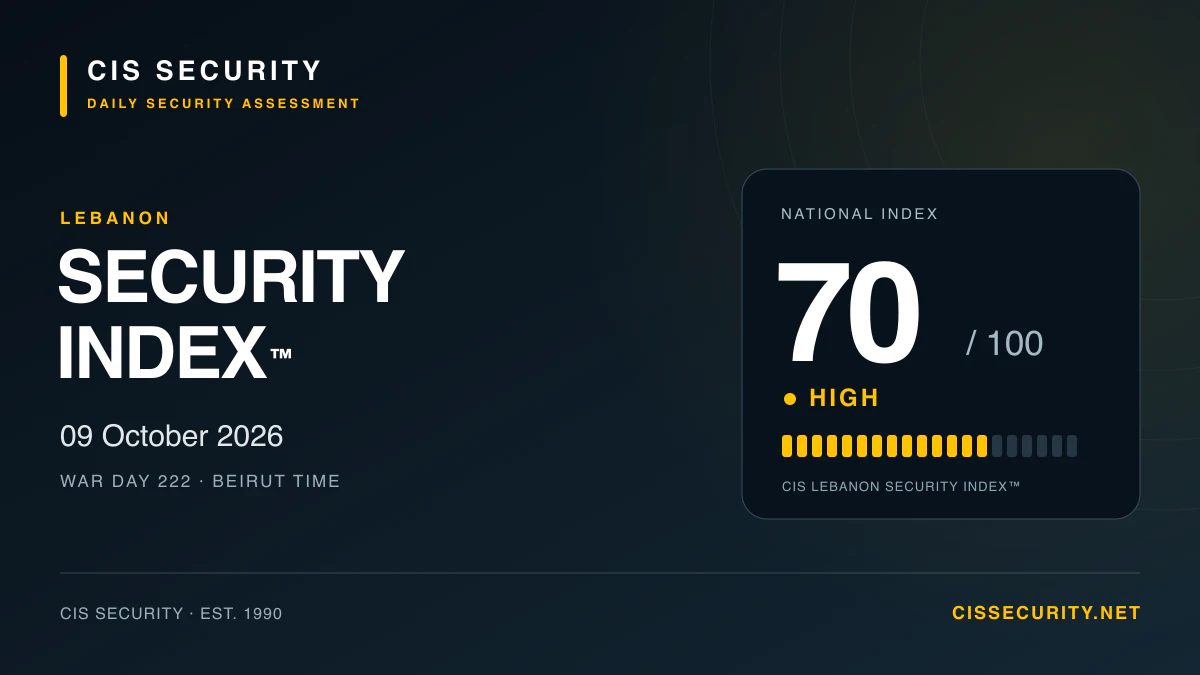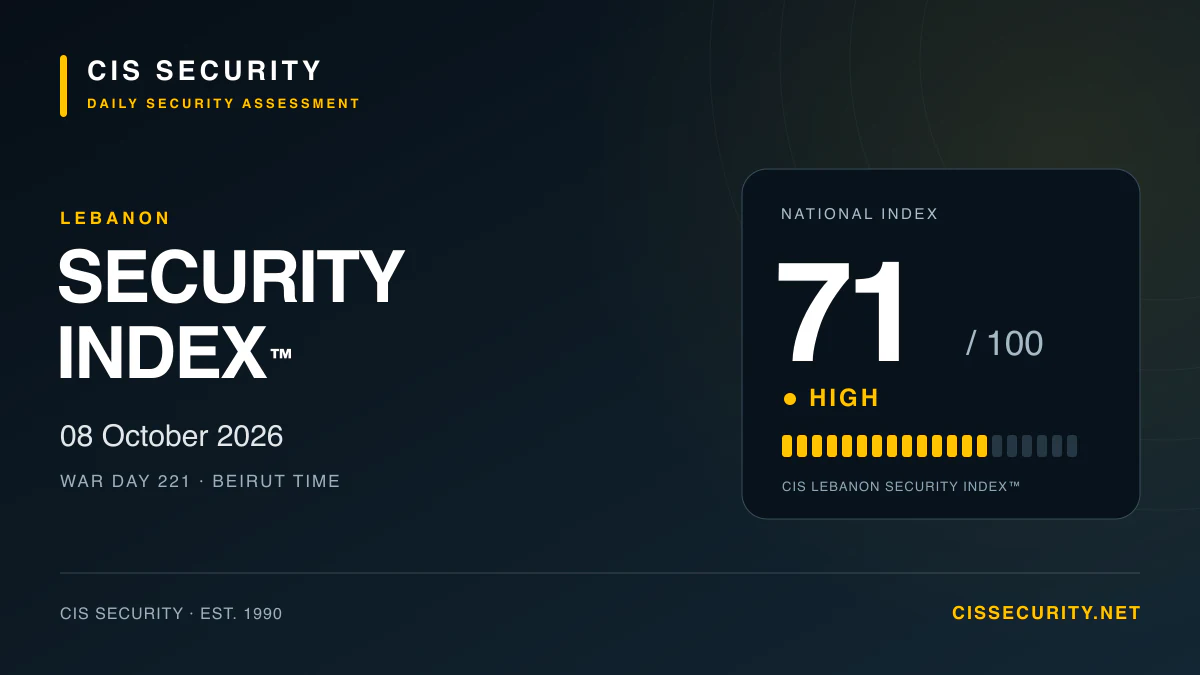
🇱🇧 CIS LEBANON SECURITY INDEX™
Friday, July 17, 2026
🔴 WAR DAY 138 | ROME TALKS CONCLUDE: PILOT-ZONE STRUCTURE AGREED (FROUN, GHANDOURIYEH, ZAWTAR) — BUT NO TIMETABLE | KATZ TELLS PENTAGON, HOURS LATER, ISRAEL STAYS "INDEFINITELY" IN LEBANON/SYRIA/GAZA ZONES | LEBANESE ARMY: "WE NEVER LEFT... THEY'RE NOT WITHDRAWING FROM ANYWHERE" | US HITS IRAN INFRASTRUCTURE FOR 6TH STRAIGHT NIGHT; IRAN STRIKES JORDAN BASE OVER HOSPITAL-AREA STRIKE | IRAN REPORTEDLY TELLS HOUTHIS TO CLOSE RED SEA IF US HITS POWER GRID
INDEX LEVEL: 🔴 CRITICAL — LEBANON PROCEDURAL PROGRESS OVERSHADOWED BY SEVERE, WIDENING REGIONAL WAR OVERALL INDEX: 88/100 TREND: ⬆️ RISING AGAIN — REGIONAL WAR ESCALATES INTO INFRASTRUCTURE STRIKES AND A CONCRETIZED RED SEA THREAT — The sixth round of Israel-Lebanon talks concluded in Rome on Wednesday, July 15, with both sides agreeing on the structure and guidelines for the pilot-zone process — for the first time, CIS can report the specific towns involved: Froun, Ghandouriyeh, and Zawtar. This is genuine, concrete progress compared to the vague "coming days" language CIS has tracked since last Thursday. However, no timetable was set, and the positive diplomatic signal was immediately complicated: hours after the Rome talks concluded, Defence Minister Katz told the Pentagon that Israeli forces will remain indefinitely in security zones across Lebanon, Syria, and Gaza. A Lebanese Armed Forces source, speaking to The National, was blunt about the practical reality on the ground: "We never left. We do regular patrols there... The Israelis say they will withdraw from the area, but in reality they're not withdrawing from anywhere. Why? Because they're not even there." Hezbollah, for its part, continues to categorically reject the entire framework agreement. Meanwhile, the broader regional war has escalated sharply: the US carried out a sixth consecutive night of strikes on Iran, this time hitting bridges, a railway station, an airport, and a communications tower, and collapsing a tower at a key Gulf of Oman port — a deliberate shift toward infrastructure targets following Trump's threat to strike Iranian power plants and bridges. Iran's Revolutionary Guards struck a US airbase in Jordan with ballistic missiles in retaliation for what it called a "barbaric" US strike near a children's cancer hospital outside Ahvaz. Most seriously for global trade, Iran has reportedly told the Houthi movement it should close the Red Sea gateway (the Bab el-Mandeb Strait) if the US strikes Iran's power grid — moving this risk from analyst speculation, as CIS reported Wednesday, to an actual reported Iranian directive. Iranian officials now say US strikes have killed dozens and wounded hundreds cumulatively. CIS assesses the regional war has entered its most dangerous phase yet, even as the Lebanon-specific track shows real, if incomplete, procedural movement.
⛔ EXECUTIVE SUMMARY — FRIDAY JULY 17, 2026 (WAR DAY 138)
ROME TALKS CONCLUDE: NAMED TOWNS, AGREED STRUCTURE, BUT STILL NO TIMETABLE
The sixth round of Israel-Lebanon talks concluded in Rome on Wednesday, July 15, after roughly seven hours of negotiations at the US Embassy the previous day. For the first time, CIS can report specifics: the two pilot zones are centered on the towns of Froun, Ghandouriyeh, and Zawtar, per Lebanese and Israeli officials. The US State Department described the talks as "productive," saying the parties "agreed on the structure and guidelines for the pilot zone process, to be finalized and implemented in the coming days." A separate Israeli official told the Jerusalem Post the talks "further reinforced that both countries were in agreement on the need to dismantle and disarm Hezbollah," and a US official said progress had been made on a plan that could see Israeli forces begin withdrawing from parts of southern Lebanon within days.
However, CIS emphasizes: no specific timetable was agreed, and Lebanese President Joseph Aoun had instructed his delegation ahead of the talks to demand "the immediate withdrawal of Israeli forces from the two pilot zones before any further discussions" — a demand that was evidently not met, since the talks proceeded on the basis of a phased structure rather than immediate withdrawal. Aoun is separately slated to visit Washington on July 21.
CIS assessment: This is genuine, incremental progress — specific towns and an agreed process structure represent more concrete information than CIS has had access to throughout this entire withdrawal saga. However, the gap between Lebanon's stated pre-talks demand (immediate withdrawal) and the actual outcome (a phased structure with no firm date) illustrates the pattern CIS has now observed repeatedly: procedural agreements accumulate, but the fundamental question of when Israeli forces actually leave remains unresolved.
HOURS LATER, KATZ TELLS PENTAGON: ISRAEL STAYS "INDEFINITELY"
Hours after the Rome talks concluded with their pilot-zone structure agreement, Israel's Defence Minister Katz told the Pentagon that Israeli forces will remain indefinitely in the broader security zones it has established across Lebanon, Syria, and Gaza — directly reaffirming the position CIS first reported from Katz on July 9, and consistent with Ambassador Leiter's July 13 framing that any pilot-zone withdrawal remains conditioned on Hezbollah's disarmament.
CIS assessment: The juxtaposition is stark and, CIS believes, deliberate: Israel is willing to agree to specific, limited, technically-structured withdrawals from small pilot areas (Froun, Ghandouriyeh, Zawtar) while simultaneously and explicitly reaffirming, at the highest defense-ministerial level, that the broader security-zone occupation across Lebanon will continue indefinitely. CIS advises interpreting any future pilot-zone withdrawal announcement as a narrow, specific, and limited development — not as evidence of a broader change in Israel's occupation posture in south Lebanon.
LEBANESE ARMY SOURCE: "THEY'RE NOT WITHDRAWING FROM ANYWHERE... BECAUSE THEY'RE NOT EVEN THERE"
In a notably candid comment to The National, a Lebanese Armed Forces security source undercut the entire framing of the "withdrawal" process: "We never left. We do regular patrols there. Yesterday we increased the number and frequency of the patrols. That's it," the source said. "The Israelis say they will withdraw from the area, but in reality they're not withdrawing from anywhere. Why? Because they're not even there."
The same source acknowledged the pilot zone areas are "not completely clear yet" of Hezbollah's presence or weapons — meaning even by Lebanon's own account, the underlying disarmament condition Israel has cited has not yet been fully satisfied. Separately, The National reports Israel has actually intensified attacks in the proposed pilot-zone area even as the diplomatic process moves forward — a pattern CIS has now observed repeatedly, where military operations and diplomatic talks proceed on separate, sometimes contradictory tracks.
CIS assessment: This is an important, deflationary counterpoint to the more optimistic diplomatic-track headlines. If accurate, the LAF source's account suggests the "pilot zone withdrawal" may be, in practical terms, a far less significant event than its diplomatic framing suggests — since Israeli forces may not have maintained a continuous physical presence inside these specific towns to begin with, making a formal "withdrawal" announcement somewhat symbolic. CIS treats this as a useful reality check but notes it comes from a single anonymous source and should not be treated as a comprehensive account of the entire pilot-zone dynamic.
HEZBOLLAH REJECTS THE FRAMEWORK ENTIRELY
Hezbollah continues to categorically reject the June 26 framework agreement, arguing it undermines Lebanese sovereignty and improperly links the end of Israel's military presence to the group's own disarmament. This ongoing rejection compounds the uncertainty around whether any pilot-zone process, even if formally implemented, can proceed smoothly given the framework's most directly affected party refuses to recognize its legitimacy.
US STRIKES IRAN FOR SIXTH STRAIGHT NIGHT — NOW TARGETING INFRASTRUCTURE
US Central Command carried out a sixth consecutive night of strikes on Iran, concluding at dawn Friday, this time explicitly targeting infrastructure: bridges, a railway station, an airport, and a communications tower in southern Iran, near the Strait of Hormuz, and collapsing a tower at a key port facility in the Gulf of Oman. Iranian state media reported three people killed in strikes on bridges in Hormozgan province. This follows through on President Trump's earlier threat to begin striking Iranian power plants and bridges if Tehran did not agree to negotiate — the White House says Trump remains "open to diplomacy" despite the shift toward infrastructure targets.
Iranian officials now say cumulative US strikes across this extended campaign have killed dozens of people and wounded hundreds, a marked increase from the "17 killed, 115 wounded" figure CIS reported as of Saturday.
CIS assessment: The deliberate shift toward infrastructure targets (bridges, airports, communications, power-adjacent facilities) represents an escalation in both the scale and the civilian-impact profile of the US campaign, moving beyond the military-installation-focused strikes CIS tracked in earlier rounds this week.
IRAN STRIKES US BASE IN JORDAN OVER STRIKE NEAR CHILDREN'S CANCER HOSPITAL
Iran's Revolutionary Guards said they struck a US airbase in Jordan with ballistic missiles in direct response to what they characterized as a US attack near a children's cancer hospital outside Ahvaz, in southwestern Iran. Iranian state media said the hospital was evacuated following US airstrikes in the area, which Foreign Ministry spokesman Esmaeil Baqaei called "barbaric." A 34-year-old teacher from Ahvaz, Hani, described the strikes to reporters: "Very intense... My hands are shaking. There were at least 11, 12 explosions."
CIS assessment: A strike in proximity to a children's hospital, regardless of the precise target and intent, represents a serious escalation in both the reality and the perception of civilian risk from this campaign, and gives Iran a specific, emotionally powerful justification for continued and expanded retaliation — including against additional third-country US bases, as seen with today's Jordan strike.
IRAN REPORTEDLY DIRECTS HOUTHIS TO CLOSE RED SEA GATEWAY IF US HITS POWER GRID
According to sources cited by regional wire reporting, Iran has told the Houthi movement in Yemen that it should close the Red Sea gateway — the Bab el-Mandeb Strait — if the US follows through on strikes against Iran's power network. This concretizes the risk CIS flagged Wednesday as an analyst assessment ("nuclear option") into what now appears to be an actual Iranian directive, or at minimum a specific contingency communicated to the Houthis.
CIS assessment: If this directive is acted upon, it would represent the most consequential single escalation of this conflict's economic dimension to date — extending the shipping crisis well beyond the Gulf and Strait of Hormuz into the Red Sea/Suez corridor that handles a substantial share of global east-west trade. CIS will monitor extremely closely for any sign of Houthi action against Red Sea shipping in the coming days, particularly if US strikes on Iran's power grid proceed as threatened.
📅 KEY TIMELINE — JULY 15–17
| Date | Event |
|---|---|
| July 15 | Trump reportedly being swayed by Arab leaders that Netanyahu is an obstacle to regional peace. Rome talks continue. Tehran billboard reads "We Kill Trump" with Trump-in-coffin imagery |
| July 16 | Rome talks conclude: pilot-zone structure agreed (Froun, Ghandouriyeh, Zawtar towns), no timetable. Katz tells Pentagon Israel stays indefinitely in Lebanon/Syria/Gaza zones. Lebanese Army source says IDF "not withdrawing from anywhere... not even there." Knesset votes to extend mandatory army service to 32 months. Tanker hit by unknown projectile near Khasab, Oman |
| July 17 (today) | US strikes Iran for 6th consecutive night — bridges, railway station, airport, communications tower hit; port tower collapsed. 3 killed in Hormozgan bridge strikes. Iran strikes US airbase in Jordan over strike near Ahvaz children's cancer hospital. Iran reportedly tells Houthis to close Red Sea gateway if US hits power grid. Knesset officially dissolved, elections confirmed for October 27. Herzog tells Saudi TV Israel wants normalization with Syria and Lebanon too |
🗺️ JULY 17 GOVERNORATE-BY-GOVERNORATE ASSESSMENT
| Governorate | Status | Detail |
|---|---|---|
| South Lebanon — Froun, Ghandouriyeh, Zawtar (named pilot zones) | 🟡 STRUCTURE AGREED, NO TIMETABLE; INTENSIFIED ATTACKS REPORTED | Do not assume any near-term change; per The National, Israeli attacks reportedly intensified here even amid talks |
| South Lebanon — all previously flagged high-risk zones | 🔴 CONTINUE PRIOR CLASSIFICATION | No change from prior days' guidance |
| South Lebanon (general) | 🔴 SEVERELY ELEVATED, INDEFINITE PRESENCE REAFFIRMED | Katz's Pentagon statement confirms no near-term broader withdrawal |
| Beqaa / Bekaa Valley | 🟠 ELEVATED | No new major strikes specifically reported today |
| South Beirut / Dahiyeh | 🟠 ELEVATED — POLITICAL TENSION | Monitor for reaction to Hezbollah's continued rejection of the framework and the Katz statement |
| Beirut (general) | 🟡 CALM BUT WATCHFUL | Aoun's July 21 Washington visit is the next key date to track |
| Mount Lebanon | ✅ CALM | Normal operations |
| North Lebanon | ✅ CALM | Normal operations |
| Akkar | ✅ CALM | Normal operations |
🚗 JULY 17 TRAVEL STATUS
| Zone | Status |
|---|---|
| Froun, Ghandouriyeh, Zawtar (named pilot zones) | 🔴 AVOID — reportedly intensified attacks even amid talks; no confirmed change on the ground |
| All previously flagged south Lebanon high-risk zones | 🔴 CONTINUE TO AVOID per prior guidance |
| Buffer zone (general) | ❌ ACTIVELY ENFORCED, INDEFINITE PER KATZ — do not approach |
| South Lebanon (general) | 🔴 HEIGHTENED CAUTION — continue minimizing non-essential travel |
| Bekaa Valley, Dahiyeh/South Beirut | 🟠 ELEVATED |
| Beirut (non-Dahiyeh), Mount Lebanon, North Lebanon, Akkar | ✅ Calm |
| Masnaa Border Crossing | ✅ OPEN |
| Rafic Hariri Airport | ✅ OPERATING |
| Strait of Hormuz | 🔴 SEVERE, 6 CONSECUTIVE NIGHTS OF STRIKES — avoid entirely |
| Bab el-Mandeb Strait / Red Sea approaches | 🔴 ELEVATED TO HIGH RISK — reported Iranian directive to Houthis; avoid |
| Jordan (bases), Iran (Ahvaz/Hormozgan/Qeshm areas) | 🔴 ACTIVELY STRUCK — avoid |
📊 JULY 17 STATISTICS — WAR DAY 138
| Metric | Figure | Source |
|---|---|---|
| Lebanon killed (cumulative, updated) | 4,324+ | Lebanese authorities, cited by HNGN/Rome talks coverage |
| Lebanon injured (cumulative, updated) | 12,221+ | Lebanese authorities |
| Named pilot zone towns | Froun, Ghandouriyeh, Zawtar | Lebanese/Israeli officials |
| Consecutive nights of US strikes on Iran | 6 | CENTCOM |
| Killed in July 17 Hormozgan bridge strikes | 3 | Iranian state TV |
| Cumulative Iranians killed/wounded (Iranian officials, updated) | "Dozens" killed, "hundreds" wounded | AP/wire reporting |
| Aoun's Washington visit | July 21, 2026 | Arkansas Democrat-Gazette |
| Total war duration | 138 days (since March 2) | CIS calculation |
🔑 KEY STATEMENTS — JULY 15–17, 2026
| Actor | Statement |
|---|---|
| US State Department | Rome talks "productive"; parties "agreed on the structure and guidelines for the pilot zone process, to be finalized and implemented in the coming days" |
| Defence Minister Katz (to Pentagon) | Israeli forces will remain indefinitely in security zones across Lebanon, Syria, and Gaza |
| Lebanese Armed Forces source (to The National) | "We never left... The Israelis say they will withdraw from the area, but in reality they're not withdrawing from anywhere. Why? Because they're not even there" |
| President Trump (on Syria) | Repeated proposal for Syria's al-Sharaa to send forces into Lebanon to "take care of" Hezbollah, saying al-Sharaa "would be more precise" than Israel |
| Iran FM spokesman Esmaeil Baqaei | US strike near Ahvaz children's cancer hospital was "barbaric" |
| Ahvaz resident Hani | "Very intense... My hands are shaking. There were at least 11, 12 explosions" |
| President Herzog (to Saudi TV) | Israel wants normalization with Syria and Lebanon too; respects Trump and Vance's efforts to curb Iran |
🛡️ CIS SECURITY — JULY 17 ASSESSMENT & GUIDANCE
Trusted Security Excellence Since 1990 | "Because Your Safety Isn't Optional"
CIS POSTURE: LEVEL 6 — CRITICAL ESCALATION ALERT (Maintained)
CIS maintains Level 6 — Critical Escalation Alert. Genuine, incremental Lebanon-specific procedural progress (named pilot-zone towns, an agreed structure) is real but does not offset the severity of the broader regional war, which has now escalated into deliberate infrastructure targeting and a reportedly concretized Iranian directive to the Houthis regarding the Red Sea. Katz's explicit "indefinite" statement to the Pentagon, delivered the same day as the Rome agreement, confirms CIS's continued assessment that no broad change in the south Lebanon security-zone occupation is imminent.
WHY TODAY'S DEVELOPMENTS MATTER FOR YOUR SAFETY
- The specific naming of the pilot-zone towns (Froun, Ghandouriyeh, Zawtar) gives CIS concrete locations to monitor for any actual, verified change in Israeli military presence — but reported intensified attacks in this same area, occurring simultaneously with the diplomatic progress, mean CIS cannot yet treat these towns as lower-risk.
- Katz's statement to the Pentagon — delivered the same day as the Rome agreement — should be read as the operative Israeli policy position: indefinite presence in the broader security zones, with the pilot-zone process treated as a narrow, separate, and limited exception.
- The Lebanese Army source's candid account, if accurate, suggests the pilot-zone "withdrawal" may prove to be a more symbolic than substantive event — CIS advises against over-interpreting any forthcoming announcement of pilot-zone withdrawal as evidence of a broader shift.
- The US shift toward deliberately targeting Iranian infrastructure (bridges, airports, power-adjacent facilities), combined with a strike near a children's hospital, indicates the broader war has entered a more civilian-impactful phase — this is directly relevant context for the overall regional risk environment even though it does not directly target Lebanon.
- A reported Iranian directive to the Houthis regarding Red Sea closure, if acted upon, would represent the most serious economic escalation of this conflict to date, extending risk well beyond the Gulf theater CIS has tracked most closely.
ZONE-BY-ZONE GUIDANCE — JULY 17
FROUN, GHANDOURIYEH, ZAWTAR (named pilot zones): Avoid — reportedly intensified attacks even amid diplomatic progress; do not assume any change until independently verified.
ALL PREVIOUSLY FLAGGED SOUTH LEBANON HIGH-RISK ZONES: Continue to avoid per prior guidance.
ALL OF SOUTH LEBANON: Continue minimizing non-essential travel; Katz's "indefinite" statement confirms the current posture as the durable baseline.
DAHIYEH, BEKAA VALLEY: Maintain elevated caution.
BEIRUT (general), MOUNT LEBANON, NORTH LEBANON, AKKAR: Calm, normal operations continue.
WHAT CIS IS WATCHING — THE WEEK AHEAD
- Does the pilot-zone withdrawal from Froun, Ghandouriyeh, and Zawtar actually occur and get independently verified, or does it remain a procedural agreement without on-the-ground implementation?
- Does President Aoun's July 21 Washington visit produce any further movement on the broader withdrawal question, particularly given Katz's same-week "indefinite" statement?
- Does Iran's reported Houthi directive translate into actual Red Sea shipping attacks, particularly if the US proceeds with strikes on Iran's power grid?
- Does the US continue its infrastructure-targeting campaign against Iran, and does this produce further retaliatory strikes against third-country US bases (following today's Jordan strike)?
- Does Trump's repeated proposal for Syria to intervene against Hezbollah in Lebanon gain any traction, given al-Sharaa's public reluctance to date?
📞 EMERGENCY CONTACTS — JULY 17, 2026
CIS Security 24/7: +961 3 539900 | info@cissecurity.net | www.cissecurity.net Lebanese Army South Lebanon Liaison: +961-8-802-510 US Embassy Emergency: +1-202-501-4444 | BeirutACS@state.gov Lebanese Red Cross: 1760 Civil Defence: 125 ISF: 112 National Mental Health Lifeline: 1564 (24/7 — confidential)
⚠️ FINAL ASSESSMENT — WAR DAY 138, JULY 17, 2026
This week's Lebanon-specific story is one of genuine but limited progress, deliberately bounded by Israel's simultaneous reaffirmation of indefinite presence elsewhere — while the broader regional war has grown more dangerous still.
The conclusion of the sixth round of Rome talks, with an agreed structure and named towns (Froun, Ghandouriyeh, Zawtar) for the pilot-zone process, represents real, concrete progress compared to the vaguer assurances CIS has tracked since last Thursday. But the timing of Defence Minister Katz's statement to the Pentagon — delivered the very same day, confirming indefinite Israeli presence across the broader security zones in Lebanon, Syria, and Gaza — makes clear that Israel intends this pilot process to remain narrow and separate from any broader change in posture. A Lebanese Armed Forces source's blunt characterization — that Israeli forces may not have had a continuous presence in these specific towns to begin with, making any "withdrawal" announcement more symbolic than substantive — adds a further note of caution to how CIS interprets whatever comes next from this process.
Against this backdrop, the broader US-Iran war has entered its most dangerous and geographically consequential phase yet. Six consecutive nights of US strikes have now shifted toward deliberate infrastructure targets — bridges, an airport, a communications tower, and port facilities — with Iranian officials reporting a strike near a children's cancer hospital outside Ahvaz that has triggered further Iranian retaliation, including a missile strike on a US base in Jordan. Most seriously, reports that Iran has directed the Houthi movement to close the Red Sea gateway if US strikes proceed against Iran's power grid would, if acted upon, extend this conflict's economic and security impact far beyond anything CIS has tracked to date.
CIS maintains Level 6 — Critical Escalation Alert and will watch closely for verified implementation of the pilot-zone withdrawal, President Aoun's July 21 Washington visit, and any sign of Houthi action against Red Sea shipping in the days ahead.
+961 3 539900 | info@cissecurity.net | cissecurity.net CIS Security — Because Your Safety Isn't Optional — Est. 1990
CIS Lebanon Security Index™ | Friday, July 17, 2026 | WAR DAY 138 Sources: Times of Israel, "Sixth round of Israel-Lebanon talks begins in Rome, with focus on IDF pullout 'pilot'" (July 14-15, 2026); HNGN, "Lebanon-Israel Reach Rome Withdrawal Deal As Israel Vows To Stay In Broader 'Security Zones'" (July 16, 2026 — Katz Pentagon statement, updated casualty figures 4,324/12,221, Hezbollah rejection); Haaretz, "Israel agrees to withdraw IDF from two Lebanon pilot zones, U.S. official says" (July 15, 2026); Arkansas Democrat-Gazette, "Lebanon, Israel to establish 'pilot zones'" (July 16, 2026 — Froun/Ghandouriyeh/Zawtar town names, Aoun July 21 DC visit, Trump al-Sharaa proposal); The National, "'We never left': Lebanese army says it already patrols pilot zone as talks with Israel move forward" (July 16, 2026); Jerusalem Post, "Israel-Lebanon talks conclude in Rome, pilot zones agreed, IDF may begin withdrawal in days" (July 15-16, 2026); SocialNews.XYZ/Xinhua, "Israel, Lebanon conclude Rome talks, move closer to launching 'pilot zones'" (July 16, 2026); ARY News, "US hits Iran infrastructure" (July 17, 2026 — bridges, railway station, airport strikes; Hormozgan casualties; Jordan base strike over Ahvaz hospital; Baqaei "barbaric" quote; Hani eyewitness quote; Houthi Red Sea directive); WSLS/AP, "US strikes bridges and collapses a tower at a key port as its Iran campaign expands" (July 17, 2026 — cumulative "dozens killed, hundreds wounded"); Sunday Guardian Live, "US Launches Sixth Wave of Airstrikes on Southern Iran" (July 17, 2026); Times of Israel liveblog July 16-17, 2026 (Knesset dissolution, Herzog Saudi TV interview); UN Security Council Report, "Lebanon, July 2026 Monthly Forecast" (background OCHA figures). All Lebanon casualty figures from Lebanese Ministry of Public Health, National News Agency, and wire service tracking. All diplomatic and military statements from named officials or sourced reporting, primarily Times of Israel, Jerusalem Post, The National, Axios-derived coverage, and AP/wire service reporting July 15–17, 2026. Index compiled: Friday, July 17, 2026 — Beirut time.