🇱🇧 CIS LEBANON SECURITY INDEX™
Saturday, September 12, 2026
🟠 WAR DAY 195 | ROME TALKS PUSHED BACK A FULL MONTH TO OCTOBER — U.S. CITES SCHEDULING CONFLICTS, LEBANON CITES ISRAELI STRIKES | PRESIDENT AOUN MAKES HIS FIRST WARTIME VISIT TO NABATIEH, DECLARES "NO NEW NEGOTIATIONS WITH ISRAEL AT PRESENT" | AL JAZEERA: DEMOLITIONS CONTINUE ACROSS THE SOUTH AS ISRAEL "EXPANDS OCCUPATION BEYOND MILITARY BOUNDARY"
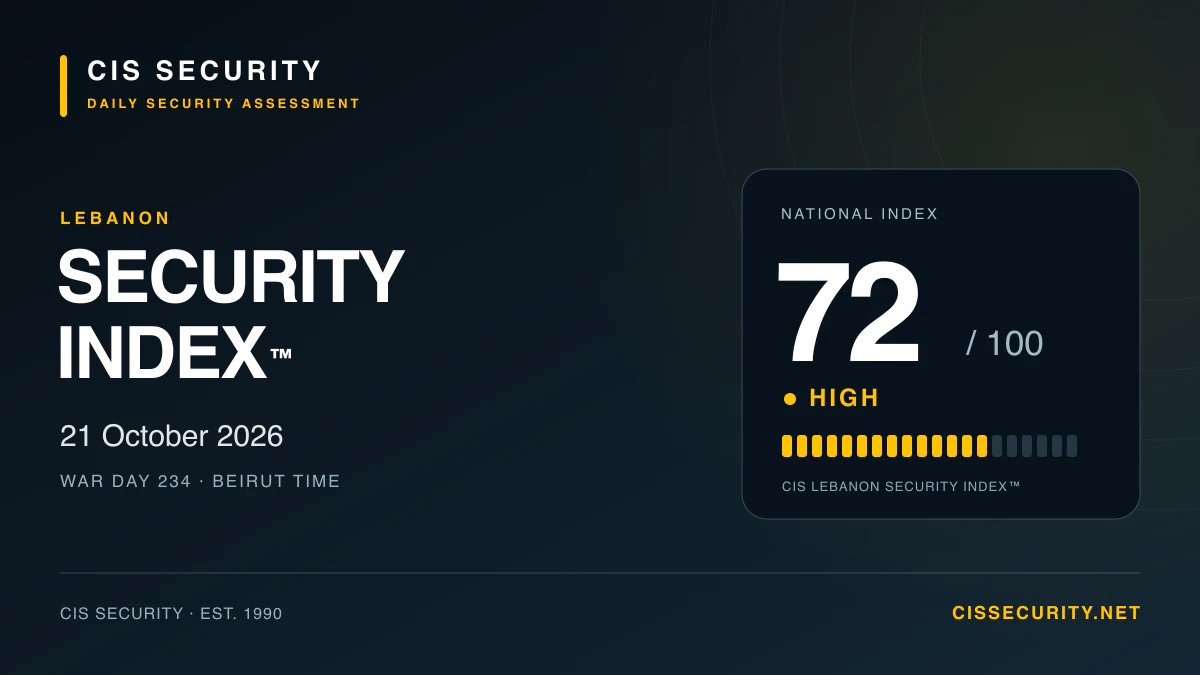
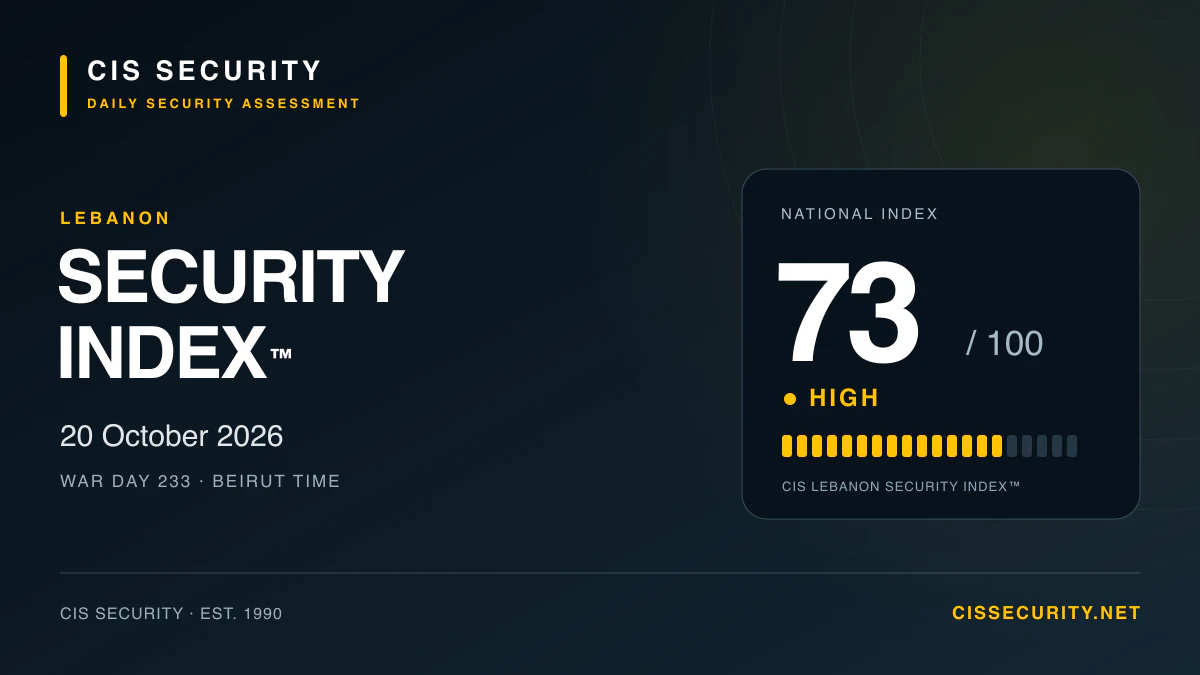
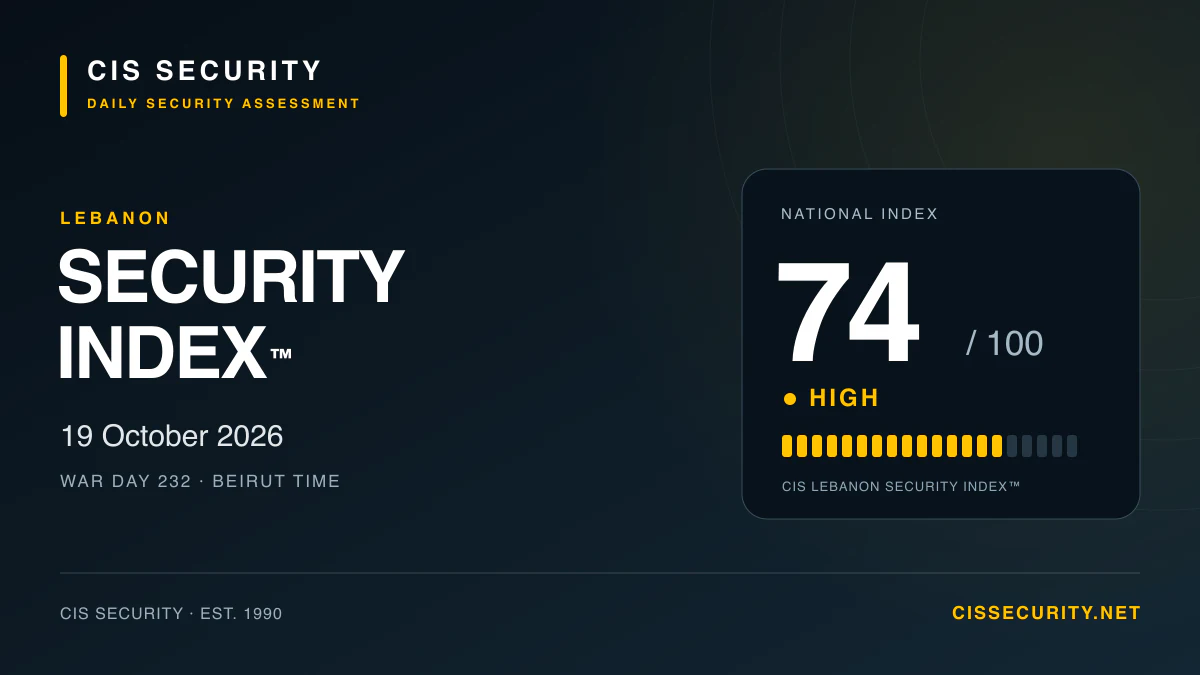
INDEX LEVEL: 🟠 HIGH — THE MILITARY PICTURE IS UNCHANGED, BUT THE DIPLOMATIC TRACK JUST LOST A MONTH OVERALL INDEX: 77/100 TREND: ↗️ WORSENING (DIPLOMATICALLY) — CIS nudges its Index score up today, not because of a new mass-casualty incident, but because the primary mechanism for de-escalating this conflict has just been pushed back by a full month. A U.S. diplomatic official confirmed Friday that the next round of US-brokered Israel-Lebanon talks, originally set for Rome next week — what would have been the eighth round of direct negotiations since April — has been postponed to October. The official reasons cited: the Jewish holiday period, the UN General Assembly later this month, and a Paris conference in support of the Lebanese Armed Forces. In place of the Rome round, Israeli and Lebanese ambassadors are expected to meet at the US State Department in Washington next week to discuss implementation of the June 26 framework agreement, though a source familiar with the matter also pointed to UN General Assembly scheduling constraints. Israel separately attributed the delay to scheduling difficulties and reiterated its position that the Lebanese Armed Forces are not yet capable of dismantling Hezbollah's military infrastructure; Lebanon, for its part, accuses Israeli forces of indiscriminate strikes that undermine Beirut's own disarmament efforts. Against this backdrop, President Joseph Aoun made an unannounced visit Saturday to Nabatieh — his first trip to the south since the war began in March — declaring plainly that "there are no new negotiations with Israel at present." Al Jazeera separately reported continued Israeli demolitions across southern villages Saturday, framing the pattern as Israel "expanding" rather than reducing its occupation footprint. CIS raises its Index modestly to reflect the diplomatic setback and the absence of any sign of Israeli forces reducing their footprint, while noting that today's reporting does not include a new mass-casualty strike on the scale of the Kfar Rumman or Nabatieh incidents earlier this month.
⛔ EXECUTIVE SUMMARY — SATURDAY SEPTEMBER 12, 2026 (WAR DAY 195)
THE ROME ROUND IS OFF — FOR A MONTH, AT LEAST
Axios first reported, and Reuters, AFP, and RTÉ subsequently confirmed via the same US diplomatic source, that the round of Israel-Lebanon talks scheduled for Rome next week has been postponed until October, with no specific October date yet announced. The US State Department is expected instead to host the two countries' ambassadors in Washington next week for consultations on implementing the framework agreement signed June 26, 2026 — which sets out Hezbollah's disarmament and a phased Israeli withdrawal from designated "pilot areas." A US official described the framework as "the only practical mechanism for restoring Lebanon's sovereignty and Israel's security."
CIS assessment: A one-month delay to the eighth round of a process that has already produced seven rounds without a breakthrough is a meaningful setback, particularly arriving in the same week as the most dramatic single Israeli military action of the entire cycle (Thursday's Ali al-Taher tunnel demolition). CIS treats the officially cited scheduling reasons (holidays, UNGA, a Paris conference) as plausible on their own terms, while noting — as reported separately by Al Jazeera in recent weeks, citing a Lebanese source — that some in Beirut view the timing as convenient for Israel, which faces its own October legislative elections and has been described by that source as seeking to "buy time" on pilot-zone implementation. CIS presents this as a contested characterization rather than a CIS finding.
AOUN GOES TO NABATIEH: "NO NEW NEGOTIATIONS WITH ISRAEL AT PRESENT"
President Aoun arrived unannounced in Nabatieh on Saturday, accompanied by army commander Rodolphe Haykal and the heads of Lebanon's security agencies — his first visit to southern Lebanon since fighting broke out in March. He toured Nabatieh's government headquarters, inspecting damage from the airstrikes CIS has documented extensively this month, and praised staff at Nabatieh Governmental Hospital for continuing to provide care in an area most residents have fled. Speaking to reporters, Aoun said: "There are no new negotiations with Israel at present," and separately stated that "the withdrawal of Israel, the return of prisoners and displaced people, as well as reconstruction, are national constants that the state is committed to implementing." To residents who greeted him, he said: "We stand by your side, and we are looking into how to provide all the necessary services so that you can remain here safely." The visit followed a September 9 security meeting Aoun chaired at Baabda Palace specifically on conditions in Nabatieh, after which Lebanon increased its army deployment to the area; some residents have been calling on the army to further boost its presence there to deter a possible Israeli ground offensive.
CIS assessment: This is a significant symbolic and political development on top of the Rome postponement. A sitting president's first visit to an active-strike area, six months into the conflict, timed the same week as the Rome delay and the Ali al-Taher demolition, reads to CIS as a deliberate signal of state re-engagement with the south — both reassurance to residents and a public marker of the government's negotiating position (no concessions absent Israeli withdrawal) ahead of whatever October round eventually convenes.
AL JAZEERA: DEMOLITIONS CONTINUE, OCCUPATION "EXPANDS" RATHER THAN SHRINKS
Al Jazeera reported Saturday that Israeli forces continued to strike and demolish buildings across southern Lebanon even as the Rome round was being postponed, running a segment titled "Conflict in southern Lebanon: Israeli expands occupation beyond military boundary." This is consistent with reporting Al Jazeera and other outlets have carried through the month: Israel continues to occupy dozens of villages inside a self-declared "security zone" covering roughly 7 percent of Lebanese territory, and International Crisis Group analyst David Wood has told Al Jazeera that Israel "has recently expanded — rather than reduced — its occupation of Lebanese territory," even as it pays "lip service" to the pilot-zones framework meant to enable a phased withdrawal.
CIS assessment: The core structural disagreement underlying the stalled talks, as described to Al Jazeera by Atlantic Council analyst Nicholas Blanford, is that Lebanon wants pilot zones established precisely where Israeli forces are currently operating (so Israel can withdraw from them), while Israel prefers pilot zones in areas it is not currently occupying — meaning implementation of the scheme, even where nominally agreed, does little to shrink Israel's actual footprint. CIS regards this as the single most important structural fact explaining why seven rounds of talks have not produced a durable de-escalation, and sees no indication in today's reporting that an eighth round — whenever it occurs — would resolve it.
CONTEXT: WHAT AN EIGHTH ROUND WOULD BUILD ON
Israel and Lebanon have held seven rounds of direct, US-mediated negotiations since April — five in Washington, two in Rome — under the framework signed June 26. A senior Lebanese official told Israeli outlets Ynet and Yedioth Ahronoth this week that Lebanon needs direct Israeli cooperation to make progress on Hezbollah's disarmament: "It is clear to us that only you can do the job, but do it properly. You need to declare that when Hezbollah is disarmed, Israel will withdraw completely. Then peace between the countries will be possible."
CIS assessment: This quote, read alongside Aoun's Saturday statement, suggests Lebanon's negotiating position has hardened somewhat rather than softened in the aftermath of this month's escalation — explicitly demanding an Israeli withdrawal commitment as a precondition rather than treating disarmament and withdrawal as simultaneous or Israel-contingent steps to be worked out later.
📅 KEY TIMELINE — SEPTEMBER 10–12
| Date | Event |
|---|---|
| Sep 10 (Thu, evening) | IDF destroys Ali Taher tunnel network; Netanyahu/Katz declare "operational control... above and below ground" |
| Sep 11 (Fri) | US diplomatic official confirms Rome talks, set for next week, postponed to October |
| Sep 11 (Fri) | Israel attributes delay to scheduling difficulties; Lebanon blames indiscriminate strikes for undermining disarmament efforts |
| Sep 12 (Sat) | President Aoun makes unannounced first wartime visit to Nabatieh; declares no new talks with Israel "at present" |
| Sep 12 (Sat) | Al Jazeera reports continued demolitions across southern villages; frames pattern as expanding, not shrinking, occupation |
🗺️ GOVERNORATE-LEVEL SECURITY STATUS
| Governorate | Status |
|---|---|
| Nabatieh | 🟠 HIGH — most residents have fled the city; presidential visit and increased army deployment reflect sustained state concern |
| South Lebanon (broader) | 🟠 HIGH — continued demolitions reported Saturday; Israel occupies dozens of villages inside its self-declared security zone |
| Beirut | 🟡 MEDIUM — no direct incident reported; political/diplomatic activity centered here and in Washington |
| Mount Lebanon, Keserwan-Jbeil, North Lebanon, Akkar, Beqaa Valley, Baalbek-Hermel | 🟢 LOW — no CIS-identified incidents for today's reporting window |
| Rafic Hariri Airport | ✅ Operating |
| Strait of Hormuz / Gulf of Oman | 🟠 HIGH — Iran's planned "restricted zone" declaration remains pending as of this edition |
📊 SEPTEMBER 12 STATISTICS — WAR DAY 195
| Metric | Figure | Source |
|---|---|---|
| Rome talks delay | Postponed from "next week" to October (~1 month) | US diplomatic official, via Axios/Reuters/AFP/RTÉ |
| Direct Israel-Lebanon negotiation rounds held since April | 7 (5 in Washington, 2 in Rome) | Times of Israel / Anadolu |
| Israeli-declared "security zone" footprint | ~7% of Lebanese territory | The National |
| Aoun's last visit to south Lebanon before today | None since the war began in March 2026 | AFP, via multiple outlets |
| Cumulative Lebanon toll since March 2, 2026 | 4,362 killed, 12,378 injured, 1M+ displaced (unchanged from Sep 11 edition; no updated official figure reported today) | Lebanese authorities, carried forward |
| War duration | 195 days (conflict-day anchor 2026-03-02, inclusive count) | CIS calculation |
| Truce-day count | 85 days since the June 20 truce anchor | CIS calculation |
🔑 KEY STATEMENTS
| Actor | Statement (paraphrased/summarized) |
|---|---|
| President Joseph Aoun (Nabatieh) | "There are no new negotiations with Israel at present"; called Israeli withdrawal, prisoner/displaced return, and reconstruction "national constants" Lebanon is committed to |
| US diplomatic official (on Rome postponement) | Cited scheduling conflicts — Jewish holidays, UN General Assembly, a Paris conference supporting the LAF — as reasons for the October delay |
| Israel (on the delay) | Attributed postponement to scheduling difficulties; maintains the Lebanese Armed Forces are not yet capable of dismantling Hezbollah's infrastructure |
| Lebanon (on the delay) | Accuses Israeli forces of indiscriminate strikes that undermine Beirut's disarmament efforts |
| Senior Lebanese official (to Ynet/Yedioth Ahronoth) | Said Lebanon needs Israel to commit that "when Hezbollah is disarmed, Israel will withdraw completely" |
| ICG analyst David Wood (to Al Jazeera) | Said Israel has "expanded — rather than reduced" its occupation of Lebanese territory despite the pilot-zones framework |
🛡️ CIS SECURITY — SEPTEMBER 12 ASSESSMENT & GUIDANCE
CIS POSTURE: LEVEL 5 — SEVERE ALERT (Maintained)
CIS maintains Level 5 — Severe Alert. Today's developments are not primarily about new casualties — CIS has no confirmed new mass-casualty incident to report for today — but the month-long delay to formal talks, combined with continued reported demolitions and no sign of Israeli forces reducing their footprint, removes the modest optimism CIS expressed in yesterday's edition regarding a dated diplomatic path forward. President Aoun's visit to Nabatieh is a positive signal of state engagement but does not, on its own, change the security picture on the ground.
What CIS is watching: The Washington ambassadors' meeting next week, and whether it produces any implementation progress that could substitute for the delayed Rome round; whether the structural disagreement over pilot-zone locations (Lebanon wants them where Israel operates; Israel wants them where it doesn't) shows any sign of narrowing; whether Hezbollah, still silent on the Ali al-Taher tunnel demolition, responds to this week's developments in any form; and whether Israel's October legislative election timeline continues to shape its posture on the broader negotiating calendar.
📞 EMERGENCY CONTACTS
CIS Security 24/7 (for active clients): +961 3 539900 | info@cissecurity.net Lebanese Army South Lebanon Liaison: +961-8-802-510 US Embassy Emergency: +1-202-501-4444 Lebanese Red Cross: 1760 | Civil Defence: 125 | ISF: 112 National Mental Health Lifeline: 1564
⚠️ FINAL ASSESSMENT — WAR DAY 195, SEPTEMBER 12, 2026
Today's edition marks a shift in what is driving CIS's risk assessment. For most of September, the Index has moved primarily in response to casualty counts — strikes, funerals, running tolls. Today's developments are diplomatic and political rather than kinetic, and CIS judges them serious enough to raise its score regardless: the eighth round of Israel-Lebanon talks, already delayed through seven inconclusive prior rounds, has now lost a full month, arriving in the same week Israel declared "operational control" over Ali al-Taher "above and below ground" and days after a wave of strikes killed at least 29 people in the Nabatieh region. President Aoun's decision to make his first wartime visit to the south now, and to state plainly that no new talks are underway, reads as Lebanon signaling it will not treat the current military reality as grounds for renewed concessions.
The structural problem CIS has now heard described independently by two separate analysts — Lebanon wants pilot zones where Israel operates, Israel wants them where it doesn't — is, in CIS's assessment, the actual reason this conflict has proven so difficult to wind down through the negotiating track, and nothing in today's reporting suggests an October round will resolve it. Al Jazeera's framing of continued Israeli demolitions as an expansion rather than a reduction of the occupation footprint is consistent with that structural read.
CIS maintains Level 5 — Severe Alert and raises its Index modestly to 77/100, reflecting a diplomatic setback layered on top of an already-fragile security situation, even in the absence of a new single mass-casualty event to report today.
The CIS Lebanon Security Index™ is an informational professional assessment. It is not a guarantee of safety and not a substitute for official government guidance. In emergencies, follow official emergency services. CIS accepts no liability for decisions made solely on Index readings.
+961 3 539900 | info@cissecurity.net | cissecurity.net CIS Security — Because Your Safety Isn't Optional — Est. 1990
CIS Lebanon Security Index™ | Saturday, September 12, 2026 | WAR DAY 195 Sources: Wanted in Rome/AFP, "Israel-Lebanon Talks in Rome Pushed Back to October" (Sep 12, 2026); Ynetnews/AFP, "Israel-Lebanon talks in Rome postponed to October as diplomatic calendar fills up" (Sep 12, 2026); Anadolu Agency, "New round of Israel-Lebanon talks moved to Washington; Rome round pushed back to October: Axios" (Sep 12, 2026); Times of Israel liveblog, September 12, 2026; AFP via Free Malaysia Today / EWN / Washington Times, "Lebanon's president pledges Israeli withdrawal on visit to south" (Sep 12, 2026); Al Jazeera, "Israel-Lebanon talks postponed as explosions rock southern Lebanon" (Sep 12, 2026); Al Jazeera, "In southern Lebanon, Israeli demolitions continue 'day and night'" (Sep 4, 2026) and "Claimed Israeli capture of Lebanese ridge reshapes negotiation dynamics" (Sep 7, 2026); prior CIS reporting (September 5–11, 2026) carried forward for context.
CIS presents the allegation that Israel is delaying talks for domestic electoral reasons as a contested characterization sourced to a Lebanese official cited by Al Jazeera, not as a CIS finding; the officially stated reasons for the delay (holidays, UNGA, a Paris conference) are reported alongside it without CIS adjudicating between them. No updated cumulative casualty figure was reported today; the March 2 running total is carried forward from Friday's edition. All military, diplomatic, and political statements are attributed to named officials, spokespersons, or sourced reporting. Index compiled: Saturday, September 12, 2026 — Beirut time.