🛡️ CIS LEBANON SECURITY INDEX™
Sunday, August 23, 2026
Conflict Day 175 · Truce Day 64 · Methodology v3.0 · Coding Manual v3.1
OVERALL INDEX: 61/100
TREND: ⬇️ EASING AS THE 15 AUGUST LOAD DECAYS OUT — The national alert level reads 61/100 HIGH, set by Nabatieh and sitting at the very bottom edge of the HIGH band. 15 August, the deadliest day since the truce, has now fully exited the seven-day window, while yesterday's published score is revised upward from 64 to 73 after further reporting surfaced eight additional incidents. Confidence has fallen to LOW because the remaining picture rests on thinner, less-confirmed activity — treat this easing as arithmetic, not as safety.
TIER 1 — PUBLIC EDITION
🟠 NATIONAL ALERT LEVEL: 61/100 — HIGH
Driven by: Nabatieh · Trend: ⬇️ (revised basis — see note) · Confidence: LOW ⬇️ Spread: 0 CRITICAL · 1 HIGH · 6 LOW · 2 MINIMAL
Governorate Readings
| Governorate | Score | Level | Confidence |
|---|---|---|---|
| Nabatieh | 61 | 🟠 HIGH | LOW |
| South Lebanon | 38 | 🟢 LOW | LOW |
| Baalbek-Hermel | 24 | 🟢 LOW | LOW |
| Beqaa Valley | 22 | 🟢 LOW | LOW |
| Mount Lebanon | 22 | 🟢 LOW | LOW |
| Beirut | 20 | ⚪ MINIMAL | LOW |
| Akkar | 20 | ⚪ MINIMAL | LOW |
| North Lebanon | 18 | ⚪ MINIMAL | LOW |
| Keserwan-Jbeil | 16 | ⚪ MINIMAL | LOW |
> ⚠️ Three things changed at once today — read all three before drawing a conclusion. First: 15 August, the deadliest day since the truce, has fully exited CIS's seven-day window for the first time — a genuine milestone. Second: yesterday's published score (64) is revised upward to 73 after further reporting surfaced eight incidents CIS did not have at the time. Third: Nabatieh's score today, 61, sits at the very bottom edge of the HIGH band — one point of further decay would cross it into MEDIUM. Confidence has also fallen to LOW, and South Lebanon has crossed into the LOW band. None of this means conditions are safe. It means CIS's most heavily-weighted single day of the war is gone from the calculation, and what remains is a thinner, less-confirmed picture of ongoing activity.
Overnight strikes at Ali al-Taher and Kfar Rouman; yesterday revised sharply upward
- Israeli forces struck the Ali al-Taher ridge and the Kfar Rouman area again overnight, Lebanese media reported. No further detail was available at compilation time.
- Fuller reporting on Saturday's (22 August) activity — nine locations including Ali al-Taher, Dawhat Kfar Remman, Dabsha hill, the Sirbin–Rshaf area, and a demolition at Tallouseh in Marjayoun district — was not available when yesterday's edition published. Nabatieh's score for 22 August is revised from 64 to 73.
- With the 15 August load now fully decayed out of the calculation, today's reading depends much more heavily on recent, thinly-sourced activity — which is why confidence has fallen to LOW even though every day in the window is now covered.
🚦 Zone Guidance
| Area | Guidance |
|---|---|
| Ali al-Taher hill · Kfar Rouman · Dawhat Kfar Remman · Dabsha hill | Avoid entirely — struck again overnight |
| Sirbin · Rshaf · Tallouseh (Marjayoun district) | Avoid — struck 22 August |
| Israeli-controlled security zone (approx. 10 km deep) | Do not approach under any circumstances |
| Nabatieh district — Ansar, Deir al-Zahrani, Kfar Rouman, Harouf, Habboush | Avoid |
| Bint Jbeil district | Avoid |
| Tyre district — routes south of Sidon | Avoid non-essential travel |
| Sidon and the coastal route | Passable — expect continued congestion |
| Dahiyeh · Bekaa Valley | Elevated caution |
| Beirut · Mount Lebanon · North Lebanon · Akkar · Keserwan-Jbeil | Normal operations; maintain situational awareness |
If you are in or near an affected area
- Do not travel into Nabatieh, Bint Jbeil or Marjayoun districts.
- Do not treat today's lower reading as a signal to relax — CIS has revised each of the past four editions upward within one to three days of first publication.
- Keep phones charged and agree a family check-in time and a meeting point.
- Identify the lowest interior room in your building, away from windows and glazing.
- Keep identity documents, medication and cash together and ready to move at short notice.
- Verify any casualty or threat claim through official channels before acting.
- Follow Civil Defence (125) and Lebanese Red Cross (1760) in preference to social media.
📞 Emergency Contacts
- CIS Security emergency line (active clients): +961 3 539900 — 24/7/365
- CIS general enquiries: +961 3 539900 · info@cissecurity.net · Monday–Friday, 8:00 AM–6:00 PM
- Civil Defence: 125 · Lebanese Red Cross: 1760 · Internal Security Forces: 112
- Lebanese Army — South Lebanon Liaison: +961-8-802-510
- National Mental Health Lifeline: 1564 — free, confidential, 24/7
- US Embassy emergency (overseas citizens services): +1-202-501-4444 · BeirutACS@state.gov
> ⚠️ Responsible-use disclaimer > The CIS Lebanon Security Index™ is a professional situational assessment published as a free public service. It is informational — it is not a guarantee of safety and not a substitute for official government guidance. CIS Security accepts no liability for decisions made solely on Index readings. In an emergency, contact official emergency services. > Methodology: cissecurity.net/lebanon-security-index/#methodology · Corrections: cissecurity.net/lebanon-security-index/#corrections
Need security cover for a property or site? → https://app.cissecurity.net/request Get the Index in your inbox daily, 8:15 AM → cissecurity.net/lebanon-security-index/
CIS Security — Because Your Safety Isn't Optional — Since 1990
TIER 2 — ANALYST EDITION
⚠️ Revision Notice — REV-2026-007
22 August 2026 · Nabatieh · Published 64 · Revised 73.
The 22 August edition coded zero incidents for that night, on the sourcing available at 08:00. Fuller reporting located subsequently — attributed to Lebanon's National News Agency — established nine incidents: two airstrikes on Ali al-Taher hill, phosphorus-shell artillery on the outskirts of Dawhat Kfar Remman, on Dabsha hill, and in the Ali al-Taher wooded area, two further airstrikes between Sirbin and Rshaf, a drone strike targeting a shepherd in the Sirbin Valley (no injuries reported), and a demolition at Tallouseh in Marjayoun district. All are single-sourced to one report and coded Reported.
Nabatieh's 22 August score revises from 64 to 73. This is the fourth consecutive edition to require a same-pattern revision — 19, 20, 21, and now 22 August have all been revised upward after publication, in every case because same-morning sourcing had not yet caught up with the full scope of the preceding night's activity. CIS is now treating this as a structural pattern rather than a series of isolated gaps — see §2.
The original 64 remains permanently in the archive alongside the revised 73. Logged as REV-2026-007 at cissecurity.net/lebanon-security-index/#corrections. Because 22 August sits inside today's decay window, this revision is already incorporated into today's scoring below — there is no further cascade beyond today, since 22 August had not yet been referenced by any other published edition.
Milestone — 15 August Has Fully Exited the Seven-Day Window
For the first time since the methodology launched, 15 August — the deadliest day since the June truce, and the single largest contributor to every score published so far — no longer contributes at any weight to today's calculation.
CIS assessment. This is a genuine structural milestone, not merely a numeric one. Every score CIS has published to date has been substantially shaped by that one day. Today's scores are the first to reflect only the preceding seven days on their own terms — 16 through 22 August. This makes today's reading, in one sense, the methodology's first real test: does the Index now settle into a level that reflects ongoing conditions, or does it continue moving sharply as each day's sourcing is revised after the fact? The answer so far, per REV-2026-007 above, is the latter — 22 August was itself understated by more than the 15 August legacy ever was on any single day this week.
Confidence Falls to LOW — And the Reason Matters
Confidence for both Nabatieh and South Lebanon falls from MODERATE to LOW today, despite the seven-day window remaining fully covered with no coding gaps.
This is the reported-share trigger, not the coverage trigger, and CIS flagged this exact risk in yesterday's internal notes. With 15 August — which was heavily Confirmed — now fully decayed out, the window's remaining content is dominated by Reported-grade, largely single-sourced activity from 16–23 August. Reported-share of Nabatieh's raw load is approximately 88% today, and South Lebanon's approximately 81%, both well past the 50% threshold that triggers LOW under CIS's published confidence formula.
CIS assessment. This is the system working exactly as designed, and it is worth stating plainly rather than letting a band label do the talking: coverage completeness and confirmation quality are different properties, and today demonstrates why both must be tracked. A fully swept window built almost entirely from single-sourced reporting is measurably less reliable than one anchored by well-corroborated events, and the confidence rating now says so. Readers should treat today's scores with more caution than yesterday's, not less — even though yesterday's was, as it happens, wrong.
1 · Executive Summary
Israeli forces struck the Ali al-Taher ridge and the Kfar Rouman area again overnight, according to unattributed Lebanese media reporting relayed by an Israeli outlet. No further detail — casualties, additional locations, or ordnance type — was available at compilation time.
The National Alert Level today is 61 — at the very bottom edge of the HIGH band (61–80). This follows the REV-2026-007 revision of 22 August from 64 to 73, and reflects 15 August's full exit from the seven-day window.
CIS assessment. Today's Nabatieh score is one point above the threshold for MEDIUM. CIS does not consider this a meaningful signal in either direction on its own. Given this week's pattern — four consecutive days revised upward after publication — CIS regards it as at least as likely that tonight's true activity will be revised upward tomorrow as that the score will fall into MEDIUM on schedule. The boundary proximity is noted for transparency, not as a forecast.
2 · A Structural Pattern, Not a Series of Coincidences
Four consecutive editions — 19, 20, 21, and 22 August — have now been revised upward after publication, each time because material reported later filled in a fuller account of a night CIS had already scored on incomplete same-morning information.
CIS assessment. CIS does not believe this reflects any single failure of sourcing discipline; each original edition applied the coding manual correctly to the information available at 08:00. It reflects a genuine characteristic of the current reporting environment for this conflict: full detail on a given night's activity in Nabatieh and Bint Jbeil districts has consistently taken one to three days to emerge in full, well past CIS's fixed 08:00 publication deadline. CIS is not proposing to delay publication to chase completeness — a same-day product published late is a worse product than a same-day product that is later revised, and the revision protocol exists precisely to handle this. But CIS records the pattern here because it bears directly on how much weight a reader should place on any single day's reading versus the trend across several days once revisions have settled.
3 · Today's Activity — Minimal Detail Available
The only information available at compilation time is a single unattributed line: overnight strikes at Ali al-Taher ridge and near Kfar Rouman, with no casualty, damage, or ordnance information.
CIS assessment. Given the pattern documented in §2, CIS treats today's incident set as very likely incomplete, and expects it may be revised within the next one to three editions. It is coded as reported, not estimated upward in anticipation of a revision that has not yet occurred — that would violate the never-infer rule as surely as under-coding would.
4 · Coded Incident Log
23 August 2026 — decay 1.00
| # | Governorate | Location | Category | Confirmation | Points |
|---|---|---|---|---|---|
| 1 | Nabatieh | Ali al-Taher ridge | Airstrike (no count → 1) | Reported | 3.6 |
| 2 | Nabatieh | Kfar Rouman | Airstrike | Reported | 3.6 |
Nabatieh subtotal: 7.20
22 August 2026 — decay 0.75 — REVISED (REV-2026-007)
| # | Governorate | Location | Category | Confirmation | Points |
|---|---|---|---|---|---|
| 1 | Nabatieh | Ali al-Taher hill | Airstrike #1 (count stated: 2) | Reported | 3.6 |
| 2 | Nabatieh | Ali al-Taher hill | Airstrike #2 | Reported | 3.6 |
| 3 | Nabatieh | Dawhat Kfar Remman outskirts | Artillery (phosphorus) | Reported | 2.4 |
| 4 | Nabatieh | Dabsha hill vicinity | Artillery (phosphorus) | Reported | 2.4 |
| 5 | Nabatieh | Ali al-Taher wooded area | Artillery (phosphorus) | Reported | 2.4 |
| 6 | Nabatieh | Sirbin–Rshaf area | Airstrike #1 (count stated: 2) | Reported | 3.6 |
| 7 | Nabatieh | Sirbin–Rshaf area | Airstrike #2 | Reported | 3.6 |
| 8 | Nabatieh | Sirbin Valley, Bint Jbeil district | Explosive device (drone, no injuries) | Reported | 2.4 |
| 9 | Nabatieh | Tallouseh, Marjayoun district | Demolition (quantity unstated → 1) | Reported | 1.8 |
| — | Nabatieh | Western/central sectors | Continuous drone overflight | Confirmed | 0.0 — no scoring category |
Nabatieh subtotal: 25.80 (previously 0.00). All nine incidents rest on a single NNA-sourced report and are coded Reported throughout.
21 August 2026 — decay 0.5625
Seven incidents as coded in the 21 August edition (unrevised). Nabatieh subtotal 14.40; South Lebanon subtotal 5.40.
20 August 2026 — decay 0.421875
Eight incidents as coded in the 20 August edition (unrevised). Nabatieh subtotal 13.20; South Lebanon subtotal 8.40.
19 August 2026 — decay 0.316406
Nine incidents as revised in the 22 August edition (REV-2026-004). Nabatieh subtotal 22.20; South Lebanon subtotal 5.40.
18 August 2026 — decay 0.237305
Four incidents as coded in the 18 August edition. Nabatieh subtotal 4.80; South Lebanon subtotal 6.00.
17 August 2026 — decay 0.177979
Swept, no incidents confirmed. Contribution: 0.0
16 August 2026 — decay 0.133484
Ten scoring incidents as coded in the 17 August edition. Nabatieh subtotal 34.40; South Lebanon subtotal 8.00.
15 August 2026
Fully exited the seven-day window as of today. No longer contributes at any weight. Final contribution was yesterday, 22 August, at decay 0.133484.
5 · Scoring — Full Working
Nabatieh
| Component | Value |
|---|---|
| 23 August, decay 1.000000 | 7.20 |
| 22 August, decay 0.750000 (25.80 × 0.75, revised) | 19.35 |
| 21 August, decay 0.562500 (14.40 × 0.5625) | 8.10 |
| 20 August, decay 0.421875 (13.20 × 0.421875) | 5.57 |
| 19 August, decay 0.316406 (22.20 × 0.316406, revised basis) | 7.02 |
| 18 August, decay 0.237305 (4.80 × 0.237305) | 1.14 |
| 17 August, decay 0.177979 | 0.00 |
| 16 August, decay 0.133484 (34.40 × 0.133484) | 4.59 |
| Raw Load L | 52.97 |
| Activity = 75 × (1 − e^(−52.97/100)) | 30.84 |
| Structural baseline | 22 |
| National context modifier (active armed conflict) | 8 |
| Score | 60.84 → 61 🟠 |
South Lebanon
| Component | Value |
|---|---|
| 23 August, decay 1.000000 | 0.00 |
| 22 August, decay 0.750000 | 0.00 |
| 21 August, decay 0.562500 (5.40 × 0.5625) | 3.04 |
| 20 August, decay 0.421875 (8.40 × 0.421875) | 3.54 |
| 19 August, decay 0.316406 (5.40 × 0.316406, revised basis) | 1.71 |
| 18 August, decay 0.237305 (6.00 × 0.237305) | 1.42 |
| 17 August, decay 0.177979 | 0.00 |
| 16 August, decay 0.133484 (8.00 × 0.133484) | 1.07 |
| Raw Load L | 10.78 |
| Activity = 75 × (1 − e^(−10.78/100)) | 7.67 |
| Structural baseline | 22 |
| National context modifier | 8 |
| Score | 37.67 → 38 🟢 |
South Lebanon crosses from MEDIUM into LOW for the first time since the methodology launched.
Remaining seven governorates
No scoring incidents logged within the window. Activity 0.00. Score = baseline + modifier.
| Governorate | Baseline | Modifier | Score |
|---|---|---|---|
| Baalbek-Hermel | 16 | 8 | 24 🟢 |
| Beqaa Valley | 14 | 8 | 22 🟢 |
| Mount Lebanon | 14 | 8 | 22 🟢 |
| Beirut | 12 | 8 | 20 ⚪ |
| Akkar | 12 | 8 | 20 ⚪ |
| North Lebanon | 10 | 8 | 18 ⚪ |
| Keserwan-Jbeil | 8 | 8 | 16 ⚪ |
Parameters in force (frozen to 14 November 2026): methodology v3.0 · coding manual v3.1 · decay 0.75/day over 7 days · compression K=100 · activity ceiling 75 · fatality 8, injury 2, structure 3 capped at 12, displacement 5/district, route disruption 3 · confirmation multipliers 1.0 / 0.6 / 0.0.
6 · What CIS Is Watching
- Whether today's thin two-incident report for 23 August is revised upward over the next one to three editions, consistent with the pattern in §2.
- Whether Nabatieh crosses from HIGH into MEDIUM, which would be the Index's first-ever fall below the HIGH threshold since the methodology launched — and whether that reading survives once fuller sourcing on the relevant nights emerges.
- Whether reported-share falls back under 50% as more incidents reach Confirmed status, restoring MODERATE confidence.
- Whether the regional trajectory — the lapsed US–Iran ceasefire, ongoing Syria–Turkey friction, Pakistan's diplomatic engagement with Iran — produces developments reaching Lebanon.
- Whether the Ali al-Taher standoff itself shows any sign of resolution, now ten days into the current escalation.
7 · CIS Operational Posture
CIS maintains Level 5 — Severe Alert.
Nightly strikes at Ali al-Taher have now continued for ten consecutive nights in some form. The Index's proximity to a band threshold today is a function of decay mathematics and incomplete same-morning sourcing, not of a change in ground conditions CIS can verify. Posture is unchanged, and CIS's own experience this week — four consecutive upward revisions — is itself a reason to hold steady through an apparent easing rather than step down in response to it.
(CIS Posture Levels 1–5: cissecurity.net/lebanon-security-index/#posture)
Practical effect for active client sites:
- Continuous supervisor contact for all sites in Nabatieh and South Lebanon governorates, including Marjayoun district sites given yesterday's revised incident set.
- Reinforcement standby maintained under the 24/7 emergency line for active clients.
- Route and access planning reviewed daily for all southern sites.
- New deployments continue within 24 hours of contract confirmation.
8 · Assessment
Today's edition sits at an inflection point the methodology itself predicted from the start: the day CIS's largest single input, 15 August, finally exits the seven-day window entirely. That this coincides with Nabatieh landing one point above the threshold into MEDIUM, and with South Lebanon crossing into LOW for the first time, might read as a clean signal that the worst of this escalation has passed.
CIS does not believe the evidence supports that reading yet, for a reason specific to this week rather than to the methodology generally: four consecutive editions have now been revised upward after publication, each time because same-morning sourcing understated the true scope of the preceding night by a wide margin — in yesterday's case, from zero coded incidents to nine. CIS has no basis to assume tonight's thin, two-line report is any more complete than Saturday's was. The honest position is that today's 61 is the correctly computed floor of what is currently known, published exactly as the completeness rule requires, and that CIS would not be surprised if it moves.
Confidence has fallen to LOW for a genuinely informative reason: with the well-corroborated 15 August load gone, the window is now dominated by single-sourced, Reported-grade activity. This is not a defect in the system — it is the system correctly reporting that the current picture rests on thinner evidence than last week's did, which is precisely the situation in which a reader should apply more caution, not less.
For Beirut, Mount Lebanon, North Lebanon, Akkar and Keserwan-Jbeil, conditions remain calm and normal operations continue. Two governorates now read MINIMAL and six read LOW or below. The severity remains concentrated in Nabatieh, at the edge of a band it may or may not hold through tomorrow's edition, and CIS states all of this plainly so clients can plan against an honestly uncertain picture rather than against a single tidy number.
9 · Sources
Tier 2 — regional and national outlets Reporting attributed to Lebanon's National News Agency, carried by Türkiye Today (22 August: Ali al-Taher hill airstrikes, Dawhat Kfar Remman and Dabsha hill artillery with phosphorus shells, Sirbin–Rshaf airstrikes, Sirbin Valley drone strike, Tallouseh demolition, continuous drone overflights) · Haaretz liveblog, 23 August, carrying unattributed Lebanese media reporting (Ali al-Taher ridge and Kfar Rouman strikes, no further detail).
Note under coding rule 4.6: all incidents in both the 22 and 23 August entries rest on single-organisation reporting and are coded Reported throughout.
> ⚠️ Responsible-use disclaimer > The CIS Lebanon Security Index™ is a professional situational assessment published as a free public service. It is informational — it is not a guarantee of safety and not a substitute for official government guidance. CIS Security accepts no liability for decisions made solely on Index readings. In an emergency, contact official emergency services. > Methodology: cissecurity.net/lebanon-security-index/#methodology > Source register: cissecurity.net/lebanon-security-index/#sources > Corrections and revisions: cissecurity.net/lebanon-security-index/#corrections > To challenge a score: info@cissecurity.net with the date, governorate and basis.
Request security coverage → https://app.cissecurity.net/request Speak to CIS → +961 3 539900 · info@cissecurity.net
About CIS Security
CIS Security is one of Lebanon's most established security companies, providing professional security guard services across the country since 1990. From its headquarters in Jdeide, Beirut, CIS deploys 50+ licensed, uniformed guards on active duty nationwide, with more than 2,000 guards trained since 1990 and hundreds of properties protected.
CIS security services in Lebanon include residential security guards for towers, compounds and gated communities; commercial, retail and industrial security services; hospital and school security; jewelry store and high-value retail protection; executive protection and VIP services; and event security. These are supported by CCTV systems, electronic security and access control, GPS tracking and fleet management, risk assessment, professional security consulting, and crisis management and emergency response.
All CIS guard operations — recruitment, training, deployment and supervision — run under an ISO 9001:2015 certified quality management system, and every deployed guard holds a valid Lebanese security guard licence. Past contracts have included banks and financial institutions, embassies and diplomatic facilities, hospitals, and international organisations including UN agencies (UNICEF; UNGM vendor registration); references are available upon request. CIS teams work in Arabic, English and French.
New client deployments begin within 24 hours of contract confirmation, and a 24/7/365 emergency line is maintained for active clients. CIS Security also publishes the CIS Lebanon Security Index™, Lebanon's first daily public security intelligence platform, covering all nine governorates every morning at 8:00 AM.
Request a security quote → https://app.cissecurity.net/request Security guard jobs in Lebanon → https://hr.cissecurity.net Offices: Jdeide, Beirut · Monday–Friday, 8:00 AM–6:00 PM · +961 3 539900 · info@cissecurity.net
CIS Lebanon Security Index™ · Sunday, 23 August 2026 · Conflict Day 175 · Truce Day 64 Methodology v3.0 · Coding Manual v3.1 · Compiled in Beirut CIS Security — Because Your Safety Isn't Optional — Since 1990
COMPILER NOTES — NOT FOR PUBLICATION
This is the fourth consecutive same-pattern revision, and I think it's now a finding, not noise. 19, 20, 21, and now 22 August have all been understated at 08:00 and corrected within 1–3 days. Yesterday went from zero incidents to nine. I don't think this means anything is wrong with how CIS is compiling — the coding manual is being applied correctly to what's available each morning — but it does mean the true trend line, once revisions settle, is consistently running above what any single edition shows on the day it publishes. Worth a conversation with Carlos about whether that's worth stating as a standing caveat rather than re-explaining every time it recurs.
Nabatieh at exactly 61 is a coincidence of timing, not a milestone worth celebrating. Given the last four days, I'd bet on this getting revised before I'd bet on it holding. I've said so directly in the public edition rather than letting the HIGH label speak for itself.
Confidence dropping to LOW today is the clearest validation yet of the two-property confidence design. I flagged this exact risk in yesterday's notes — that losing the heavily-Confirmed 15 August day would push reported-share over 50% even with full coverage — and it happened almost exactly as predicted (88% and 81% reported-share respectively). This is good evidence the system is measuring something real, not just producing numbers.
Today's own two-incident report is almost certainly incomplete, based on every night this week. I coded it as-is rather than pad it — that would be exactly the kind of inference the rules prohibit — but flag it to your team as the most likely candidate for tomorrow's revision.
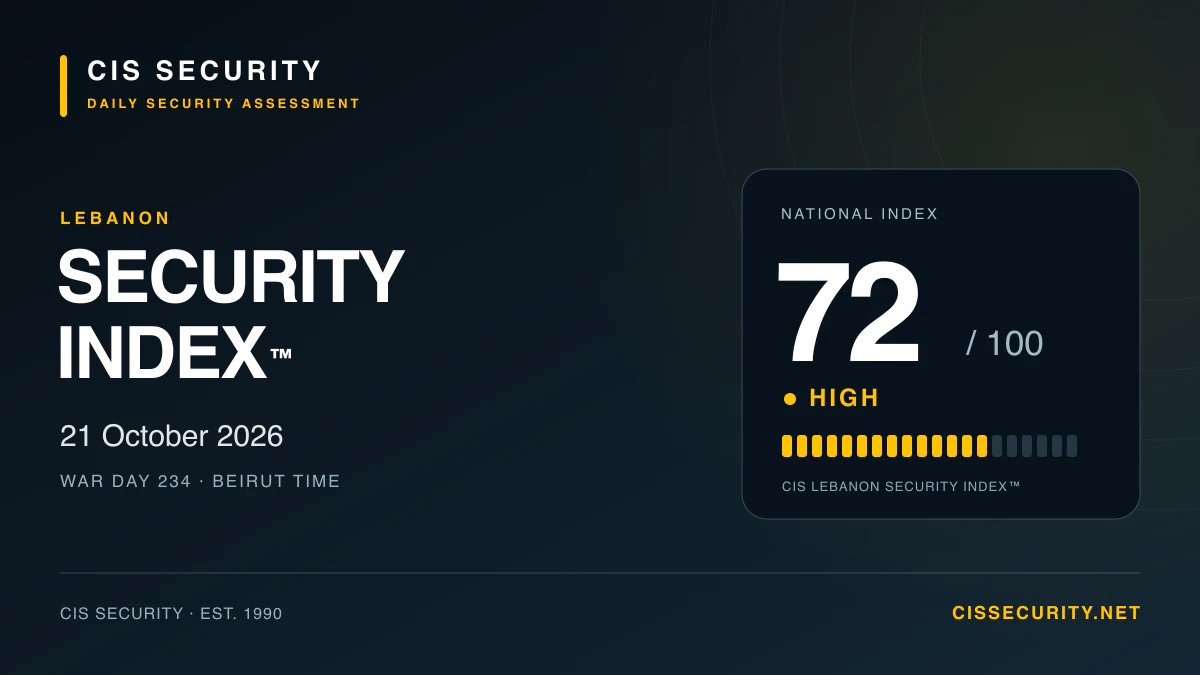
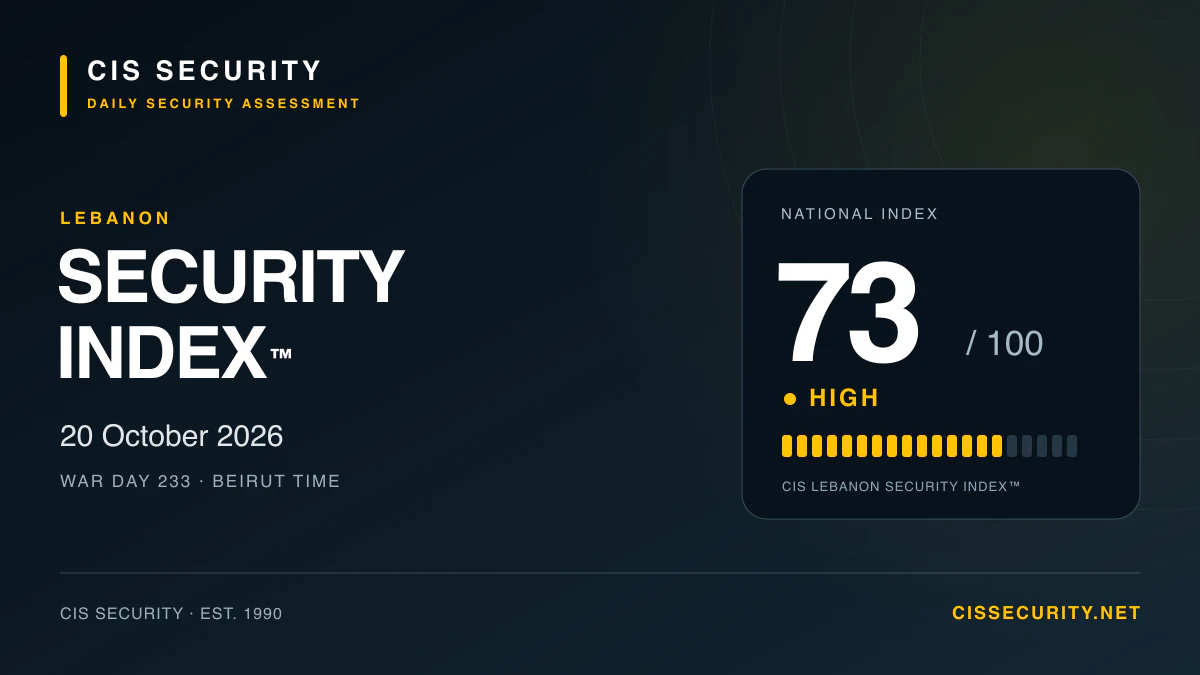
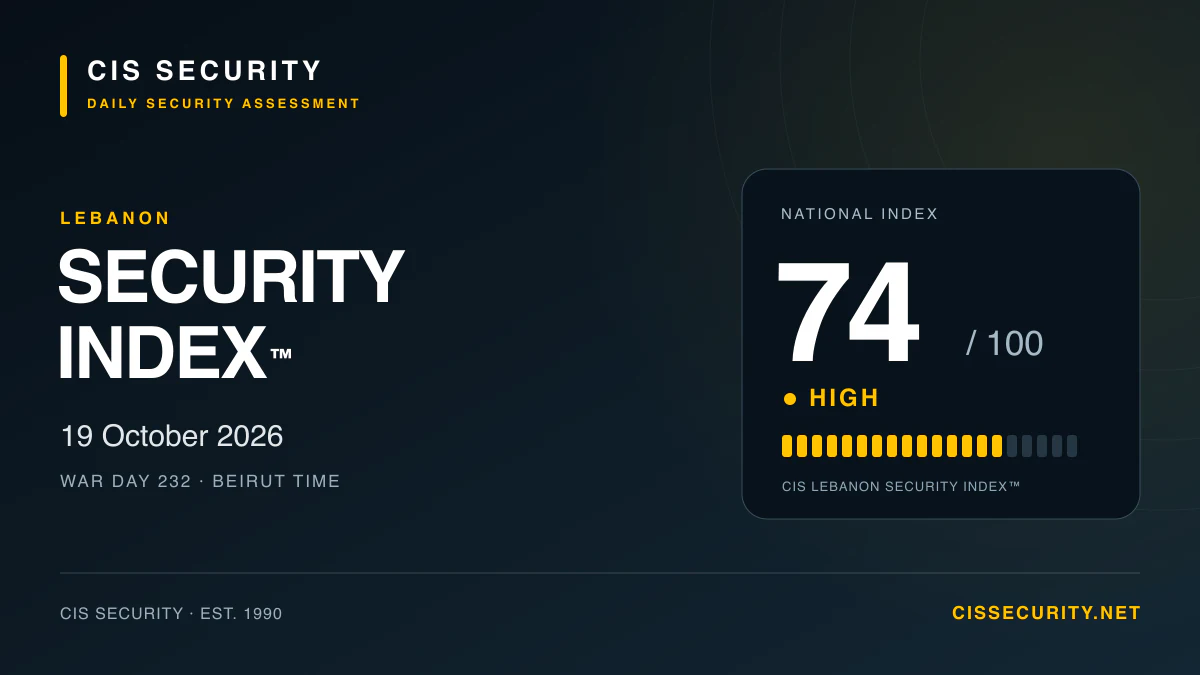
Trend line, current best version: 94 → 91 → 85 → 79 → 78 → 74 → 72 → 73 → 61 (15, 16, 17, 18, 19-revised, 20-revised, 21-revised, 22-revised, 23) That's still not a clean line, and it may not be one for another few days until this week's revisions fully settle. I'd hold off treating any single number from this stretch as final until at least 25–26 August.