🇱🇧 CIS LEBANON SECURITY INDEX™
Wednesday, July 22, 2026
🟠 WAR DAY 143 | NEXT ROUND OF TALKS SET FOR AUGUST 4 IN ROME | AOUN SETS THREE CONDITIONS FOR HEZBOLLAH DISARMAMENT — INVOKES FARC AND IRA AS MODELS | SALAM: ISRAELI WITHDRAWAL START IS "THE BEGINNING OF A PATH" | ANALYST: TRUMP-AOUN MEETING A "SLAP IN THE FACE" FOR NETANYAHU | SYRIA INTERCEPTS SECOND HEZBOLLAH-BOUND ARMS SHIPMENT IN A WEEK | US STRIKES IRAN FOR 11TH STRAIGHT NIGHT, TRUMP THREATENS "PICKAXE MOUNTAIN"
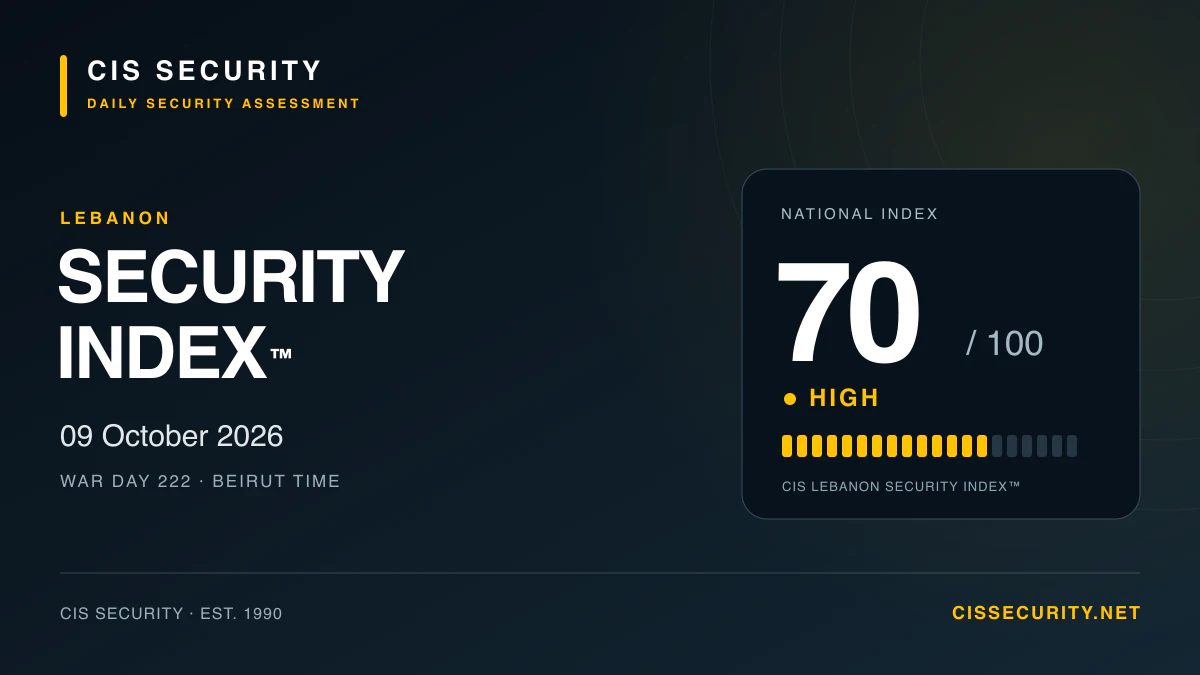
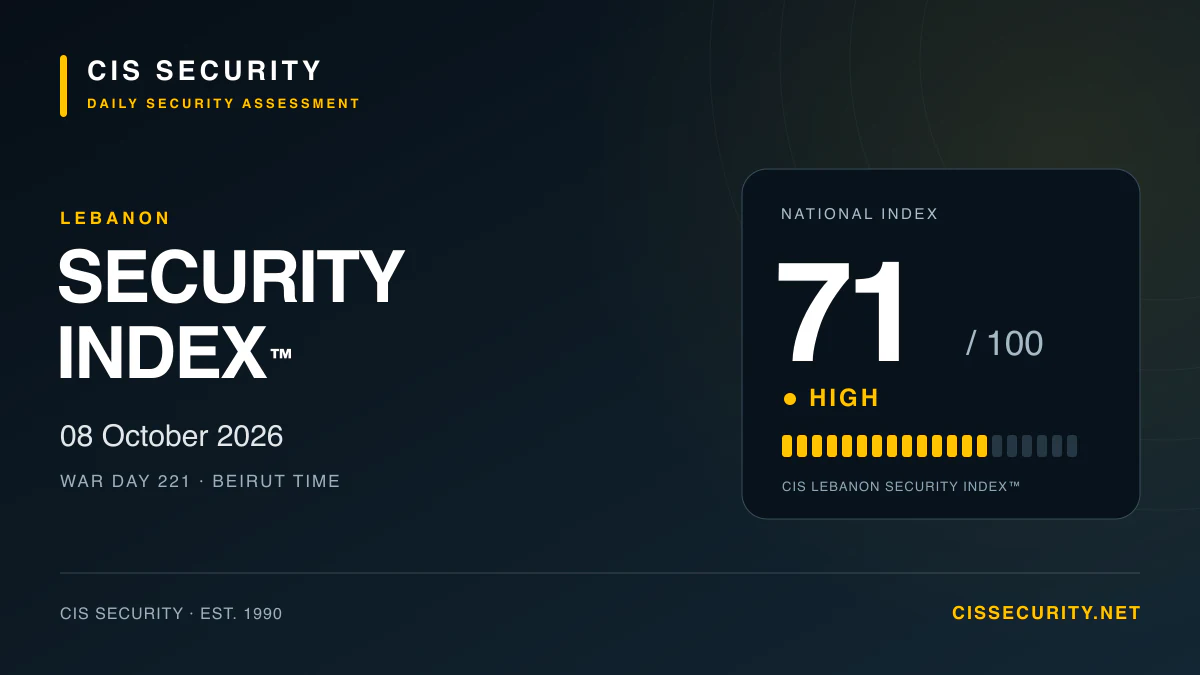
INDEX LEVEL: 🟠 HIGH — DIPLOMATIC FOLLOW-THROUGH CONTINUES, BUT NO NEW GROUND-LEVEL BREAKTHROUGH OVERALL INDEX: 67/100 TREND: ↔️ STABLE — In the 24 hours since President Aoun's historic White House meeting, the diplomatic track has continued to move, if incrementally. A Lebanese official confirmed Wednesday that the next round of US-brokered Israel-Lebanon talks is scheduled for August 4 in Rome, formalizing that the process launched in June will continue on a regular cadence rather than stalling after last week's session. Speaking at a Tuesday evening dinner hosted by Lebanon's ambassador to Washington and attended by members of Congress and Trump administration officials, President Aoun laid out — for the first time in this level of detail — three explicit conditions for Hezbollah's disarmament, invoking the disarmament processes of Colombia's FARC and Northern Ireland's IRA as models, and stating plainly that removing the "root cause" Hezbollah cites (Israeli occupation) must come first. Prime Minister Salam separately characterized the beginning of Israel's withdrawal as "the beginning of a path" rather than a completed achievement. One French broadcaster's Jerusalem correspondent described the optics of the Trump-Aoun meeting itself as "a slap in the face" for Israeli PM Netanyahu, given the warmth of Trump's reception for Aoun set against Israel's continued military presence. Separately, Syrian authorities announced they intercepted a second Hezbollah-bound arms shipment in a week — this time dozens of anti-tank missiles — reinforcing the interdiction pattern CIS flagged on July 16. And the regional war continued to intensify: the US struck Iran for an eleventh consecutive night, Trump said the US would soon strike Iran's fortified "Pickaxe Mountain" nuclear site, and Iran reportedly launched drone strikes on US and allied bases in the Gulf.
⛔ EXECUTIVE SUMMARY — WEDNESDAY JULY 22, 2026 (WAR DAY 143)
NEXT ROUND OF TALKS CONFIRMED: AUGUST 4, ROME
A Lebanese official confirmed to Reuters Wednesday that Lebanon and Israel are scheduled to hold their next round of US-brokered talks on August 4 in Rome (or "Italy," per varying reports) — continuing what Reuters describes as "more than three months of face-to-face talks" between the two countries, an arrangement notable in itself given they "remain formally at war and have had no normal diplomatic relations through decades of invasion, military occupation and cross-border conflict." This will be the sixth substantive round in the process, following the five meetings that produced the June 26 framework and last week's Rome session that yielded the pilot-zone agreement.
CIS assessment: The confirmation of a specific next date — roughly two weeks out — is itself a modest positive signal: it indicates neither side is currently threatening to walk away from the table, and provides a concrete near-term marker CIS can use to assess whether momentum from the pilot-zone handover continues or stalls.
AOUN SETS THREE EXPLICIT CONDITIONS FOR HEZBOLLAH DISARMAMENT
In the most detailed public articulation yet of his government's actual roadmap for disarming Hezbollah, President Aoun told a Tuesday evening dinner audience — hosted by Lebanon's ambassador to Washington, Nada Hamadeh Moawad, and attended by members of Congress and US administration officials — that disarmament requires three sequential steps:
- Removing "the root cause long cited by Hezbollah to justify its existence": ending Israel's occupation of Lebanese territory.
- The Lebanese Army "assuming full and exclusive operational control," which Aoun said "requires immediate and unconditional support for Lebanon's military as the country's only legitimate defender."
- Reintegration — "through a reconstruction program run solely by the Lebanese state and coupled with real economic opportunities so that weapons are no longer the only option."
Aoun explicitly invoked international precedent, citing the demobilization of Colombia's FARC and the disarmament of the Irish Republican Army in Northern Ireland as models, summarizing the approach as "disarmament, demobilisation and reintegration." He was notably candid about Hezbollah's social depth, stating: "The armed group is not a foreign mercenary force, but is made up of Lebanese citizens shaped over four decades by ideological, social and military investment" into what he described as a non-state armed group.
His central formulation: "Hezbollah can be disarmed if we are honest about what it truly requires: ending the occupation, the army assuming full control, and a reconstruction program managed solely by the state." Separately, at the Lebanese embassy reception, Aoun told guests that Israel's withdrawal could remove "the root cause that Hezbollah has long cited as its justification" — and that only then could Hezbollah actually be disarmed.
CIS assessment: This is a substantively more detailed and sequenced framework than anything CIS has previously reported from Aoun, and it directly reframes the "chicken-and-egg" dispute at the heart of the entire framework: Israel insists it will not withdraw until Hezbollah disarms; Aoun is now stating publicly and specifically, before members of the US Congress, that disarmament cannot realistically occur until Israel withdraws first. This does not resolve the underlying sequencing dispute, but it does mark the clearest, most doctrinally-grounded Lebanese counter-position yet, explicitly invoking successful international disarmament precedents to make the case that Hezbollah's disarmament is achievable — but only in a specific order.
SALAM: WITHDRAWAL START IS "THE BEGINNING OF A PATH," NOT A DESTINATION
Prime Minister Nawaf Salam said separately Wednesday that the start of Israel's withdrawal from Lebanese territory marks "the beginning of a path" that the state will continue to pursue — a carefully calibrated statement that acknowledges Tuesday's Zawtar al-Gharbiyeh handover as genuine progress while explicitly declining to characterize it as anything more than a first step.
CIS assessment: Salam's framing is consistent with the cautious, incremental tone CIS has observed from Lebanese officials throughout this process — neither overselling Tuesday's pilot-zone handover nor dismissing it, a notably more measured posture than either Hezbollah's outright rejectionism or the more triumphant framing offered by some US officials.
ANALYST: AOUN-TRUMP MEETING WAS "A SLAP IN THE FACE" FOR NETANYAHU
France 24's Jerusalem correspondent, Noga Tarnopolsky, characterized Tuesday's Trump-Aoun meeting as representing "a slap in the face" for Israeli Prime Minister Benjamin Netanyahu — a striking editorial framing worth noting for what it signals about how the meeting is being read in Israeli political circles, even though CIS notes this is analytical commentary rather than an official Israeli government statement. The comment reflects a reading in which Trump's warm public reception of Aoun, his direction that US airlines resume direct Lebanon flights, and his stated openness to speaking with Hezbollah directly are seen as Washington asserting an independent, more accommodating posture toward Beirut than Israel has favored.
Separately, Israeli officials have expressed skepticism that the Lebanese Armed Forces are strong enough to disarm Hezbollah by force on their own, and continue to argue Israeli troops are needed in the south to "provide a buffer zone keeping the Iran-backed terror group away from its border." During the Trump meeting, Aoun — himself a former army commander — pushed back implicitly on this framing, describing the Lebanese military as "the backbone of security and stability" and the country's most established institution.
CIS assessment: This is the clearest evidence yet of an emerging three-way divergence in how Washington, Beirut, and Tel Aviv each frame the Lebanese Army's readiness and the appropriate sequencing of withdrawal versus disarmament — Washington appearing (per this analysis) to lean toward accommodating Beirut's position, while Israeli officials maintain their own forces remain necessary regardless of LAF capability claims.
SYRIA INTERCEPTS SECOND HEZBOLLAH-BOUND ARMS SHIPMENT THIS WEEK
Syrian authorities announced they intercepted a shipment of "dozens of anti-tank missiles" allegedly being smuggled through Syrian territory to Hezbollah in Lebanon, according to Syrian customs officials. This is the second such interdiction CIS has recorded within a single week — following the July 16 seizure of a Hezbollah-bound arms shipment on the Syria-Iraq border.
CIS assessment: Two separate, publicly announced interdictions of Hezbollah-bound weapons within a week represents a meaningful and apparently sustained pattern of Syrian cooperation against Hezbollah's resupply routes, rather than an isolated incident. If this pace continues, it may prove more consequential to Hezbollah's actual military capacity over time than the diplomatic disarmament framework itself, since it degrades the group's ability to rearm regardless of what is agreed at the negotiating table.
REGIONAL WAR: 11TH CONSECUTIVE NIGHT OF STRIKES, "PICKAXE MOUNTAIN" THREAT, DRONE ATTACKS ON GULF BASES
CIS's tracking of the broader US-Iran war shows continued, undiminished — and in some respects newly escalatory — activity:
- US Central Command confirmed it struck military targets in Iran for an 11th consecutive night on Tuesday into Wednesday.
- President Trump said Tuesday the US would strike Iran's "Pickaxe Mountain" nuclear site "probably pretty soon," amid reports that Tehran has moved nuclear centrifuges — and possibly enriched uranium — to this secretive, fortified underground enrichment facility. CIS flags this as a potentially significant escalatory threshold: a strike on a hardened underground nuclear enrichment site would represent a different category of target than the military command centers, maritime capabilities, and air-defense systems struck over the preceding ten nights.
- Iran's military said it launched drone strikes on a US base, targeting "housing and welfare units" and an equipment depot, according to Iran's Fars news agency, with additional drones reportedly launched at hangars and buildings used by US troops at a base in Bahrain. CIS notes the Pentagon has released only limited information about these alleged attacks and has not independently confirmed the specifics, consistent with the cautious approach CIS has taken throughout this conflict toward unverified IRGC/Iranian state media claims.
- Separately, the UN Security Council Report's July Lebanon Monthly Forecast — a document CIS is incorporating for the first time — confirms that France and Italy formally announced on June 25 they will co-lead an "international coalition to support Lebanon in a post-UNIFIL context," including a proposed EU Common Security and Defence Policy (CSDP) mission, though key aspects including the mission's actual mandate remain undefined. The UN Secretary-General's report on the implementation of Resolution 1701 was due July 9, with closed UN Security Council consultations expected to provide a venue for discussing the future of a UN presence along the Blue Line.
CIS assessment: The reported movement of nuclear material to a hardened facility, combined with Trump's explicit threat to strike it "probably pretty soon," represents a genuine risk of significant further escalation in the broader regional war — a strike on a fortified underground nuclear site would be a materially different and more consequential action than the infrastructure and military-asset strikes CIS has tracked since the ceasefire's collapse in early July.
📊 UPDATED KEY FIGURES — AS OF JULY 22, 2026
| Metric | Figure | Source |
|---|---|---|
| Days of consecutive US strikes on Iran | 11 | CENTCOM |
| Hezbollah-bound arms interdictions by Syria (past week) | 2 (Iraq border arms shipment July 16; anti-tank missiles this week) | Syrian customs/interior ministry |
| Next Israel-Lebanon talks round | August 4, Rome/Italy | Lebanese official, via Reuters |
| Total rounds of Israel-Lebanon talks since framework | 6th round upcoming (5 meetings produced the June 26 framework, plus the July 14-15 Rome round) | Reuters |
| UNIFIL post-mission coalition lead nations | France and Italy (announced June 25) | UN Security Council Report |
📌 WHAT CIS IS WATCHING — THE WEEK AHEAD
- Does the August 4 Rome round hold as scheduled, and does the interim two-week period see further pilot-zone handovers (Froun, Srifa, or the additional villages "agreed in principle")?
- Does Aoun's three-condition framework — occupation ends, army gains full control, then reintegration — gain any traction as a basis for resolving the sequencing dispute with Israel, or does Israel continue to insist on disarmament-first?
- Does the pattern of Syrian arms interdictions continue at this pace, and does Hezbollah or Iran respond publicly to these seizures?
- Does the US actually strike Iran's "Pickaxe Mountain" facility, and if so, does this trigger a significant escalation beyond the current pattern of nightly strikes and Gulf-state exchanges?
- Does the EU/France-Italy post-UNIFIL coalition's mandate get clarified in the coming weeks, particularly ahead of UNIFIL's eventual drawdown?
🛡️ CIS SECURITY — JULY 22 ASSESSMENT & GUIDANCE
Trusted Security Excellence Since 1990 | "Because Your Safety Isn't Optional"
CIS POSTURE: LEVEL 4 — HIGH ALERT (maintained)
CIS maintains Level 4 — High Alert, unchanged from yesterday. Today's developments are incrementally positive on the diplomatic track (confirmed next talks date, Aoun's detailed disarmament framework, continued Syrian arms interdictions) but are offset by the further intensification of the regional war, particularly the potential for a strike on Iran's underground nuclear facility, which would represent a meaningful new escalation risk.
ZONE-BY-ZONE GUIDANCE
ZAWTAR AL-GHARBIYEH / ZAWTAR AL-SHARQIYEH BOUNDARY: Continue to avoid — unresolved risk following Tuesday's gunfire incident. FROUN, SRIFA: Elevated caution — likely sites of further pilot-zone handover activity in the coming days. MANSOURI (TYRE DISTRICT): Continue to avoid pending resolution of the July 18 fatal blast investigation. SECURITY ZONE / BUFFER ZONE (GENERAL): Do not approach under any circumstances. SYRIA-IRAQ AND SYRIA-LEBANON BORDER AREAS: Elevated caution given active arms-interdiction operations and associated security activity. DAHIYEH, BEKAA VALLEY: Maintain elevated caution given the ongoing regional war. BEIRUT (general), MOUNT LEBANON, NORTH LEBANON, AKKAR: Calm, normal operations continue.
📞 EMERGENCY CONTACTS — JULY 22, 2026
CIS Security 24/7: +961 3 539900 | info@cissecurity.net | www.cissecurity.net Lebanese Army South Lebanon Liaison: +961-8-802-510 US Embassy Emergency: +1-202-501-4444 | BeirutACS@state.gov Lebanese Red Cross: 1760 Civil Defence: 125 ISF: 112 National Mental Health Lifeline: 1564 (24/7 — confidential)
⚠️ FINAL ASSESSMENT — WAR DAY 143, JULY 22, 2026
Today's developments confirm that the momentum generated by Tuesday's historic Washington visit and pilot-zone handover has not immediately stalled — but they also make clear how much distance remains between the two sides' actual positions.
The confirmation of an August 4 Rome date, alongside Aoun's newly detailed three-condition disarmament framework, together suggest a Lebanese government trying to substitute concrete process and sequencing logic for the vaguer diplomatic language that has characterized much of the post-framework period. Aoun's explicit citation of FARC and IRA precedents, and his candid acknowledgment that Hezbollah is a deeply rooted Lebanese social phenomenon rather than a "foreign mercenary force," reflect a more sophisticated and arguably more honest public case for disarmament than CIS has previously recorded from Beirut.
But the fundamental sequencing dispute remains entirely unresolved: Aoun insists occupation must end before disarmament can realistically proceed; Israeli officials continue to argue their forces are needed precisely because they doubt the Lebanese Army's current capacity to act without them. Whether Tarnopolsky's "slap in the face" framing reflects a genuine shift in Washington's tilt between the two positions, or merely a warm diplomatic gesture without practical consequence, will only become clear as the pilot-zone process either expands or stalls in the coming weeks.
Meanwhile, the steady drumbeat of Syrian arms interdictions — now two in a single week — may prove to be the most consequential, least-publicized development of this period, gradually constraining Hezbollah's capacity regardless of the diplomatic outcome. And the regional war's potential escalation toward a strike on Iran's underground nuclear facility looms over all of this as the single largest wildcard for how the broader environment surrounding Lebanon's own negotiations develops in the days ahead.
CIS maintains Level 4 — High Alert and will be watching closely for both the pace of further pilot-zone handovers and any decision to strike Iran's fortified nuclear site.
+961 3 539900 | info@cissecurity.net | cissecurity.net CIS Security — Because Your Safety Isn't Optional — Est. 1990
CIS Lebanon Security Index™ | Wednesday, July 22, 2026 | WAR DAY 143
Sources: Reuters, "Lebanon, Israel to hold next talks in Italy on August 4, Lebanese official says" (July 22, 2026 — via Al-Monitor, US News, Jerusalem Post syndication; full Aoun "root cause" quote, talks history); Anadolu Agency (AA), "Lebanese president sets 3 conditions for Hezbollah disarmament, including Israeli withdrawal" (July 22, 2026 — full Aoun dinner speech quotes, FARC/IRA references, Salam "beginning of a path" quote); The Express Tribune, same AA-sourced report (July 22, 2026); The Times of Israel, "July 22: Trump claims Iran is 'not ready to make a deal,' but they will be very soon" (July 22, 2026 — Israeli officials' skepticism of LAF capacity, Aoun "backbone of security and stability" quote, Iran drone strikes on US/Bahrain bases via Fars News); The Times of Israel, "Daily Briefing July 22: IDF Lebanon pullout takes shape as Gaza peace plan stalls" (July 22, 2026 — 11th consecutive night of strikes, "Pickaxe Mountain" threat and centrifuge relocation reports); France 24, "Middle East war live: Lebanon's army accuses Israel of firing near troops in 'pilot zone'" (July 21-22, 2026 — Tarnopolsky "slap in the face" characterization, 11th consecutive night CENTCOM confirmation); The Yeshiva World News, July 22, 2026 daily roundup (Syrian interception of anti-tank missiles shipment to Hezbollah); UN Security Council Report, "Lebanon, July 2026 Monthly Forecast" (published early July, referenced July 22 — France/Italy post-UNIFIL coalition announcement, EU CSDP mission, Resolution 1701 Secretary-General report due July 9); prior CIS reporting (July 4–21, 2026) carried forward for context.
CIS notes that Iranian and IRGC claims regarding strikes on US and allied Gulf bases are drawn from Iranian state media (Fars News) and have not been independently confirmed by the Pentagon as of this writing; they are presented as reported claims, not verified facts. All other diplomatic and political statements are attributed to named officials or sourced reporting, July 21–22, 2026. Index compiled: Wednesday, July 22, 2026 — Beirut time.