CIS LEBANON SECURITY INDEX - June 30 2026
Tuesday, June 30, 2026
🟠 WAR DAY 121 | KATZ: "WE WILL NOT WITHDRAW A MILLIMETER UNTIL HEZBOLLAH DISARMED" | ISRAEL DEMOLISHES MAJOR HEZBOLLAH TUNNEL SYSTEMS | LEBANON PRESIDENT VOWS ARMY DEPLOYMENT TO BORDER | IRAN MINISTER: FIGHTING COULD RESTART "WITHIN 2 DAYS" | WITKOFF/KUSHNER IN QATAR — NO DIRECT IRAN MEETING | NABATIEH STRUCK AGAIN OVERNIGHT | HEZBOLLAH PROTESTS CONTINUE IN DAHIYEH
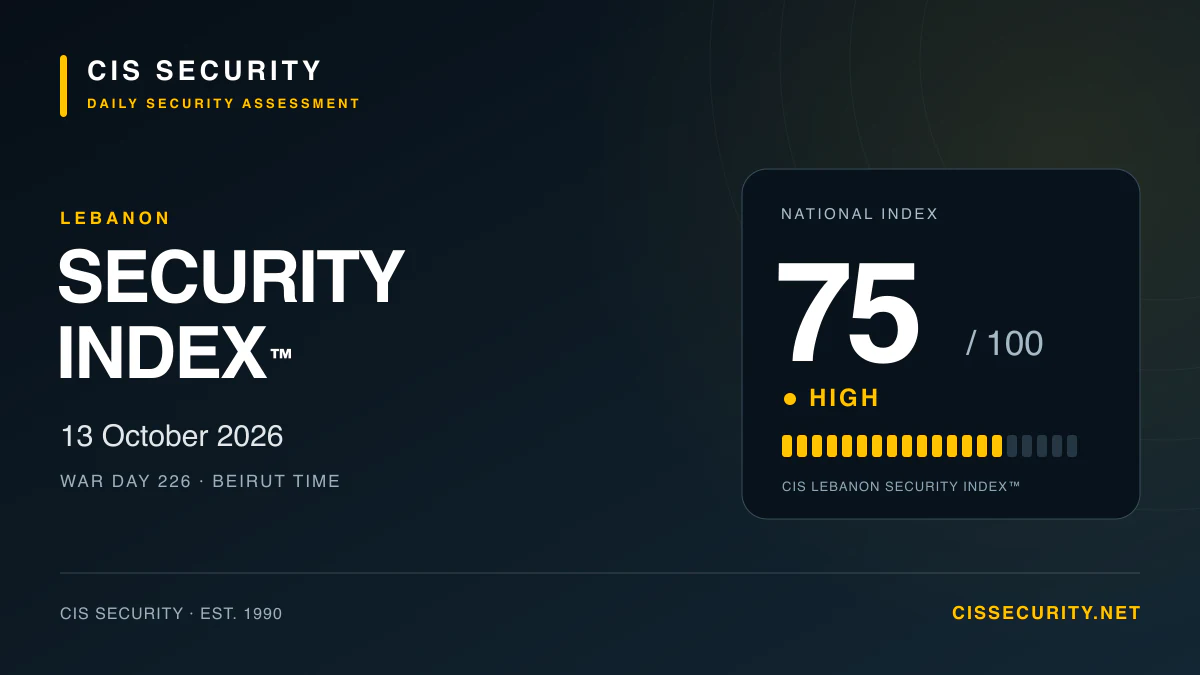
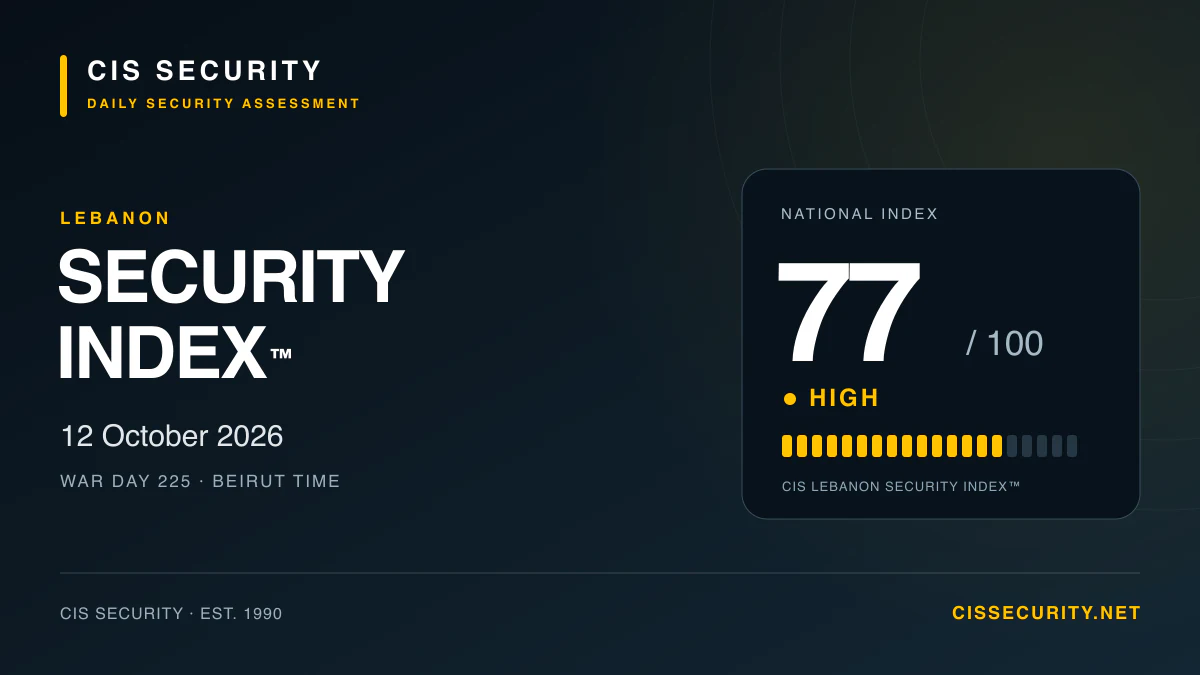
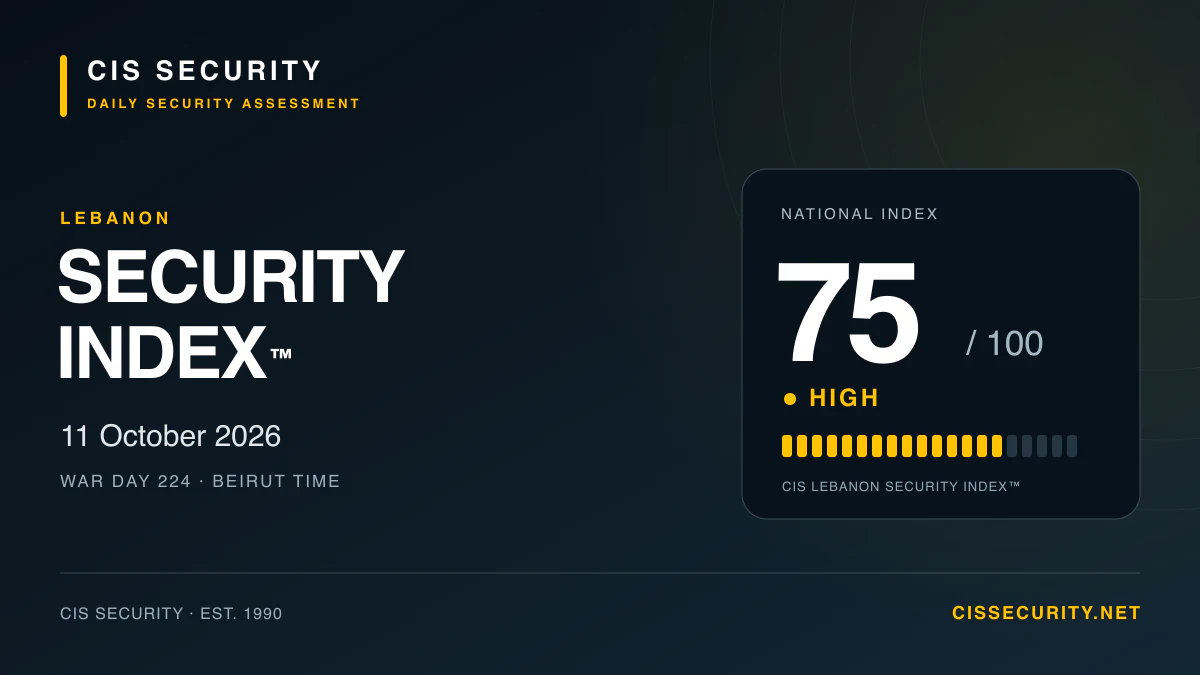
INDEX LEVEL: 🟠 HIGH — ENTRENCHED STALEMATE OVERALL INDEX: 65/100 TREND: ↔️ STABILIZING AT AN UNRESOLVED PLATEAU — Four days after the historic June 26 framework agreement, the fundamental contradiction has only hardened: Defence Minister Katz stated unambiguously this week that Israel "will not withdraw a millimeter" beyond the two pilot-program areas until Hezbollah is fully disarmed, and admitted the IDF was prevented by US pressure from a "massive" campaign that would have caused Hezbollah's "collapse"; Israel struck three Hezbollah command centers in Nabatieh and Mayfadoun overnight Sunday into Monday and demolished a major underground Hezbollah drone tunnel in Majdal Zoun; Lebanese President Aoun has told the US CENTCOM commander the Lebanese army is determined to deploy "up to the border"; Hezbollah's parliamentary bloc warns of "internal conflict" over the agreement and predicts it will not be implemented; Iran's Rezaei has warned fighting could restart "within two days" if violations continue; US envoys Witkoff and Kushner are in Qatar today but will not hold a direct meeting with Iranian officials; Hezbollah supporters have staged repeated street protests in Dahiyeh, including burning tires, against the government's signing of the Israel agreement.
⛔ EXECUTIVE SUMMARY — TUESDAY JUNE 30, 2026 (WAR DAY 121)
KATZ'S MOST DIRECT STATEMENT YET — "NOT A MILLIMETER"
In by far the bluntest official Israeli statement since the June 26 framework agreement, Defence Minister Israel Katz told reporters Monday: "People should not hold their breath wondering where the next place will be from which Israel will withdraw in Lebanon, because it will not happen until Hezbollah is disarmed. We have no territorial ambitions in Lebanon, but until Hezbollah is disarmed, we will not withdraw a millimeter."
Katz confirmed that the Israeli military is unlikely to withdraw from additional areas of southern Lebanon beyond the two agreed-upon locations that were already part of the pilot program under which the Lebanese army will take over — the same two areas referenced in last week's framework signing. Crucially, neither of those two areas includes Beaufort Castle, the strategically symbolic lookout point Israel recaptured in May, which had been the centerpiece of Israel's 18-year occupation of south Lebanon until 2000.
Katz also disclosed a remarkable admission about the constraints under which Israel has been operating: he said that had it not been for American pressure, the IDF would have carried out a "massive" aerial campaign that "would have dismantled Hezbollah" entirely, and that the terror group was "begging the Iranians to save it." According to Katz, when Trump "linked Iran and Lebanon" in the broader MOU negotiations, Israel had to stop "bringing down buildings in Beirut" — though it could still carry out "surgical strikes" on Hezbollah targets in the capital. "I'm sorry about that linkage, but it was an American interest," Katz said. "If there had not been a linkage between the Lebanon and Iran arenas, Hezbollah would have collapsed," he claimed.
CIS assessment: This is the clearest official acknowledgment yet that Israel's restraint in Lebanon over recent weeks has been a product of US diplomatic pressure tied to the broader Iran negotiations — not a change in Israeli strategic intent. Katz's statement strongly suggests that any erosion in that US pressure, or any perceived Iranian or Hezbollah violation severe enough to justify renewed escalation, could see Israel revert to a far more intensive campaign than what Lebanon has experienced even during the worst weeks of June.
THE TUNNEL DEMOLITIONS CONTINUE — MAJDAL ZOUN AND BEAUFORT RIDGE
On Sunday evening (June 28), the IDF demolished a major Hezbollah underground facility in the southern Lebanon village of Majdal Zoun, announced jointly by Netanyahu and Katz. The tunnel ran approximately 200 meters and reached depths of over 25 meters, and according to the military had been used by Hezbollah to assemble, store, and launch Iranian-made drones. Israel says it updated the US and the American representative in Lebanon ahead of the demolition.
Katz confirmed Monday that the IDF still has "more tunnels to destroy and blow up," specifically citing a major underground Hezbollah system beneath the Beaufort Ridge, which he said will be destroyed with "500 tons of explosives." This is a significant forward-looking statement: Israel is not describing its current operations as winding down, but rather as an ongoing systematic campaign against Hezbollah's military infrastructure that will continue regardless of the diplomatic framework signed last Friday.
CIS notes separately: The Times of Israel reported June 25 that the IDF had postponed demolition of several Hezbollah facilities — including the Majdal Zoun tunnel (since carried out) and infrastructure near Beaufort Castle — specifically under the ceasefire, and had halted efforts to capture a "strategic" underground Hezbollah facility beneath the Ali Taher ridge near Nabatieh, which the military describes as the "nerve center" of Hezbollah's Badr regional division. This indicates Israel retains active, unexecuted military objectives in the area, suspended rather than abandoned.
NABATIEH AND MAYFADOUN STRUCK AGAIN OVERNIGHT
The Israeli Air Force struck three Hezbollah command centers in the Nabatieh and Mayfadoun areas of southern Lebanon overnight Sunday into Monday, the military confirmed. The IDF said the strikes were carried out "in response to the continued attacks against our forces operating in the security zone by the Hezbollah terror organization." Separately, the IDF said troops of its Multi-Domain unit destroyed a Hezbollah rocket launcher in southern Lebanon during the same period.
This continues the now well-established pattern: strikes in the Nabatieh-Mayfadoun corridor have occurred repeatedly since the June 26 signing, occurring on essentially a near-daily basis despite the formal framework agreement.
LEBANON'S OWN POSITION — ARMY DEPLOYMENT TO THE BORDER
Lebanese President Joseph Aoun has told the CENTCOM commander that the Lebanese army is determined to deploy its forces "up to the border," signaling Beirut's intent to assert the sovereignty provisions of last week's framework agreement through actual, physical military deployment rather than just diplomatic language.
This is a significant operational claim — if implemented, it would represent the most concrete step yet toward the "sequenced process" the framework agreement describes, in which the Lebanese army restores "effective sovereign authority over all Lebanese territory." However, CIS notes this remains, for now, a stated intention rather than a verified deployment, and any such move would need to navigate both the active Israeli buffer zone and Hezbollah's continued presence in much of the same territory.
Separately, Aoun told Trump in a phone call last week that the Lebanese state "will assume its responsibilities" in implementing the framework agreement — language that suggests Beirut is positioning itself as fully committed to the deal's implementation, distinct from Hezbollah's rejection of it.
HEZBOLLAH'S INTERNAL WARNING — "INTERNAL CONFLICT"
Hezbollah lawmaker Hassan Fadlallah warned of "internal conflict" in Lebanon over the country's agreement with Israel, which the Iran-backed group rejects, and predicted the deal would not be implemented. This is a notable escalation in rhetoric from Hezbollah's parliamentary representatives — moving beyond simple rejection of the agreement to an explicit warning about domestic Lebanese political stability.
Continued street protests: Hezbollah supporters have staged repeated demonstrations in Beirut's southern suburbs against the government's signing of the Israel framework agreement, including blocking the old airport road with burning tires on the day of the signing (June 26) and continuing into the following days. The Lebanese military has vowed to maintain public order, stating: "The army command will not allow any breach of security or threat to civil peace through actions with unpredictable consequences, road blockages, or attacks on public or private property."
Visual signals from the street: AFP photographs from recent days show men riding scooters flying banners depicting slain Hezbollah leader Hassan Nasrallah in Beirut's southern suburbs, alongside separate images of "Lebanon first" billboards — one of which was set on fire along the same airport road near Hezbollah's stronghold. These competing visual symbols capture the genuine political tension within Lebanese society over the framework agreement's legitimacy.
THE BROADER IRAN-US PICTURE — STALLED AND FRAGILE
Iran's IRGC says it attacked US sites in the Gulf region in retaliation for American strikes in Iran that followed an Iranian attack on a commercial vessel in the Strait of Hormuz. The IRGC's statement, carried by state TV, warned: "If the aggression is repeated, our response will be broader than this."
Iran cancelled its participation in scheduled technical talks with the US amid the mutual Hormuz strikes, though the two countries subsequently agreed to halt attacks on each other and meet again — talks that were originally planned for Switzerland but were moved to Doha, Qatar, due to the flare-up, with the agenda shifted specifically to the Hormuz standoff.
Today (June 30): US envoys Steve Witkoff and Jared Kushner are in Doha to meet Qatari mediators, but there will be no direct high-level meeting between Washington and Tehran. Qatar's foreign ministry spokesperson Majed Al Ansari confirmed the talks will cover "all regional issues... including, of course, negotiations with Iran, but also including Lebanon." Separately, Iranian officials met with Oman in Muscat to discuss the future management of the Strait of Hormuz, per the MOU signed earlier this month — described as the first meeting of a new joint Iran-Oman committee on the strait.
Katz's warning on Iran: Regarding tensions with Tehran, Katz said that if Iran attacks Israel with ballistic missiles in response to actions in Lebanon, the IDF will respond and is preparing to operate independently of US coordination. "It could happen even within two days," he said. "We have targets to strike in Iran, and the IDF is prepared and on alert, but we will not interfere with the US president's course of action vis-à-vis the Iranians."
CIS assessment: The 60-day clock established by the original MOU (signed June 17) continues to run, but actual implementation — both on Hormuz and on Lebanon — remains contested and incomplete. The pattern of cancelled talks, relocated venues, and parallel unilateral strikes suggests the diplomatic architecture remains fragile rather than settled, even as no single event has yet caused full collapse.
📅 KEY TIMELINE — JUNE 27–30
| Date | Event |
|---|---|
| June 27 | Netanyahu: Israel "created conditions" for Iranian regime's potential collapse. Israeli drone strikes Nabatieh area, day after framework signing. Hezbollah supporters protest in Dahiyeh; Lebanese army vows to maintain order. Vance: "violence will be met with violence" after US strikes Iran following Hormuz vessel attack |
| June 28 | IDF demolishes major Hezbollah drone tunnel in Majdal Zoun (200m long, 25m deep). Iran cancels technical talks amid Hormuz strikes; both sides agree to halt and meet Tuesday in Doha instead of Switzerland. Hezbollah MP Fadlallah warns of "internal conflict," predicts deal won't be implemented. Aoun tells Trump Lebanese state "will assume its responsibilities" |
| June 29 | Iran says no talks with US "in coming days" despite both sending delegations to Qatar. IAF strikes three Hezbollah command centers, Nabatieh/Mayfadoun, overnight. Katz: "will not withdraw a millimeter" until Hezbollah disarmed; admits US pressure prevented "massive" campaign that would have caused Hezbollah "collapse." Katz: Beaufort Ridge tunnel system next, to be destroyed with "500 tons of explosives." Iran-Oman first joint Hormuz committee meeting, Muscat |
| June 30 (today) | Witkoff and Kushner in Doha, Qatar — meeting mediators, NOT holding direct meeting with Iran. Iranian minister warns fighting could restart "within 2 days." Aoun tells CENTCOM commander Lebanese army determined to deploy "up to the border." IDF continues strikes on Hezbollah targets in south Lebanon |
🗺️ JUNE 30 GOVERNORATE-BY-GOVERNORATE ASSESSMENT
| Governorate | Status | Detail |
|---|---|---|
| South Lebanon — Nabatieh / Mayfadoun | 🔴 ACTIVE — REPEATED STRIKES | Three Hezbollah command centers struck overnight Sun-Mon; ongoing near-daily pattern |
| South Lebanon — Majdal Zoun | 🔴 RECENT MAJOR DEMOLITION | Major underground tunnel facility destroyed June 28 |
| South Lebanon — Beaufort Ridge / Ali Taher | 🔴 UPCOMING TARGET | Katz confirms further major demolition planned (500 tons explosives); Ali Taher tunnel capture effort "halted" but not abandoned |
| South Lebanon — two pilot withdrawal areas | 🟡 TRANSITIONING | Lebanese army handover process ongoing per framework; excludes Beaufort Castle |
| South Lebanon (general) | 🟠 ELEVATED — ENTRENCHED | Near-daily strikes continue despite framework; Israel states it will not withdraw further |
| Beqaa / Bekaa Valley | 🟠 ELEVATED | No major new strikes specifically reported today |
| South Beirut / Dahiyeh | 🟠 ELEVATED — POLITICAL TENSION | Continued Hezbollah protest activity since June 26; Lebanese army monitoring for unrest |
| Beirut (general) | ✅ CALM | Normal operations; high political/diplomatic attention |
| Mount Lebanon | ✅ CALM | Normal operations |
| North Lebanon | ✅ CALM | Normal operations |
| Akkar | ✅ CALM | Normal operations |
🚗 JUNE 30 TRAVEL STATUS
| Zone | Status |
|---|---|
| Nabatieh / Mayfadoun corridor | 🔴 ACTIVE STRIKE ZONE — repeated overnight strikes; avoid |
| Majdal Zoun | 🔴 RECENT MAJOR MILITARY ACTIVITY — avoid |
| Beaufort Ridge / Ali Taher | 🔴 UPCOMING MAJOR DEMOLITION PLANNED — avoid; large explosion (500 tons) expected |
| Buffer zone (general) | ❌ ACTIVELY ENFORCED — do not approach |
| Two pilot withdrawal areas | 🟡 STATUS UNCLEAR — handover in progress; do not assume fully safe |
| South Lebanon (general) | 🟠 CONTINUE CAUTION — near-daily strikes persist |
| Bekaa Valley | 🟠 ELEVATED |
| Dahiyeh / South Beirut | 🟠 ELEVATED — political protest activity; avoid demonstration areas, particularly near airport road |
| Beirut (non-Dahiyeh) | ✅ Calm |
| Mount Lebanon | ✅ Calm |
| North Lebanon | ✅ Calm |
| Masnaa Border Crossing | ✅ OPEN |
| Rafic Hariri Airport | ✅ OPERATING — note: airport road in Dahiyeh area has seen periodic protest-related disruption; allow extra time |
| Strait of Hormuz | 🟡 VOLATILE — recent mutual Iran-US strikes; talks moved to Doha; Iran-Oman committee established; traffic reportedly slowed again amid tensions |
📊 JUNE 30 STATISTICS — WAR DAY 121
| Metric | Figure | Source |
|---|---|---|
| Lebanon killed (cumulative) | 4,000+ (precise figure pending latest Health Ministry update) | Wikipedia / Al Jazeera |
| Lebanon displaced (cumulative) | Over 1 million (>20% of population) | Wikipedia |
| IDF soldiers killed (Lebanon, cumulative) | 37+ | Wikipedia Timeline of 2026 Lebanon War |
| Pilot withdrawal areas | 2 specific locations (excludes Beaufort Castle) | Times of Israel |
| Iran warning on fighting resumption | "Within 2 days" if violations continue | Times of Israel, citing Iranian minister |
| Total war duration | 121 days (since March 2) | CIS calculation |
| US-Iran MOU 60-day clock | Day 13 of 60 (signed June 17) | CIS calculation |
🔑 KEY STATEMENTS — JUNE 27–30, 2026
| Actor | Statement |
|---|---|
| Defence Min. Katz | "We will not withdraw a millimeter" until Hezbollah is disarmed. "If there had not been a linkage between the Lebanon and Iran arenas, Hezbollah would have collapsed." Beaufort Ridge tunnel system to be destroyed with "500 tons of explosives." If Iran attacks over Lebanon, "it could happen even within two days." |
| PM Netanyahu | Hailed framework deal as "a historic achievement for Israel." Separately claimed Israel "created conditions" for Iranian regime's potential collapse |
| Hezbollah MP Hassan Fadlallah | Warned of "internal conflict" in Lebanon over the Israel agreement; predicted the deal "would not be implemented" |
| Lebanese President Aoun | Told Trump the Lebanese state "will assume its responsibilities" in implementing the framework. Told CENTCOM commander the army is determined to deploy "up to the border" |
| Lebanese Army (statement) | "The army command will not allow any breach of security or threat to civil peace through actions with unpredictable consequences, road blockages, or attacks on public or private property" |
| IRGC (Iran) | Attacked US sites in Gulf in retaliation for US strikes; "If the aggression is repeated, our response will be broader than this" |
| VP Vance | "Violence will be met with violence" after US struck Iran following Hormuz vessel attack. "If they have disagreements about how the MOU is being applied, they can pick up the phone" |
| Qatar FM spokesperson Majed Al Ansari | Witkoff/Kushner in Doha to discuss "all regional issues... including, of course, negotiations with Iran, but also including Lebanon" |
| Israeli security official (to Ynet) | An attack on Israeli territory "might not necessarily lead to an Israeli strike in Beirut's Dahiyeh" — case-by-case assessment going forward, departure from prior automatic-response policy |
🛡️ CIS SECURITY — JUNE 30 ASSESSMENT & GUIDANCE
Trusted Security Excellence Since 1990 | "Because Your Safety Isn't Optional"
CIS POSTURE: LEVEL 4 — HIGH ALERT (Maintained)
CIS maintains Level 4 today. The past four days since the framework signing have not produced the de-escalation many had hoped for — if anything, Katz's candid admissions this week represent the most explicit official confirmation yet that Israel's military objectives in Lebanon remain extensive and largely unconstrained by the diplomatic framework, other than the narrow, specific pilot withdrawal program.
WHY KATZ'S STATEMENTS THIS WEEK ARE SIGNIFICANT FOR YOUR SAFETY
- "Not a millimeter" is about as unambiguous as official language gets. This forecloses any expectation of further Israeli withdrawal from south Lebanon in the near term, beyond the two already-agreed pilot areas.
- The admission that US pressure — not Israeli restraint — has limited the campaign's scope is operationally important. It means the current relative calm in much of Lebanon (outside the Nabatieh-Mayfadoun corridor) is contingent on continued US diplomatic engagement, not a permanent strategic shift by Israel. Any reduction in US attention or leverage could see operations intensify.
- The planned Beaufort Ridge demolition (500 tons of explosives) is a concrete, scheduled future military operation, not a hypothetical. Residents and any CIS clients with interests near the Beaufort Ridge/Ali Taher area should expect a major, audible demolition event in the coming period, alongside continued related military activity.
- The shift away from "automatic" Dahiyeh strikes (per the Israeli security official's comments) is a genuinely positive procedural change — moving from a blanket retaliation policy to case-by-case assessment reduces (though does not eliminate) the risk of reflexive strikes on Beirut's southern suburbs in response to isolated incidents elsewhere.
ZONE-BY-ZONE GUIDANCE — JUNE 30
NABATIEH / MAYFADOUN: Continue to avoid. This corridor has experienced the most consistent, repeated strikes of any area since the June 26 framework signing.
BEAUFORT RIDGE / ALI TAHER: Avoid. A major demolition (500 tons of explosives) is planned by Israel's own announcement. Expect a significant audible/seismic event and continued military activity in this specific area.
MAJDAL ZOUN: Avoid in the near term given the recent major tunnel demolition and associated military presence.
THE TWO PILOT WITHDRAWAL AREAS: Monitor for confirmed Lebanese Army deployment. Do not assume full safety until independently verified that IDF has fully departed and Lebanese forces have established stable control.
DAHIYEH: Exercise increased caution around protest activity, particularly near the airport road, which has seen repeated demonstrations including burning tires since June 26. The shift to case-by-case Israeli response policy is a positive development but does not eliminate Dahiyeh's risk profile, especially if any new triggering incident occurs.
BEKAA VALLEY: No new major strikes reported today specifically, but maintain elevated caution given the area's recent history.
BEIRUT (general), MOUNT LEBANON, NORTH LEBANON, AKKAR: Calm, normal operations continue.
WHAT CIS IS WATCHING — THE WEEK AHEAD
- Does the Lebanese army actually deploy "up to the border" as Aoun has stated to CENTCOM? This would be a significant, concrete step toward the framework's sovereignty provisions — watch for independent verification of any such deployment.
- Does the Beaufort Ridge demolition occur, and does it trigger any Hezbollah response? Given the scale described (500 tons of explosives), this represents one of the larger planned military operations in the near-term pipeline.
- Do today's Doha talks (Witkoff/Kushner with Qatari mediators) produce any movement on the Hormuz standoff, even without direct Iran engagement? The continued absence of direct US-Iran talks, despite the 60-day MOU clock running, is a concerning signal for the broader negotiation's health.
- Does Hezbollah's internal warning of "conflict" manifest as actual unrest, or remain primarily rhetorical? The combination of continued street protests and explicit parliamentary warnings about non-implementation suggests genuine internal Lebanese political strain over the framework agreement — worth monitoring for any escalation beyond peaceful demonstration.
- Does Iran's "within two days" warning on potential fighting resumption prove accurate, or is it primarily rhetorical pressure? Given the pattern of repeated near-miss escalations throughout June, CIS treats this warning seriously without assuming it will necessarily materialize on the stated timeline.
📞 EMERGENCY CONTACTS — JUNE 30, 2026
CIS Security 24/7: +961 3 539900 | info@cissecurity.net | www.cissecurity.net Lebanese Army South Lebanon Liaison: +961-8-802-510 US Embassy Emergency: +1-202-501-4444 | BeirutACS@state.gov Lebanese Red Cross: 1760 Civil Defence: 125 ISF: 112 National Mental Health Lifeline: 1564 (24/7 — confidential)
⚠️ FINAL ASSESSMENT — WAR DAY 121, JUNE 30, 2026
Four days after the historic signing, the only thing that has truly changed is the clarity of the disagreement.
This week, Israel's own Defence Minister removed any remaining ambiguity about his country's position: no withdrawal beyond two narrow pilot areas, no timetable beyond Hezbollah's full disarmament, and — most strikingly — an open admission that only American diplomatic pressure has prevented a far more devastating campaign than what Lebanon has already endured. "If there had not been a linkage between the Lebanon and Iran arenas, Hezbollah would have collapsed," Katz said, all but stating that Israel's restraint is borrowed time rather than a genuine strategic choice.
Meanwhile, Lebanon's own institutions are attempting to use the framework agreement as leverage for genuine sovereignty — President Aoun's stated intent to deploy the army "up to the border" is the most concrete operational claim yet from Beirut's side. Whether that deployment actually happens, and how it interacts with both continued Israeli operations and Hezbollah's entrenched presence in the same territory, will be one of the most important things to watch in the coming days.
And underneath all of it, the war's basic rhythm continues unchanged: strikes in Nabatieh and Mayfadoun, a major tunnel demolished, another even larger one (500 tons of explosives at Beaufort Ridge) scheduled, and Hezbollah supporters in the streets of Dahiyeh protesting an agreement their own leadership has called "null and void."
One hundred and twenty-one days into this war, Lebanon finds itself with more diplomatic architecture than at any prior point — a signed trilateral framework, a 60-day MOU clock, a de-confliction cell, ongoing talks in Doha — and yet the fundamental military reality on the ground has barely shifted. CIS maintains Level 4 — High Alert — and continues to advise extreme caution in south Lebanon, particularly around the Nabatieh-Mayfadoun-Beaufort corridor where Israeli operations remain most active and explicit future plans have been announced.
+961 3 539900 | info@cissecurity.net | cissecurity.net CIS Security — Because Your Safety Isn't Optional — Est. 1990
CIS Lebanon Security Index™ | Tuesday, June 30, 2026 | WAR DAY 121 Sources: Times of Israel liveblog June 29, 2026 (Katz full statement "not withdraw a millimeter" "no territorial ambitions" "people should not hold their breath"; Beaufort Ridge "500 tons of explosives"; "could happen even within two days" Iran ballistic missile warning; Iran Oman joint committee Hormuz Muscat Gharibabadi; IAF three Hezbollah command centers Nabatieh Mayfadoun overnight; Multi-Domain unit rocket launcher destroyed); Times of Israel "Katz: Israel has no territorial ambitions in Lebanon" liveblog entry (June 29, 2026 — full Katz quotes on US linkage "I'm sorry about that linkage, but it was an American interest"; "when you enter into a partnership it has advantages but it also comes with certain constraints"; "massive aerial campaign would have dismantled Hezbollah"; "begging the Iranians to save it"; "bringing down buildings in Beirut" halted, "surgical strikes" continued; pilot program two areas Lebanese army takeover); Times of Israel liveblog June 28, 2026 (IDF demolishes Majdal Zoun tunnel 200 meters 25 meters deep drone facility; Netanyahu Katz joint statement; updated US American representative Lebanon ahead demolition; Iran cancels technical talks Hormuz strikes; agree halt attacks meet Tuesday Doha Qatar instead Switzerland; topic shifted Hormuz standoff; Hassan Fadlallah "internal conflict" warning "deal would not be implemented"; Aoun told Trump Lebanese state "will assume its responsibilities"; Cpt. David Hazutt funeral Hezbollah attack); Times of Israel liveblog June 27, 2026 (Netanyahu "created conditions" Iranian regime collapse; Israeli drone strikes Nabatieh day after framework; Hezbollah supporters protest Dahiyeh burning tires old airport road; Lebanese army statement "will not allow any breach of security"; Vance "violence will be met with violence" X post; "if they have disagreements... pick up the phone"; Rezaei response violation MOU "swift and decisive"; Israeli security official Ynet Dahiyeh case-by-case policy shift); Times of Israel liveblog June 25, 2026 (IDF postponed demolition Majdal Zoun Beaufort Castle infrastructure ceasefire; halted Ali Taher ridge capture "nerve center" Badr regional division; Israeli officials deny Reuters withdrawal report; potential withdrawal discussed negotiations no agreement yet; State Department official says Israel withdrawn some territory); Times of Israel liveblog June 21, 2026 (Zamir "clear and unchanged defending the north" Ali Taher Beaufort areas; "fragile" ceasefire high readiness; de-confliction cell Iran US Lebanon Pakistan Qatar joint statement); Times of Israel liveblog June 30, 2026 (Witkoff Kushner Doha Qatar no direct Iran meeting; Al Ansari "all regional issues including negotiations with Iran but also including Lebanon"; Iran fighting could restart "within 2 days" minister; Aoun CENTCOM commander army deploy "up to the border"; IDF strikes Hezbollah targets south Lebanon; 14-point pact 60 days negotiate permanent truce February 28 start); Times of Israel "Document: Eventual IDF redeployment from Lebanon — full text Israel-Lebanon deal security annex" (referenced June 30, 2026); CBS News "Iran threatens complete halt to talks after trading strikes with US" (June 2026 — UNIFIL mandate ends December 31 2026 UN Security Council decision September 2025; seven UNIFIL soldiers died since war began; Macron Meloni European coalition post-UNIFIL; Aoun "sincere expression international commitment"; Zamir approved continued operations security zone "in accordance with ceasefire agreement"; CENTCOM Friday strikes Iran response Hormuz "Iran given chance honor ceasefire elected not"; Araghchi "any attempt adopt new or separate arrangements... will only lead to more complicated situations"); Wikipedia "2026 Lebanon War" and "Timeline of the 2026 Lebanon War" (updated June 30, 2026 — cumulative figures over 4,000 killed over 1 million displaced 37 IDF soldiers killed; UNIFIL mandate termination context; historical strike pattern context); Al Jazeera "Hezbollah demands Israel leave Lebanon unconditionally" (June 26, 2026, referenced — France Italy international coalition post-UNIFIL initiative). All Lebanon casualty figures from Lebanese Ministry of Public Health and Wikipedia tracking. All diplomatic and military statements from named officials or sourced reporting, primarily Times of Israel liveblogs June 21-30, 2026. Index compiled: Tuesday, June 30, 2026 — Beirut time.