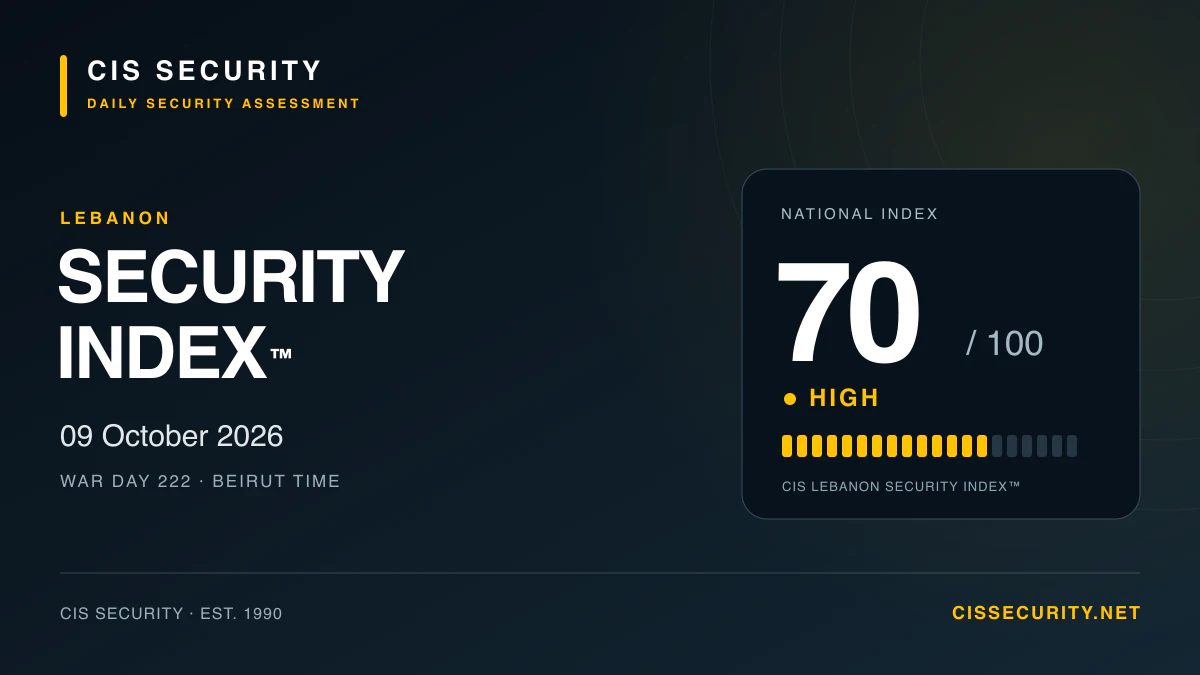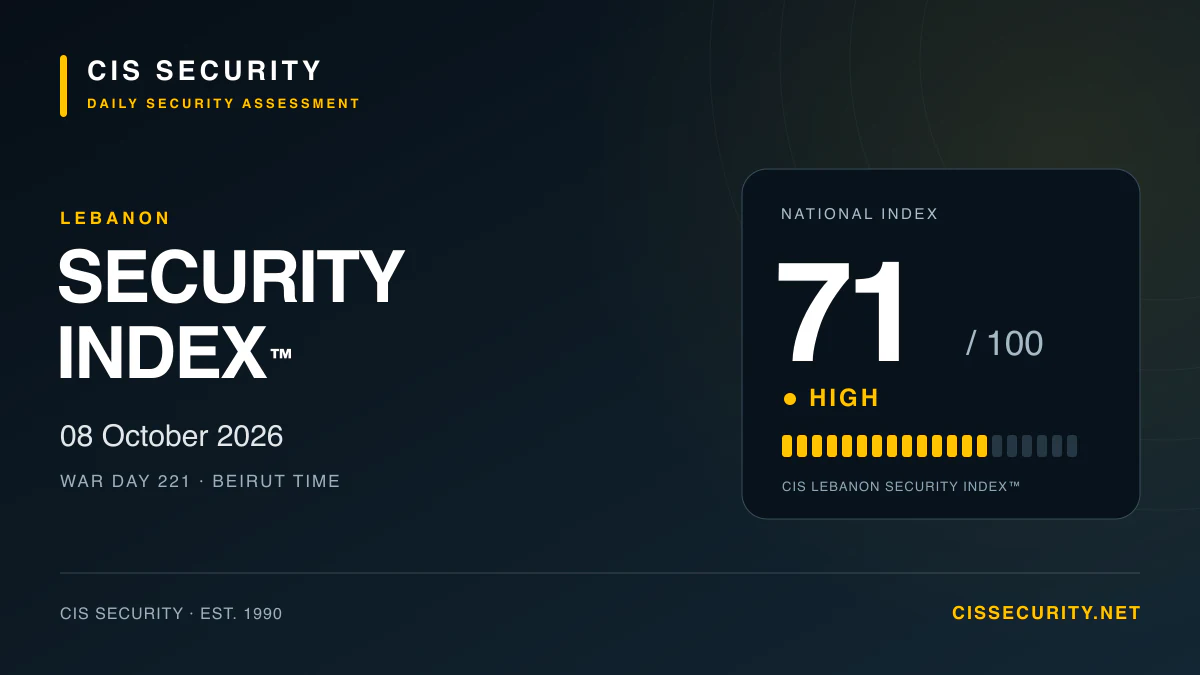
🇱🇧 CIS LEBANON SECURITY INDEX™
Tuesday, September 1, 2026
🔴 WAR DAY 184 | ISRAEL TELLS WASHINGTON THE PILOT-ZONE PROJECT HAS "FAILED" | SENIOR ISRAELI OFFICIAL: "NO REAL FRICTION BETWEEN THE LEBANESE ARMY AND HEZBOLLAH" | QASSEM, AGAIN: DEAL IS "ILLEGITIMATE, UNLAWFUL, HUMILIATING" — REJECTS VERIFICATION SYSTEM OUTRIGHT | PARADOX: LEBANESE ARMY OFFICERS THEMSELVES WANT IDF TO STAY, FEAR HEZBOLLAH'S RETURN | ONE BRIGHT SPOT: METULA SCHOOL REOPENS FOR FIRST TIME SINCE OCTOBER 2023
INDEX LEVEL: 🔴 CRITICAL — THE FRAMEWORK'S CENTRAL DISARMAMENT MECHANISM HAS BEEN DECLARED A FAILURE BY THE ISRAELI GOVERNMENT ITSELF, TO WASHINGTON, IN WRITING OVERALL INDEX: 77/100 TREND: ⬆️ RISING SHARPLY — CIS must report today the most consequential single verdict on the entire post-framework process since it began tracking this conflict in late June. Israel's government has formally conveyed to the United States, through security channels, that the pilot-zone program in southern Lebanon — the specific mechanism CIS has followed in painstaking detail since the July 21 handover of Zawtar al-Gharbiyeh — "has failed," according to Israeli news outlet Walla, corroborated by the Jerusalem Post, Naharnet, the Algemeiner, and FDD's own daily briefing. A senior Israeli security official's verdict, delivered on condition of anonymity, is worth quoting in full: "There is no real friction between the Lebanese Army and Hezbollah. Hezbollah would not want anyone to collect its weapons or destroy its infrastructure." Israeli officials specifically accuse the Lebanese Armed Forces of failing to act on precise coordinates for Hezbollah infrastructure that Israel itself has supplied, even while continuing to request additional intelligence it then does not act upon — and assess that Army Commander Rodolphe Haykal "is afraid of confronting Hezbollah leaders in southern Lebanon." Compounding this, a fresh Meir Amit Intelligence and Terrorism Information Center report published the same day found Hezbollah-linked organizations, including the Wa Ta'awanu Association, continuing to operate openly inside the pilot zones under the guise of humanitarian and civil work. Hezbollah's Secretary-General Naim Qassem, for his part, has offered no ambiguity about his own view of the process: in a speech this week, he again rejected the entire framework agreement as "illegitimate, unlawful, humiliating," explicitly stating "we do not agree to the 'pilot zones' or to what comes from them," and rejecting outright any proposed international verification system for disarmament. And in a genuinely striking, counterintuitive twist CIS is reporting for the first time today, a senior American official says certain Lebanese Army officers themselves do not actually want Israeli forces to withdraw — for fear that an IDF departure would allow Hezbollah to swiftly reoccupy the areas from which it has been excluded. Amid all of this, one small, human-scale sign of normalization stands out: for the first time since October 2023, the Israeli border town of Metula reopened its elementary school and kindergarten this week, welcoming 36 students in grades one through six and 18 kindergartners.
⛔ EXECUTIVE SUMMARY — TUESDAY SEPTEMBER 1, 2026 (WAR DAY 184)
THE VERDICT: ISRAEL TELLS WASHINGTON THE PILOT-ZONE PROJECT "HAS FAILED"
Israel has conveyed a formal message to the United States, through security channels, that the pilot-zone program launched in southern Lebanon following the June memorandum of understanding "has failed," according to Israeli news outlet Walla, reported Thursday, August 28, and independently corroborated by the Jerusalem Post, Naharnet, the Algemeiner, and FDD's Overnight Brief.
The core of Israel's complaint, per multiple sourced accounts:
- "The Lebanese Army is not destroying terror infrastructure based on the coordinates provided to it by the IDF, while at the same time requesting more coordinates, even though it is not doing anything about it," a senior security official told Walla.
- A senior Israeli security official's most direct characterization: "There is no real friction between the Lebanese Army and Hezbollah. Hezbollah would not want anyone to collect its weapons or destroy its infrastructure."
- Senior IDF officials specifically assess that LAF Commander Gen. Rodolphe Haykal "continues to cooperate with Hezbollah, is reluctant to confront the terror group's commanders in southern Lebanon, and has been ineffective in searching for and locating Hezbollah infrastructure and weapons."
- The Israeli official added that the Lebanese military is "more focused on coordination" than enforcement, and that Israel's dissatisfaction is the reason it has, per CIS's own August 10 and August 22 reporting, refused to expand the pilot-zone framework beyond the original three villages (Zawtar al-Gharbiyeh, Srifa, and Froun).
- Israeli assessments separately note that Iran, previously a significant source of support to Hezbollah, is currently preoccupied with its own survival struggles amid the broader regional war and is "not rushing to come to Hezbollah's aid."
CIS assessment: This is, in CIS's own considered judgment, the single most damaging verdict on the framework's central operating mechanism that CIS has documented in over two months of tracking this process. Every positive development CIS has reported regarding the pilot zones — the July 21 handover itself, the weapons-cache discovery CIS covered on July 29, President Salam's rebuilding pledge, the incremental civilian return to Zawtar al-Gharbiyeh — must now be read against an explicit, formal Israeli government assessment that the entire underlying mechanism these developments were meant to validate has not worked. CIS notes this is Israel's own characterization, conveyed confidentially to its closest ally rather than as public messaging, which lends it particular credibility as a genuine internal assessment rather than a negotiating position calculated for external audiences.
INDEPENDENT CORROBORATION: HEZBOLLAH-LINKED GROUPS STILL OPERATING OPENLY IN THE PILOT ZONES
The Meir Amit Intelligence and Terrorism Information Center (ITIC), an Israeli research institute, released a report the same week concluding that the pilot program has failed to deliver on the security commitments in the MoU, finding that Hezbollah-linked organizations continue operating openly in the pilot zones, and that the Lebanese government "struggles to confront the group's extensive civilian infrastructure." The report specifically names the Wa Ta'awanu Association, which provides food and housing assistance to local residents but has long been suspected of also serving as civilian cover for Hezbollah's activities in the area.
CIS assessment: This finding directly corroborates and extends CIS's own August 8 reporting, in which CIS documented Hezbollah's Islamic Health Organization continuing to operate openly in Zawtar al-Gharbiyeh — the flagship pilot-zone village. What CIS then treated as a single, notable data point now appears, per this independent institutional assessment, to reflect a broader, systemic pattern across the pilot zones as a whole, rather than an isolated exception in one village.
QASSEM, AGAIN: "ILLEGITIMATE, UNLAWFUL, HUMILIATING" — NO VERIFICATION SYSTEM, EITHER
Hezbollah Secretary-General Naim Qassem used a recent speech to reject the framework agreement in the most categorical terms CIS has yet recorded, calling it "illegitimate, unlawful, humiliating" and stating plainly: "We do not agree to the 'pilot zones' or to what comes from them." He separately and explicitly rejected any proposed verification system for the disarmament process — directly foreclosing the specific mechanism (a shortlist of countries to oversee pilot-zone implementation, which CIS reported as reportedly agreed following the August Rome talks, then walked back as unconfirmed on August 14) that has been the subject of extended diplomatic discussion throughout August.
CIS assessment: Qassem's outright rejection of any verification system, delivered on the record, removes any remaining ambiguity CIS had preserved since its August 14 correction regarding whether a disarmament-verification mechanism might still emerge through ongoing US-Lebanon discussions. If Hezbollah's own Secretary-General has publicly foreclosed the entire concept of international verification, any such mechanism Lebanon and the US continue to discuss would, on Qassem's own terms, lack Hezbollah's acceptance from the outset — a structural problem no amount of further US-Lebanon technical negotiation can resolve unilaterally.
THE PARADOX: LEBANESE ARMY OFFICERS THEMSELVES WANT ISRAEL TO STAY
In a genuinely counterintuitive development CIS had not previously documented, a senior American official told Israeli broadcaster Kan that certain officers within the Lebanese Army itself do not, at this stage, want the IDF to withdraw from southern Lebanon — because they fear that an Israeli departure would allow Hezbollah to quickly reoccupy the areas from which it has been excluded.
CIS assessment: This detail, if accurate, substantially complicates the entire withdrawal-sequencing debate CIS has tracked throughout this index. President Aoun has consistently argued, at both the Rome talks and in his own Washington visit (CIS's July 22 update), that Israeli withdrawal is a precondition for meaningful Hezbollah disarmament. Today's report suggests that at least some within the Lebanese military establishment itself — the very institution meant to fill the security vacuum an Israeli withdrawal would create — privately assess the opposite: that continued Israeli presence may currently be the only reliable check on Hezbollah's return to evacuated areas. This is not necessarily inconsistent with Aoun's political position (a government can publicly demand withdrawal while some of its own officers privately doubt their institution's current capacity to enforce the resulting vacuum), but it is a genuinely important data point for assessing the LAF's actual institutional confidence in its own readiness — one that aligns uncomfortably well with Israel's own stated skepticism about the army's capacity and will, reported above.
A HUMAN-SCALE COUNTERPOINT: METULA'S SCHOOL REOPENS
In the Israeli border town of Metula — among the communities most directly affected by nearly three years of hostilities with Hezbollah — the Hanadiv Elementary School and kindergarten reopened this week for the first time since October 2023, welcoming 36 students across grades one through six and 18 kindergartners. Mayor David Azoulay told the Times of Israel: "This is very good news," as he greeted students, parents, and teachers at the school entrance. Metula's residents were evacuated for more than a year following Hezbollah's opening of a second front against Israel after October 7, 2023, with rocket and drone strikes damaging many of the village's buildings, including the school itself, which has since been renovated.
CIS assessment: CIS includes this development deliberately, alongside today's far more troubling institutional findings, because it is a genuine, verifiable, human-scale sign that at least some of the displacement and disruption this conflict has caused is beginning to reverse on the Israeli side of the border — just as CIS has documented similar, if more contested, return movement on the Lebanese side throughout this index (the 640,000+ and later 800,000+ returnee figures CIS reported in July and August). CIS does not read this as evidence that the underlying security situation has resolved — Metula remains within the border zone most exposed to any renewed hostilities — but as a data point worth weighing alongside, not instead of, today's far more serious institutional assessments.
📊 UPDATED KEY FIGURES — AS OF SEPTEMBER 1, 2026
| Metric | Figure | Source |
|---|---|---|
| Original pilot-zone villages | 3 (Zawtar al-Gharbiyeh, Srifa, Froun) | CIS tracking, confirmed multiple sources |
| Time elapsed since pilot program launch (as of Israel's "failed" assessment) | ~1.5 months (July 20/21 – late August) | Jerusalem Post |
| Metula students returning to reopened school | 36 (grades 1-6), plus 18 kindergartners | Times of Israel |
| Time Metula's school was closed | Since October 2023 (~3 years) | Times of Israel |
| Next scheduled round of Israel-Lebanon talks | September (specific date not yet confirmed in available reporting) | Jerusalem Post |
📌 WHAT CIS IS WATCHING — IMMEDIATELY
- Does Israel's "the pilot zone has failed" assessment translate into a formal policy shift — a suspension of the process, a demand for an entirely different mechanism, or renewed large-scale military action framed as a corrective response?
- Does the Lebanese government or Army Command publicly respond to Israel's specific criticisms (failure to act on provided coordinates, Haykal's alleged reluctance to confront Hezbollah), or does this remain an internal US-Israel diplomatic communication without public Lebanese rebuttal?
- Does the reported internal Lebanese Army preference for continued Israeli presence become more widely acknowledged or debated within Lebanon's own political discourse, given its direct tension with the government's official withdrawal-first negotiating position?
- Does Qassem's explicit rejection of any verification system end discussion of the mechanism entirely, or does the US-Lebanon technical dialogue continue regardless of Hezbollah's stated position?
- Does the September round of talks (date not yet confirmed) proceed at all, given the fundamental breakdown in the pilot-zone mechanism's credibility this week's reporting describes?
🛡️ CIS SECURITY — SEPTEMBER 1 ASSESSMENT & GUIDANCE
Trusted Security Excellence Since 1990 | "Because Your Safety Isn't Optional"
CIS POSTURE: LEVEL 5 — SEVERE ALERT (maintained, at elevated severity)
CIS maintains Level 5 — Severe Alert at elevated severity within this designation. A formal Israeli government assessment that the framework's central disarmament-verification mechanism has failed, corroborated by independent Israeli research institutions and compounded by Hezbollah's own explicit rejection of any verification system, together describe a process at genuine risk of complete institutional breakdown — a materially more serious situation than the incremental frictions and disputed incidents CIS has documented at individual pilot-zone locations throughout August.
ZONE-BY-ZONE GUIDANCE
CIS's zone-by-zone guidance from its August 28 update remains in full effect: continue to avoid Ali al-Taher Ridge, Ansar, Deir al-Zahrani, Biout es Sayed, Nabatieh (broader area and Deir neighborhood), Mansouri, the security zone/buffer zone generally, and to maintain elevated caution in Dahiyeh and the Bekaa Valley. CIS is additionally advising continued significant caution regarding all three original pilot-zone villages (Zawtar al-Gharbiyeh, Srifa, Froun) given today's institutional findings regarding the incomplete and contested nature of their actual security status, notwithstanding their formal "handover" designation.
📞 EMERGENCY CONTACTS — SEPTEMBER 1, 2026
CIS Security 24/7: +961 3 539900 | info@cissecurity.net | www.cissecurity.net Lebanese Army South Lebanon Liaison: +961-8-802-510 US Embassy Emergency: +1-202-501-4444 | BeirutACS@state.gov Lebanese Red Cross: 1760 Civil Defence: 125 ISF: 112 National Mental Health Lifeline: 1564 (24/7 — confidential)
⚠️ FINAL ASSESSMENT — WAR DAY 184, SEPTEMBER 1, 2026
Today's report requires CIS to state plainly what two months of granular, location-by-location tracking has been circling around: the specific mechanism at the heart of this entire framework — Lebanese Army enforcement of Hezbollah disarmament, verified zone by zone — has now been declared a failure by the very government whose cooperation it was designed to secure.
This is not a diplomatic setback of the kind CIS has documented and then seen partially reversed throughout this index — a stalled round of talks, a contested single incident, an unconfirmed report of progress. It is Israel's own confidential assessment, delivered to its closest ally through security channels rather than public statements, that the underlying premise of the pilot-zone process — that the Lebanese Army would use Israeli-supplied intelligence to actually locate and dismantle Hezbollah infrastructure — has not held true in practice. The specific, granular complaint that Lebanon is requesting more coordinates while acting on none of the coordinates already provided is a strikingly concrete allegation, not a vague expression of frustration.
Hezbollah's own position offers no counter-narrative that would ease this assessment — quite the opposite. Qassem's flat rejection of the pilot zones and of any verification mechanism confirms, from the other side entirely, that the process's foundational assumptions were contested by the party meant to be disarmed from the very outset.
And the genuinely new detail that some Lebanese Army officers themselves privately prefer continued Israeli presence suggests this is not simply a story of Lebanese unwillingness set against Israeli impatience — it may reflect a deeper, more troubling reality in which the institution central to this entire framework's success does not yet trust its own capacity to manage the security vacuum that full Israeli withdrawal would create.
Metula's reopened school is a genuine, welcome sign that some corner of this conflict's human cost is beginning to heal. But CIS's clear-eyed assessment is that today's institutional findings represent the most serious challenge to the framework's basic viability that CIS has documented since this index began. CIS maintains Level 5 — Severe Alert at elevated severity and will be watching closely for how — or whether — this specific breakdown is addressed in the weeks ahead.
+961 3 539900 | info@cissecurity.net | cissecurity.net CIS Security — Because Your Safety Isn't Optional — Est. 1990
CIS Lebanon Security Index™ | Tuesday, September 1, 2026 | WAR DAY 184
Sources: Naharnet, "Report: Israel says pilot zones scheme has 'failed'" (August 28, 2026 — full Walla-sourced quotes); The Jerusalem Post, "Lebanese army failing to curb Hezbollah activity in south, Israeli officials tell US" (August 28, 2026 — full senior security official quotes, Haykal characterization); The Yeshiva World, "ISRAEL TO U.S.: Southern Lebanon Withdrawal Pilot Has Failed As IDF Blasts Lebanese Army" (August 28, 2026); Middle East Monitor, "Israeli media: Israel tells US pilot zone project in southern Lebanon has failed" (August 28, 2026 — additional Haykal quote detail); FDD Overnight Brief, "August 28, 2026" (August 28, 2026 — Jerusalem Post corroboration); The Algemeiner, "Israel-Lebanon Deal Under Strain as Hezbollah Disarmament Falls Short" (August 28-29, 2026 — full ITIC report findings, Wa Ta'awanu Association detail); i24NEWS, "Lebanese army wants IDF to remain in southern Lebanon, for fear of Hezbollah return - report" (September 1, 2026 — full senior American official quote, Kan sourcing); NewsBeep/AFP, "Lebanese Army Wants IDF To Remain In Southern Lebanon, For Fear Of Hezbollah Return – Report" (September 1, 2026); The Times of Israel, "Hezbollah chief vows no 'surrender' as he again rejects Israel-Lebanon deal" (late August 2026 — full Qassem quotes on "illegitimate, unlawful, humiliating," pilot zones rejection, verification system rejection); The Times of Israel liveblog, "September 1, 2026" (September 1, 2026 — Metula Hanadiv Elementary School reopening, full Mayor Azoulay quote, 36/18 student figures); prior CIS reporting (July 4–August 28, 2026) carried forward for context.
CIS notes that Israel's "pilot zone has failed" assessment and the reported internal Lebanese Army preference for continued IDF presence are both drawn from anonymously-sourced official accounts (Walla and Kan, respectively) rather than on-record government statements, though corroborated across multiple independent outlets; CIS presents them as credible, well-sourced reporting rather than officially confirmed government positions. All other military, diplomatic, and political statements are attributed to named officials or sourced reporting, August 28–September 1, 2026. Index compiled: Tuesday, September 1, 2026 — Beirut time.