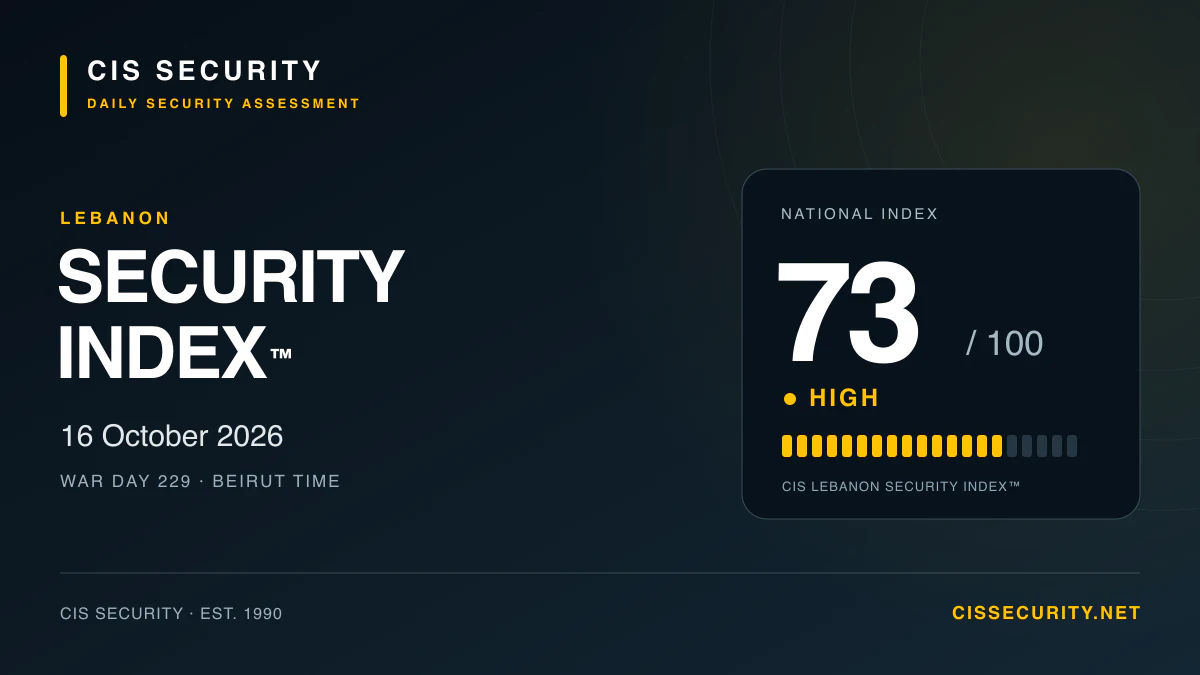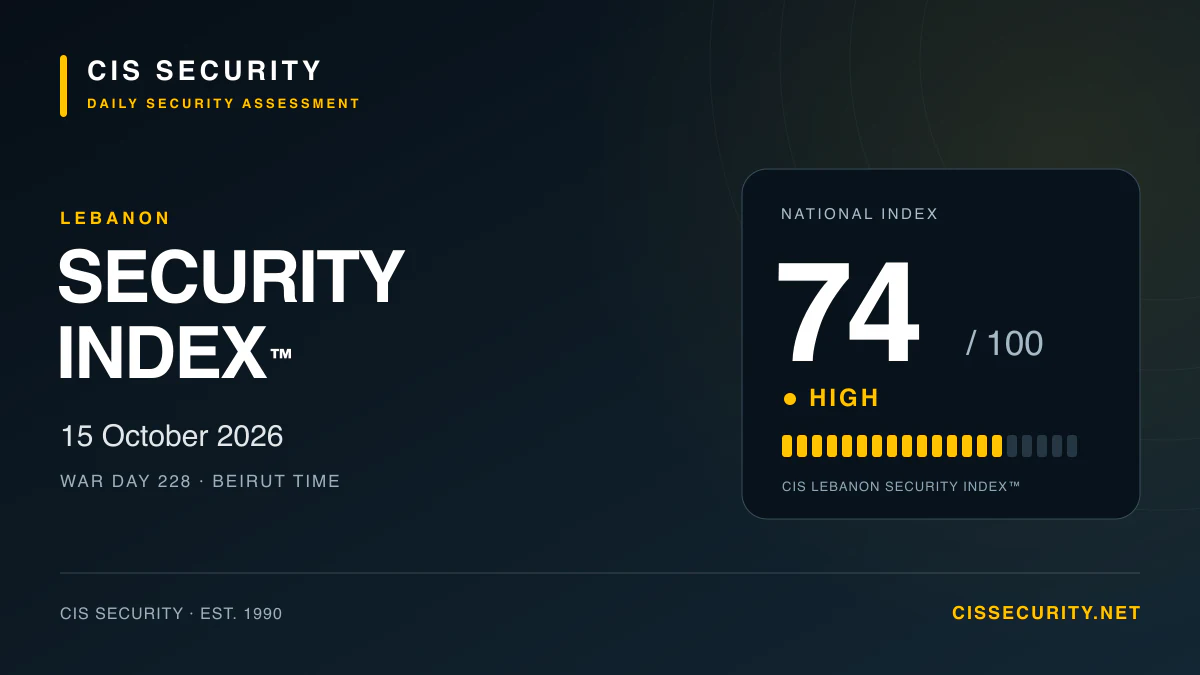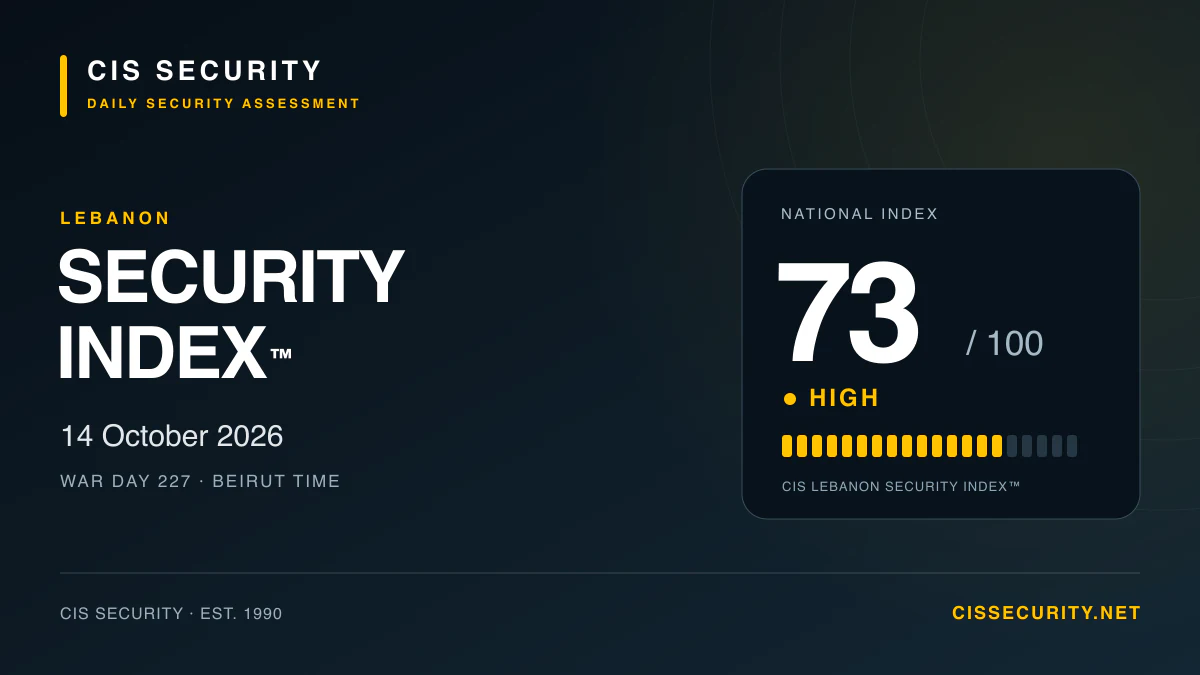
🇱🇧 CIS LEBANON SECURITY INDEX™
Friday, September 25, 2026
🟠 WAR DAY 208 | IRAN'S FM SAYS TEHRAN HAS PROPOSED A 7-DAY MIDDLE EAST-WIDE CEASEFIRE — INCLUDING LEBANON — IN EXCHANGE FOR REOPENING HORMUZ; IRANIAN STATE MEDIA DENIES IT | SALAM TELLS IRAN'S PRESIDENT LEBANON WON'T BE "AN ARENA FOR REGIONAL WARS" | TRUMP APPEARS TO SKIP SALAM IN UNGA HANDSHAKE LINE | GROUND: STRIKES AND ARTILLERY CONTINUE NEAR KFARTEBNIT, NO CASUALTIES REPORTED
INDEX LEVEL: 🟠 HIGH — A POTENTIALLY SIGNIFICANT OFF-RAMP EMERGES, BUT ITS OWN AUTHORS CAN'T AGREE IT EXISTS OVERALL INDEX: 77/100 TREND: ↔️ HOLDING, WITH GENUINE BUT CONTESTED DIPLOMATIC MOVEMENT — Iranian Foreign Minister Abbas Araghchi told the New York Times and the Guardian in New York on Thursday that Iran has submitted a proposal to the United States under which a seven-day cessation of hostilities across the Middle East — explicitly including Lebanon — would culminate in Iran reopening the Strait of Hormuz on the seventh day, contingent on the release of at least $12 billion in frozen Iranian assets, the lifting of sanctions on Iranian oil, and an end to the US naval blockade of Iran. Araghchi said he was awaiting a US response and that China supports the proposal. CIS flags an important complication: Japan's Kyodo news agency first reported this proposal Tuesday citing a senior Iranian official, but Iranian state media denied the Kyodo report at the time, and Tehran's authorities have not clarified their position even after Araghchi's own on-record comments to Western outlets. CIS also notes the $12 billion figure Araghchi cited to the Times is markedly lower than the $24 billion IRGC spokesman Mohebi described as a hardened demand just one day earlier, on Wednesday — a discrepancy CIS cannot currently resolve and flags as evidence of either an evolving Iranian position or genuine internal inconsistency in how Tehran is presenting its own demands. Separately, PM Nawaf Salam met Iranian President Masoud Pezeshkian on the UNGA sidelines Thursday and delivered a pointed message: Lebanon "has paid a heavy price in terms of its security, stability and economy" and "does not want to become an arena for regional conflicts or a venue for the exchange of messages between others," while saying he hoped for a "new chapter" in Lebanon-Iran ties. Hours earlier, footage circulated showing US President Trump appearing to bypass Salam while greeting a line of regional leaders — Iraq's PM, Turkey's Erdoğan, Jordan's King Abdullah II, Qatar's Emir, Syria's al-Sharaa, and Egypt's PM — before later shaking hands with the rest of the room as he departed; Salam dismissed the controversy to al-Jadeed television, noting Trump "shook hands with four people out of 15 present in the room" and shook the rest on his way out. On the ground, Naharnet's Friday roundup reported an Israeli strike on the area between Kfartebnit and Nabatieh al-Fawqa, with artillery shelling Wadi al-Hujeir, Majdalzoun, and the outskirts of Kfartebnit; CIS has no casualty report attached to this activity as of this edition. CIS holds its Index near yesterday's level: a genuinely significant potential diplomatic opening has emerged, directly naming Lebanon as part of a broader settlement, but its authenticity is disputed by Iran's own state media, and ground conditions in south Lebanon remain unchanged.
⛔ EXECUTIVE SUMMARY — FRIDAY SEPTEMBER 25, 2026 (WAR DAY 208)
THE 7-DAY PROPOSAL: A LEBANON CEASEFIRE AS THE PRICE OF REOPENING HORMUZ
Araghchi's account, as relayed to the New York Times and the Guardian, describes a specific, time-bound sequence: seven days of complete cessation of hostilities across the region, including Lebanon, running in parallel with US action on frozen assets, oil sanctions, and the naval blockade, concluding with Iran reopening the Strait of Hormuz on day seven. This builds on, but differs in scale from, the demands IRGC spokesman Mohebi described to AFP just one day earlier — Wednesday's figure was $24 billion released upfront with no explicit seven-day sequencing described; Thursday's figure, per Araghchi, is "at least $12 billion" tied to this specific weeklong framework.
CIS assessment: CIS treats the existence of some form of Iranian proposal along these lines as credible, given that it has now been described independently by Kyodo (citing a senior official) and by Araghchi himself on the record to two major Western outlets. What CIS cannot currently assess is whether this represents Iran's actual, coordinated negotiating position or one faction's or spokesperson's characterization of an internal deliberation that other parts of the Iranian government are not yet ready to confirm publicly. The explicit inclusion of Lebanon in this specific proposal is, regardless of its ultimate fate, further confirmation of the linkage CIS first flagged clearly in Wednesday's edition: Lebanon's trajectory may depend as much on the broader US-Iran settlement track as on anything negotiated bilaterally between Beirut and Jerusalem.
SALAM TO PEZESHKIAN: LEBANON WILL NOT BE YOUR MESSAGE BOARD
In a meeting Salam's office confirmed took place on the UNGA sidelines, the Lebanese prime minister told Iran's president directly that Lebanon does not want to be "an arena for regional conflicts or a venue for the exchange of messages between others," while separately expressing hope for a "new chapter" in bilateral relations. This is Salam's most direct statement to an Iranian head of state, in person, on the theme he and President Aoun have both pursued rhetorically throughout September — sovereignty, state authority, and resistance to being treated as a proxy battlefield.
CIS assessment: CIS reads this meeting, delivered the same day as Fadlallah's more conciliatory Beirut remarks (below) and against the backdrop of Araghchi's Lebanon-inclusive ceasefire proposal, as part of a coordinated moment in which multiple Lebanese and Iranian-aligned voices are simultaneously testing different registers — Salam pushing sovereignty and distance from Tehran, Fadlallah acknowledging Iran's regional weight while insisting it does not supplant the Lebanese state, and Iran's own foreign minister explicitly folding Lebanon into a global settlement proposal. Whether these registers are coordinated or simply coincide is not something CIS can determine from available reporting.
FADLALLAH, ONE DAY LATER: A SOFTER FOLLOW-UP
Building on Monday's more combative "preparing for confrontation" statement, Hezbollah MP Hassan Fadlallah said Thursday that Iran's "powerful regional equation" is what will ultimately compel Israeli withdrawal, reconstruction, and the return of displaced residents, and that Lebanon "cannot be separated from the region's situation." Notably, he added a clarification absent from Monday's remarks: "This does not mean Iran is replacing the Lebanese state," saying Iran has urged Lebanese authorities to negotiate on their own behalf under the "umbrella" of the US-Iran memorandum, and that Lebanon "must capitalize on" that pathway. He said Hezbollah consistently hears from Iran that "Lebanon will remain the top priority in any Iranian-American agreement."
CIS assessment: This is a noticeably more diplomatically calibrated statement than Monday's, and directly addresses a criticism — that Hezbollah's positioning effectively subordinates Lebanese sovereignty to Iranian direction — that Salam's own remarks to Pezeshkian implicitly raised the same day. CIS reads this shift as consistent with its September 24 recalibration: Fadlallah's rhetoric moves along a spectrum depending on audience and moment, and Thursday's more conciliatory framing should be weighed alongside, not simply replaced by, Monday's more combative one.
THE HANDSHAKE: SYMBOLISM, NOT SUBSTANCE, BUT WORTH NOTING
Video circulating from a New York meeting of regional leaders showed Trump greeting a line that included Iraq's, Turkey's, Jordan's, Qatar's, Syria's, and Egypt's leaders while appearing to pass over Salam, who was standing among them; Trump later shook hands with the remaining attendees, including reportedly Salam, as he left. Lebanese social media and political commentary divided sharply over whether this reflected deliberate coldness — some outlets linked speculation to Salam's prior tenure as President of the International Court of Justice during the South Africa v. Israel proceedings — or an unremarkable few seconds with no intended message. Salam himself dismissed the controversy with the line: "Many are trying to fish in troubled waters... they haven't caught a single fish."
CIS assessment: CIS treats this as a genuinely ambiguous symbolic event rather than a substantive diplomatic signal, consistent with Salam's own dismissive framing and the fact that Washington has not linked the moment to any policy position. CIS includes it because it has become a live topic of Lebanese political discourse this week, not because CIS assesses it as independently significant to the security situation.
THE GROUND: UNCHANGED, NO NEW CASUALTIES
Naharnet's Friday roundup described an Israeli strike on the area between Kfartebnit and Nabatieh al-Fawqa and artillery shelling of Wadi al-Hujeir, Majdalzoun, and Kfartebnit's outskirts — a continuation of the same recurring cluster of locations CIS has tracked for essentially the entire month. No casualty figure was reported.
CIS assessment: This pattern's persistence, unaffected by a week of intense high-level diplomatic activity in New York, is itself informative: whatever happens at the UN or in Washington-Tehran back-channels has not yet translated into any observable change in the tempo of ground operations in south Lebanon.
📅 KEY TIMELINE — SEPTEMBER 23–25
| Date | Event |
|---|---|
| Sep 23 (Wed) | Macron commits to UNIFIL replacement; Mohebi describes hardened Iranian conditions ($24B upfront) |
| Sep 24 (Thu) | EU announces €505M Lebanon package; Trump-Salam handshake controversy; Salam meets Pezeshkian, Sharaa, Lavrov |
| Sep 24 (Thu) | Fadlallah offers more conciliatory follow-up: "Iran not replacing Lebanese state" |
| Sep 24 (Thu) | Araghchi tells NYT/Guardian of a 7-day ceasefire-for-Hormuz proposal including Lebanon; Iranian media denies the earlier Kyodo report |
| Sep 25 (Fri) | Strikes/artillery continue near Kfartebnit, Nabatieh al-Fawqa, Wadi al-Hujeir, Majdalzoun; no casualties reported |
🗺️ GOVERNORATE-LEVEL SECURITY STATUS
| Governorate | Status |
|---|---|
| Nabatieh district (incl. Kfartebnit, Nabatieh al-Fawqa) | 🟠 HIGH — continued strikes/artillery; no casualties reported |
| South Lebanon (broader) | 🟠 HIGH — carried forward general elevated status |
| Beirut | 🟡 MEDIUM — no direct incident; intense diplomatic activity conducted via New York |
| Mount Lebanon, Keserwan-Jbeil, North Lebanon, Akkar, Beqaa Valley, Baalbek-Hermel | 🟢 LOW — no CIS-identified incidents for today's reporting window |
| Rafic Hariri Airport | ✅ Operating |
| Strait of Hormuz / Gulf of Oman | 🟠 HIGH — a specific, contested 7-day resolution proposal now directly links this theater to Lebanon's fate |
📊 SEPTEMBER 25 STATISTICS — WAR DAY 208
| Metric | Figure | Source |
|---|---|---|
| Proposed ceasefire duration before Hormuz reopens | 7 days, region-wide incl. Lebanon | Iranian FM Araghchi, via NYT/Guardian, cited by Naharnet |
| Frozen assets demanded (Araghchi's Thursday figure) | At least $12 billion | Araghchi, via NYT |
| Frozen assets demanded (Mohebi's Wednesday figure, for comparison) | $24 billion | IRGC spokesman Mohebi, via AFP, carried forward |
| Leaders Trump reportedly shook hands with before Salam, per Salam | 4 of 15 present in the room | PM Salam, via al-Jadeed/Naharnet |
| Locations struck/shelled, Friday | 4 (Kfartebnit–Nabatieh al-Fawqa strike; Wadi al-Hujeir, Majdalzoun, Kfartebnit artillery) | Naharnet |
| Casualties reported from Friday's activity | None reported | Naharnet |
| Cumulative Lebanon toll since March 2, 2026 | 4,386 killed, 12,400 injured (unchanged; no new official figure found today) | Al Jazeera, carried forward |
| War duration | 208 days (conflict-day anchor 2026-03-02, inclusive count) | CIS calculation |
| Truce-day count | 98 days since the June 20 truce anchor | CIS calculation |
🔑 KEY STATEMENTS
| Actor | Statement (paraphrased/summarized) |
|---|---|
| Iranian FM Abbas Araghchi | Says Iran proposed a 7-day region-wide ceasefire including Lebanon, culminating in reopening Hormuz, contingent on asset release, sanctions relief, and an end to the naval blockade |
| Iranian state media | Denied an earlier Kyodo report describing a similar proposal; Tehran has not clarified its position since |
| PM Nawaf Salam (to Pezeshkian) | Lebanon "does not want to become an arena for regional conflicts or a venue for the exchange of messages between others"; hopes for a "new chapter" |
| PM Nawaf Salam (on the handshake) | "Many are trying to fish in troubled waters... they haven't caught a single fish" |
| MP Hassan Fadlallah (Thursday) | "This does not mean Iran is replacing the Lebanese state"; Lebanon "must capitalize on" the US-Iran memorandum's umbrella |
🛡️ CIS SECURITY — SEPTEMBER 25 ASSESSMENT & GUIDANCE
CIS POSTURE: LEVEL 5 — SEVERE ALERT (Maintained)
CIS maintains Level 5 — Severe Alert. The emergence of a specific, dated proposal explicitly linking a Lebanon ceasefire to a broader Hormuz resolution is a genuinely significant development CIS will track closely, but its immediate disputed status — denied by Iranian state media even after Iran's own foreign minister described it on record — means CIS cannot treat it as an actionable near-term off-ramp. Ground conditions in south Lebanon remain materially unchanged.
What CIS is watching: Whether Tehran issues an authoritative, unified position confirming or denying the 7-day proposal; any US response to Araghchi's account; whether the discrepancy between the $12 billion and $24 billion figures is resolved or explained; and whether the intense diplomatic activity of this UNGA week produces any observable change in the ground-level strike pattern CIS has tracked essentially unchanged for the entire month.
📞 EMERGENCY CONTACTS
CIS Security 24/7 (for active clients): +961 3 539900 | info@cissecurity.net Lebanese Army South Lebanon Liaison: +961-8-802-510 US Embassy Emergency: +1-202-501-4444 Lebanese Red Cross: 1760 | Civil Defence: 125 | ISF: 112 National Mental Health Lifeline: 1564
⚠️ FINAL ASSESSMENT — WAR DAY 208, SEPTEMBER 25, 2026
Two hundred and eight days in, today's edition centers on a proposal that could matter enormously if real, and CIS's core obligation is to be honest that it does not yet know if it is. Iran's own foreign minister has now told two major Western newspapers, on the record, that Tehran has offered a specific, time-bound path — seven days of regional ceasefire, including Lebanon, ending with Hormuz reopening — while Iranian state media disputes the earlier version of the same story and Tehran's government has offered no unified clarification. CIS will not pretend more certainty than exists here: this is either a genuine, serious diplomatic opening or a trial balloon one part of the Iranian government is not prepared to own publicly, and CIS cannot yet tell which.
What CIS can say with more confidence is that this week's UN General Assembly session has, for the first time in this cycle, put Lebanon's specific fate explicitly inside a named international proposal, rather than treating it as a separate bilateral track running alongside the broader war. Salam's pointed message to Pezeshkian — delivered in person, at a moment when Iran's own foreign minister was simultaneously citing Lebanon in a global proposal — reads as Lebanon's government trying to assert some control over a narrative in which its country's fate is increasingly being negotiated by others, on other stages, for reasons only partly related to Lebanon itself.
None of this has yet changed anything on the ground. Strikes and artillery near Kfartebnit and Nabatieh al-Fawqa continued Friday exactly as they have for weeks, unaffected by any of this week's diplomacy.
CIS maintains Level 5 — Severe Alert and its Index at 77/100, reflecting a week of genuinely significant but unresolved and internally contradictory diplomatic activity, set against an unchanged security situation on the ground.
The CIS Lebanon Security Index™ is an informational professional assessment. It is not a guarantee of safety and not a substitute for official government guidance. In emergencies, follow official emergency services. CIS accepts no liability for decisions made solely on Index readings.
+961 3 539900 | info@cissecurity.net | cissecurity.net CIS Security — Because Your Safety Isn't Optional — Est. 1990
CIS Lebanon Security Index™ | Friday, September 25, 2026 | WAR DAY 208 Sources: Naharnet, "Iran proposes reopening Hormuz in 7 days, conditions include Lebanon ceasefire" (Sep 24–25, 2026, citing NYT/Guardian/Kyodo); Naharnet, "Salam comments after handshake snub by Trump" (Sep 24, 2026); Naharnet, "Salam to Pezeshkian: Iran cannot be arena for regional wars" (Sep 24, 2026); Naharnet, "Fadlallah says Lebanon can't be separated from region, Iran not replacing Lebanese state" (Sep 24, 2026); Naharnet, "South Lebanon: Latest developments" (Sep 25, 2026); Arab News, "Lebanon PM tells Iran president country cannot be arena for regional wars" (Sep 24, 2026); UPI, "Message to Iran: Lebanon rejects being a stage for regional conflicts" (Sep 24, 2026); The National, "Lebanon seeks 'new chapter' with Iran as leaders hold rare talks at UN" (Sep 24, 2026); Libnanews, "Trump-Salam: behind the missed handshake..." (Sep 25, 2026); prior CIS reporting (September 5–24, 2026) carried forward for context, particularly September 23's coverage of Mohebi's hardened conditions.
CIS explicitly flags the unresolved discrepancy between the $12 billion (Araghchi, Thursday) and $24 billion (Mohebi, Wednesday) frozen-asset figures, and the disputed status of the 7-day ceasefire proposal given Iranian state media's denial of the earlier Kyodo report. No new cumulative Lebanon casualty figure was found for today; the September 19–20 running total is carried forward. All statements are attributed to named officials, spokespersons, or sourced reporting. Index compiled: Friday, September 25, 2026 — Beirut time.