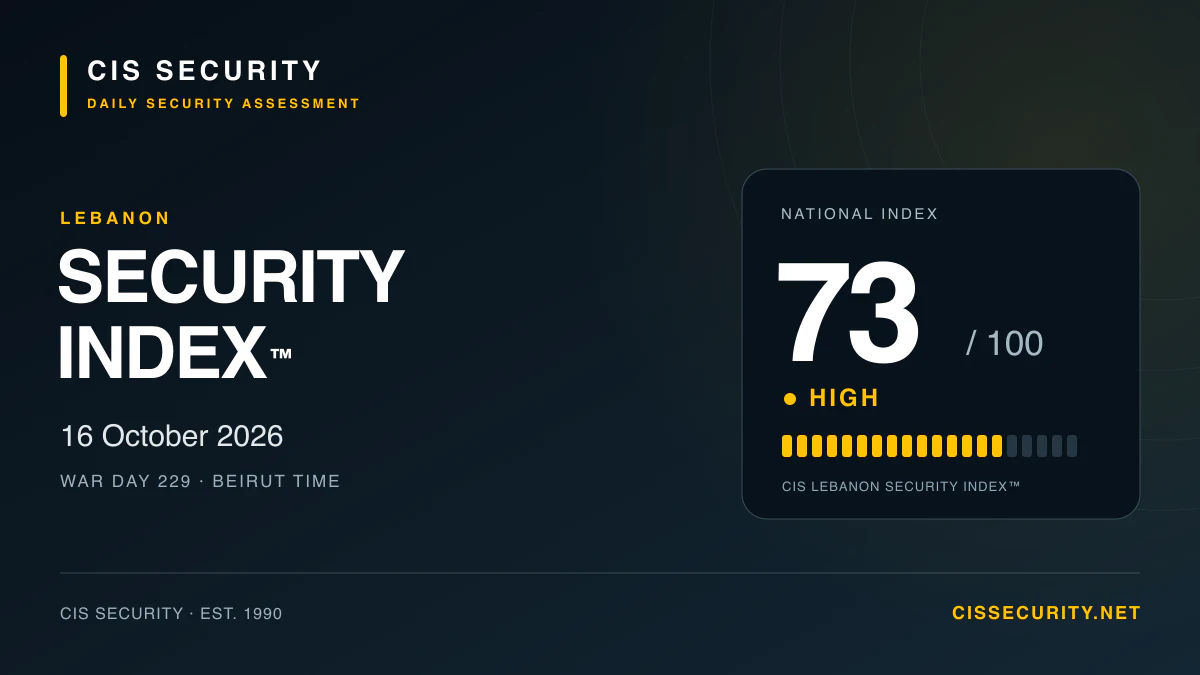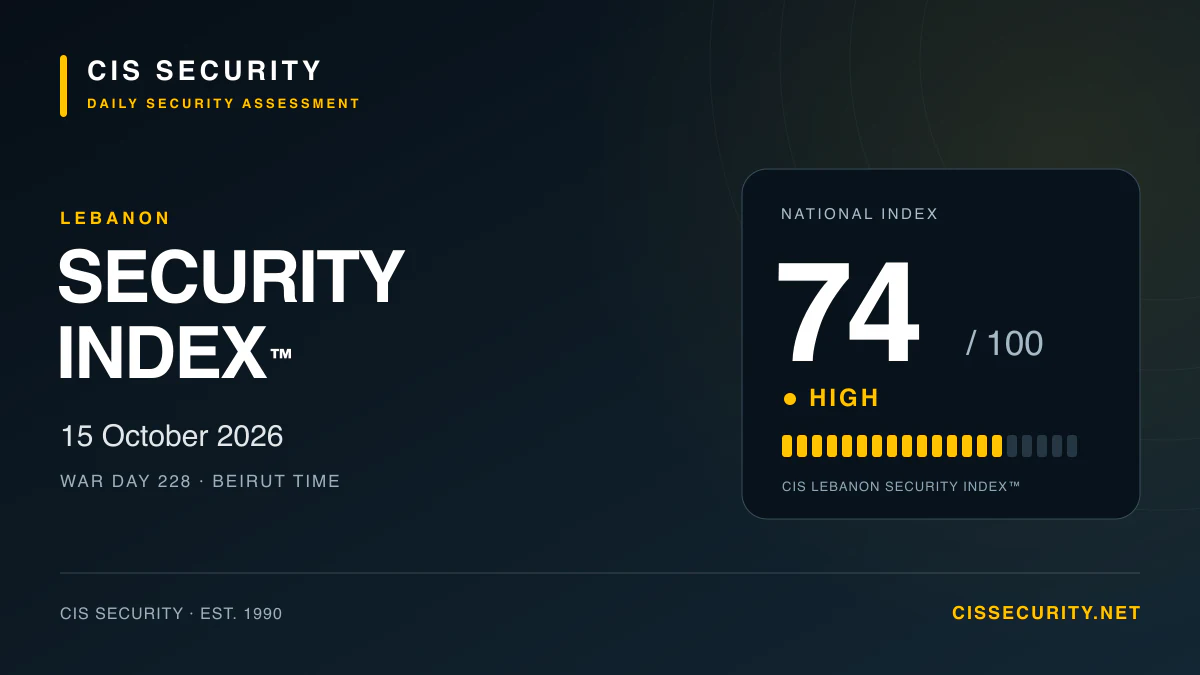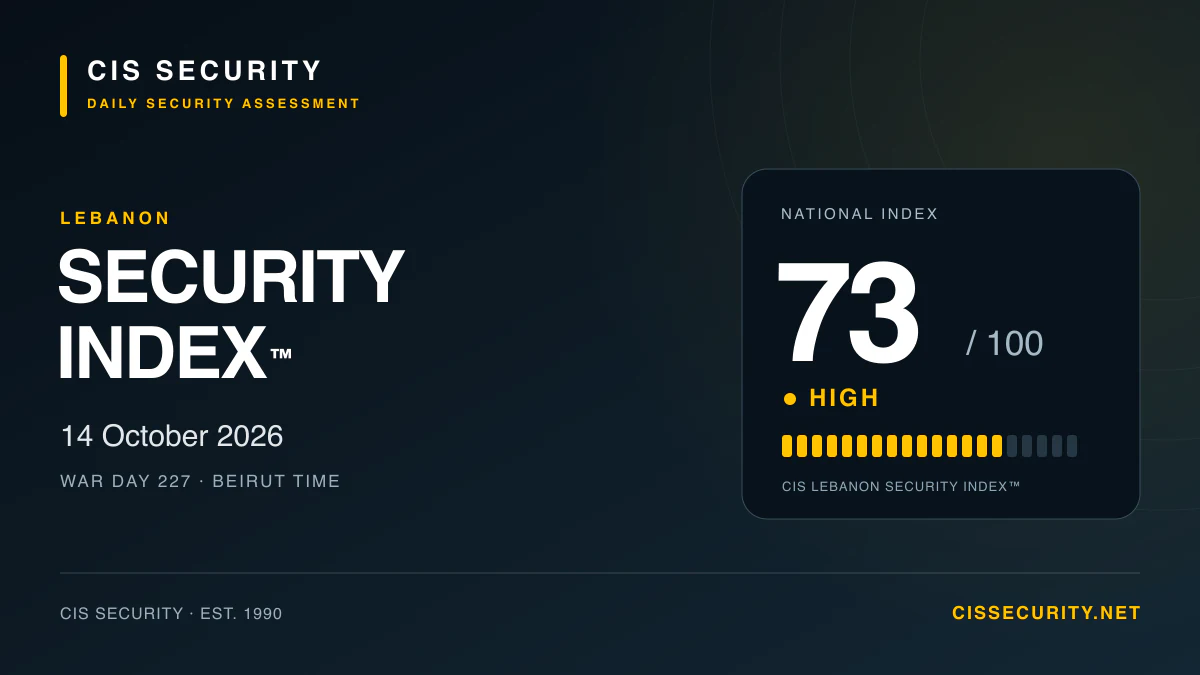
🇱🇧 CIS LEBANON SECURITY INDEX™
Saturday, September 26, 2026
🟠 WAR DAY 209 | SALAM AT UNGA: LEBANON'S "FUTURE MUST NOT BE DECIDED ON ITS BEHALF" — CALLS TO AVERT A POST-UNIFIL VACUUM, LISTS RECOVERING OCCUPIED TERRITORY AS AN "EXISTENTIAL CHALLENGE" | FADLALLAH COMPLETES A WEEK-LONG SOFTENING ARC: HEZBOLLAH AND AMAL "NOT OPPOSED" TO A POLITICAL SOLUTION, OPEN TO INDIRECT NEGOTIATIONS | UNIFIL RECORDS 195 ISRAELI AIRSPACE VIOLATIONS
INDEX LEVEL: 🟠 HIGH — THE CLEAREST WEEK OF CONVERGING DIPLOMATIC SIGNALS CIS HAS DOCUMENTED, NOT YET ACCOMPANIED BY ANY CHANGE ON THE GROUND OVERALL INDEX: 74/100 TREND: ⬇️ EASING — Addressing the UN General Assembly Friday, PM Nawaf Salam listed "three existential challenges" facing his government, the third being to "recover all of its territory from Israeli occupation and extend its sovereignty over its own national soil," explicitly invoking UN Security Council Resolution 1701 as the guiding framework. He renewed his call to "avert the vacuum" that UNIFIL's withdrawal could create without an agreed replacement force — a mission of 7,500 peacekeepers from roughly 50 countries deployed along the 120-kilometer Blue Line, whose mandate the Security Council fixed to end in December under US pressure. Salam also delivered what CIS reads as his most pointed line yet on Lebanon's position within the broader regional negotiations: the country's future "must not be decided on its behalf," and its security and stability "must not be the price paid for settlements reached in its absence" — a clear, if unstated, reference to the dynamic CIS has tracked all week, in which Lebanon's fate is increasingly discussed inside Iran-US and other regional frameworks it is not always party to. UN spokesman Stéphane Dujarric said UNIFIL peacekeepers recorded 195 airspace violations involving Israeli drones, fighter jets, and helicopters — a concrete, quantified figure CIS had not previously had access to. Separately, and in CIS's assessment more significant still, Hezbollah MP Hassan Fadlallah told a Friday press conference that Hezbollah and the Amal Movement "have not shut the doors and are not against a political solution" in the south, explicitly declaring openness to "indirect negotiations" with Israel provided they secure territorial liberation, the return of displaced residents, and reconstruction — while still rejecting what he termed "surrender, submission, or subservience" and criticizing the framework agreement as having "entrenched" the occupation. CIS reads this as the culmination of a rhetorical arc it has tracked in real time across this single week: Monday's assertion of "full operational capabilities" and "preparing for confrontation," Thursday's clarification that "Iran is not replacing the Lebanese state," and now Friday's explicit acknowledgment of openness to negotiation. CIS lowers its Index to reflect the convergence of Salam's assertive-but-engagement-oriented UN diplomacy with Hezbollah's clearest public opening toward a political track in this entire cycle, while noting plainly that ground conditions — recurring strikes and demolitions across the same rotating cluster of southern towns — remain unchanged.
⛔ EXECUTIVE SUMMARY — SATURDAY SEPTEMBER 26, 2026 (WAR DAY 209)
SALAM'S THREE EXISTENTIAL CHALLENGES
In his General Assembly address, Salam framed Lebanon's situation around three challenges he described as existential, the clearest of which — "to recover all of its territory from Israeli occupation and to extend its sovereignty over its own national soil" — directly names the issue underlying nearly every edition CIS has published this month. He explicitly cited UNSCR 1701, the resolution that ended the 2006 war and required Hezbollah's disarmament and retreat north of the Litani River, as the key guideline for relations with Israel — a resolution Israeli officials have themselves repeatedly said Lebanon and UNIFIL have failed to fully implement. Salam separately confirmed Lebanon is engaged in negotiations with Israel "to achieve arrangements" that would end the nearly three-year war and restore full sovereignty.
CIS assessment: Salam's framing places the territorial and sovereignty questions on the same rhetorical plane as existential national challenges, which CIS reads as a deliberate elevation of the south Lebanon question's stakes on the world's largest diplomatic stage, consistent with the sharpening tone CIS has tracked from Lebanon's leadership across the second half of September.
"NOT TO BE DECIDED ON ITS BEHALF": A POINTED LINE
Salam's statement that Lebanon's future must not be decided on its behalf, and that its stability must not be the price of settlements reached in its absence, is language CIS has not previously heard this directly from Lebanon's own prime minister. It arrives one day after Iran's foreign minister told Western outlets that Tehran had proposed a seven-day regional ceasefire explicitly including Lebanon as a condition for reopening the Strait of Hormuz — a proposal Lebanon itself had no visible role in shaping.
CIS assessment: CIS reads this line as Salam directly, if diplomatically, pushing back against precisely the dynamic Araghchi's Thursday proposal represents: major external powers negotiating Lebanon's ceasefire status as a bargaining chip within a larger settlement. Whether intentional or not, the timing gives this line considerably more edge than it might otherwise carry.
FADLALLAH'S WEEK: FROM "CONFRONTATION" TO "INDIRECT NEGOTIATIONS"
CIS has tracked Hassan Fadlallah's public statements closely across this single week, and the arc is now complete enough to summarize plainly. Monday: Hezbollah "maintains full operational capabilities to target Israeli troop deployments," fighters "actively fortifying... and preparing for confrontation." Thursday: Iran's regional weight matters, but "this does not mean Iran is replacing the Lebanese state." Friday: Hezbollah and Amal "have not shut the doors and are not against a political solution," and are "open to indirect negotiations if they lead us to" liberation, return, and reconstruction — while insisting "we are not warmongers" and that the successive conflicts "were imposed upon" the south's residents by history and geography.
CIS assessment: CIS does not read this arc as contradiction or confusion, but as a coherent, calibrated public communications sequence: assert continued capability and resolve, then clarify that Iran does not control Lebanese decision-making, then explicitly open a door to negotiation on Hezbollah's own stated terms. Friday's statement is, in CIS's assessment, the clearest positive signal from Hezbollah's political leadership CIS has recorded in this entire cycle — a genuine, if conditional and rhetorically hedged, acknowledgment that a negotiated outcome is not off the table. CIS cautions that Fadlallah simultaneously rejected the existing framework agreement by name, meaning this openness describes a hypothetical better deal, not support for the process currently underway.
THE GROUND: THURSDAY'S PATTERN, STILL RUNNING
CIS's most recent confirmed ground report, from Thursday, described a massive detonation around Bint Jbeil, artillery shelling of Beit Yahoun, Shaqra, Kounine, Hadatha, and al-Mansouri overnight, strikes on Mayfadoun, al-Mansouri, Wadi al-Hujair, and Wadi Slouqi, and a second consecutive night of detonations in al-Khiam. CIS has not identified a distinct new ground report specific to Saturday as of this edition.
CIS assessment: This is the same recurring cluster of towns and the same mix of methods — detonations, artillery, targeted strikes — CIS has documented essentially without interruption since early September. Neither this week's UN diplomacy nor Fadlallah's rhetorical evolution has yet produced any observable change in this pattern.
📅 KEY TIMELINE — SEPTEMBER 24–26
| Date | Event |
|---|---|
| Sep 24 (Thu) | Massive detonation around Bint Jbeil; artillery/strikes across multiple towns; Fadlallah says "Iran not replacing Lebanese state" |
| Sep 25 (Fri) | Araghchi describes 7-day Hormuz-for-ceasefire proposal including Lebanon; Fadlallah says Hezbollah/Amal open to indirect negotiations |
| Sep 25 (Fri) | Salam addresses UNGA: "three existential challenges," post-UNIFIL vacuum warning, "future must not be decided on its behalf" |
| Sep 26 (Sat) | UN spokesman confirms UNIFIL recorded 195 Israeli airspace violations; no new ground incident identified |
🗺️ GOVERNORATE-LEVEL SECURITY STATUS
| Governorate | Status |
|---|---|
| Bint Jbeil district | 🟠 HIGH — site of Thursday's massive detonation; carried forward |
| South Lebanon (broader, incl. al-Mansouri, al-Khiam) | 🟠 HIGH — recurring strike/detonation pattern continues |
| Beirut | 🟡 MEDIUM — no direct incident; UNGA diplomacy dominates the week's Lebanon-related news |
| Mount Lebanon, Keserwan-Jbeil, North Lebanon, Akkar, Beqaa Valley, Baalbek-Hermel | 🟢 LOW — no CIS-identified incidents for today's reporting window |
| Rafic Hariri Airport | ✅ Operating |
| Strait of Hormuz / Gulf of Oman | 🟠 HIGH — carried forward; Iran's 7-day proposal remains unresolved |
📊 SEPTEMBER 26 STATISTICS — WAR DAY 209
| Metric | Figure | Source |
|---|---|---|
| UNIFIL peacekeepers currently deployed | 7,500, from ~50 countries | Naharnet/Free Malaysia Today, via AFP |
| Length of the Blue Line UNIFIL monitors | 120 km (75 miles) | Naharnet/Free Malaysia Today |
| Israeli airspace violations recorded by UNIFIL (cited period) | 195 (drones, fighter jets, helicopters) | UN spokesman Stéphane Dujarric, via Naharnet |
| UNIFIL mandate end date | December 2026 | UN Security Council, via multiple outlets |
| Cumulative Lebanon toll since March 2, 2026 | 4,386 killed, 12,400 injured (unchanged; no new official figure found today) | Al Jazeera, carried forward |
| War duration | 209 days (conflict-day anchor 2026-03-02, inclusive count) | CIS calculation |
| Truce-day count | 99 days since the June 20 truce anchor | CIS calculation |
🔑 KEY STATEMENTS
| Actor | Statement (paraphrased/summarized) |
|---|---|
| PM Nawaf Salam (UNGA) | Lists recovering occupied territory as an "existential challenge"; Lebanon's future "must not be decided on its behalf" nor its stability "the price paid for settlements reached in its absence" |
| PM Nawaf Salam (on UNIFIL) | Calls to "avert the vacuum" UNIFIL's withdrawal could create without an agreed replacement |
| MP Hassan Fadlallah (Friday) | Hezbollah and Amal "have not shut the doors and are not against a political solution"; open to "indirect negotiations" for liberation, return, and reconstruction; "we are not warmongers" |
| UN spokesman Stéphane Dujarric | Confirms UNIFIL recorded 195 Israeli airspace violations |
🛡️ CIS SECURITY — SEPTEMBER 26 ASSESSMENT & GUIDANCE
CIS POSTURE: LEVEL 5 — SEVERE ALERT (Maintained; index easing further)
CIS maintains Level 5 — Severe Alert while lowering its Index further. The convergence this week of Salam's assertive UN diplomacy and Fadlallah's explicit, if conditional, opening toward indirect negotiations represents the most coherent set of converging positive diplomatic signals CIS has documented in this entire cycle. CIS does not raise this to a lower alert level because none of it has yet produced any observable change in ground conditions, and Fadlallah's openness remains explicitly conditioned on outcomes (liberation, return, reconstruction) rather than acceptance of any process currently underway.
What CIS is watching: Whether Fadlallah's Friday statement draws any response from the Lebanese government, Israel, or international mediators; whether it translates into any actual indirect-negotiation channel; whether the ground-level strike pattern in Bint Jbeil, al-Mansouri, and surrounding towns shows any change in the coming days; and further developments on Iran's disputed 7-day Hormuz proposal, which explicitly includes Lebanon.
📞 EMERGENCY CONTACTS
CIS Security 24/7 (for active clients): +961 3 539900 | info@cissecurity.net Lebanese Army South Lebanon Liaison: +961-8-802-510 US Embassy Emergency: +1-202-501-4444 Lebanese Red Cross: 1760 | Civil Defence: 125 | ISF: 112 National Mental Health Lifeline: 1564
⚠️ FINAL ASSESSMENT — WAR DAY 209, SEPTEMBER 26, 2026
Two hundred and nine days in, this week closes with the clearest set of converging diplomatic signals CIS has documented in this entire cycle — and CIS wants to state precisely what that does and does not mean. Lebanon's prime minister used the UN's largest stage to elevate the recovery of occupied territory to the level of an existential national challenge and to insist, pointedly, that his country's fate not be decided by others in its absence. Within the same 48 hours, Hezbollah's clearest political voice completed a week-long rhetorical arc — from claims of operational readiness, through a clarification of Iran's proper role, to an explicit statement that the door to indirect negotiations remains open. These are not small things, and CIS does not want to bury them under reflexive caution.
But CIS's own standing practice compels it to say clearly: none of this has yet moved a single strike, shelling, or detonation in Bint Jbeil, al-Mansouri, or any of the dozen or so towns that have anchored this Index's ground-level reporting all month. Fadlallah's openness is explicitly conditional and explicitly rejects the framework agreement currently in force. Iran's own proposed path to broader de-escalation remains disputed by its own state media. Diplomatic convergence at the level of public statements is a necessary condition for eventual de-escalation, but it is not the same thing as de-escalation itself, and CIS will continue to measure the gap between the two honestly in the editions ahead.
CIS maintains Level 5 — Severe Alert and lowers its Index to 74/100, crediting the most coherent week of positive diplomatic signals in this cycle while continuing to hold the line that words and ground conditions remain, for now, two separate things.
The CIS Lebanon Security Index™ is an informational professional assessment. It is not a guarantee of safety and not a substitute for official government guidance. In emergencies, follow official emergency services. CIS accepts no liability for decisions made solely on Index readings.
+961 3 539900 | info@cissecurity.net | cissecurity.net CIS Security — Because Your Safety Isn't Optional — Est. 1990
CIS Lebanon Security Index™ | Saturday, September 26, 2026 | WAR DAY 209 Sources: Naharnet, "At UN, Salam stresses need to avert 'vacuum' if UNIFIL leaves" (Sep 26, 2026); Naharnet, "Fadlallah says Hezbollah and Amal not against 'political solution' in south" (Sep 25, 2026); Free Malaysia Today/AFP, "Lebanon's PM stresses need to 'avert vacuum' if UN force leaves" (Sep 25, 2026); TRT World, "Lebanon PM urges action to 'avert vacuum' if UN force leaves" (Sep 25, 2026); UPI, "Lebanon prime minister warns of vacuum in south as UNIFIL mandate ends" (Sep 25, 2026); The Times of Israel liveblog, "At UN, Lebanon's PM says recovering territory from Israeli occupation is existential challenge" (Sep 25, 2026); Libnanews, "South Lebanon: Hezbollah Open to a Political Solution" (Sep 25–26, 2026); Naharnet, "South Lebanon: Latest developments" (Sep 24, 2026, ground activity carried forward); prior CIS reporting (September 5–25, 2026) carried forward for full context.
CIS notes it excluded a satirical reader comment found appended to a related Naharnet article (falsely characterizing Israel's response to Iran's proposal) that does not reflect any actual official statement; this is the same pattern of fabricated comment content CIS previously flagged and excluded in its September 19–20 editions. No new cumulative Lebanon casualty figure was found for today; the September 19–20 running total is carried forward. All statements are attributed to named officials, spokespersons, or sourced reporting. Index compiled: Saturday, September 26, 2026 — Beirut time.