🇱🇧 CIS LEBANON SECURITY INDEX™
Sunday, September 6, 2026
🟠 WAR DAY 189 | NABATIEH STRUCK DIRECTLY: HOSPITAL DESTROYED, GOVERNMENT OFFICES DAMAGED AFTER HEZBOLLAH DRONE LAUNCH | HEZBOLLAH HAS NOW FORMALLY DENIED LOSING ALI AL-TAHER, NOT MERELY DECLINED TO CONFIRM IT | PRESIDENT AOUN: STRIKES ON STATE INSTITUTIONS AND HEALTH FACILITIES ARE A "DANGEROUS ESCALATION"
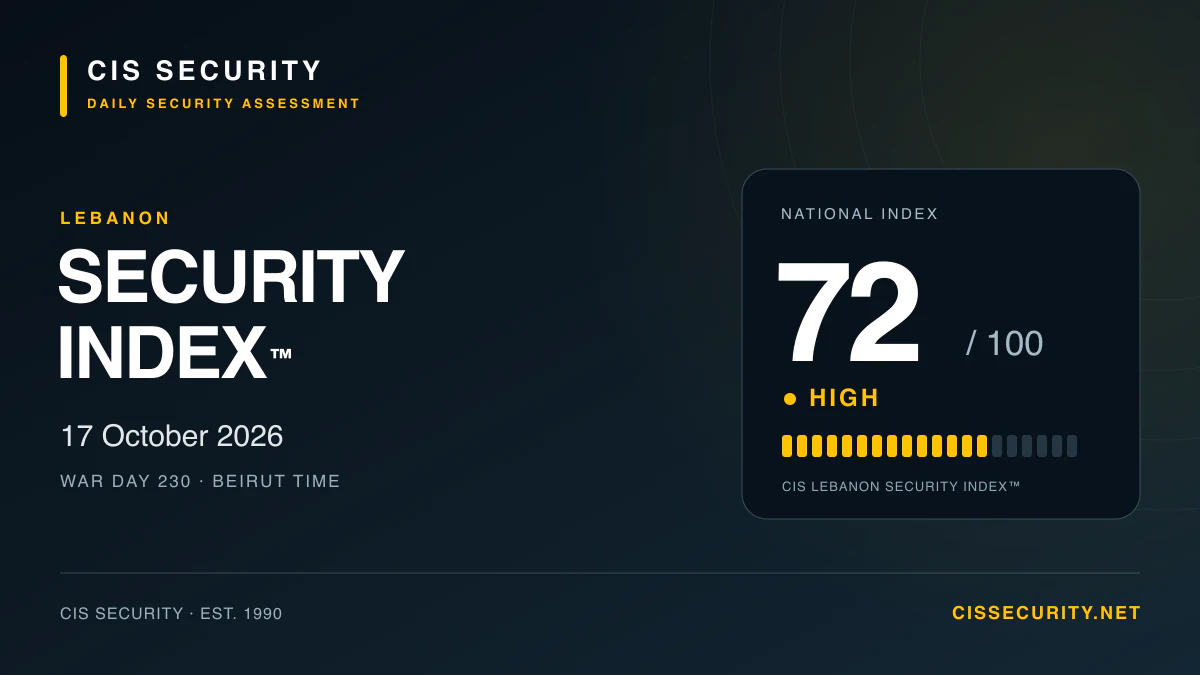
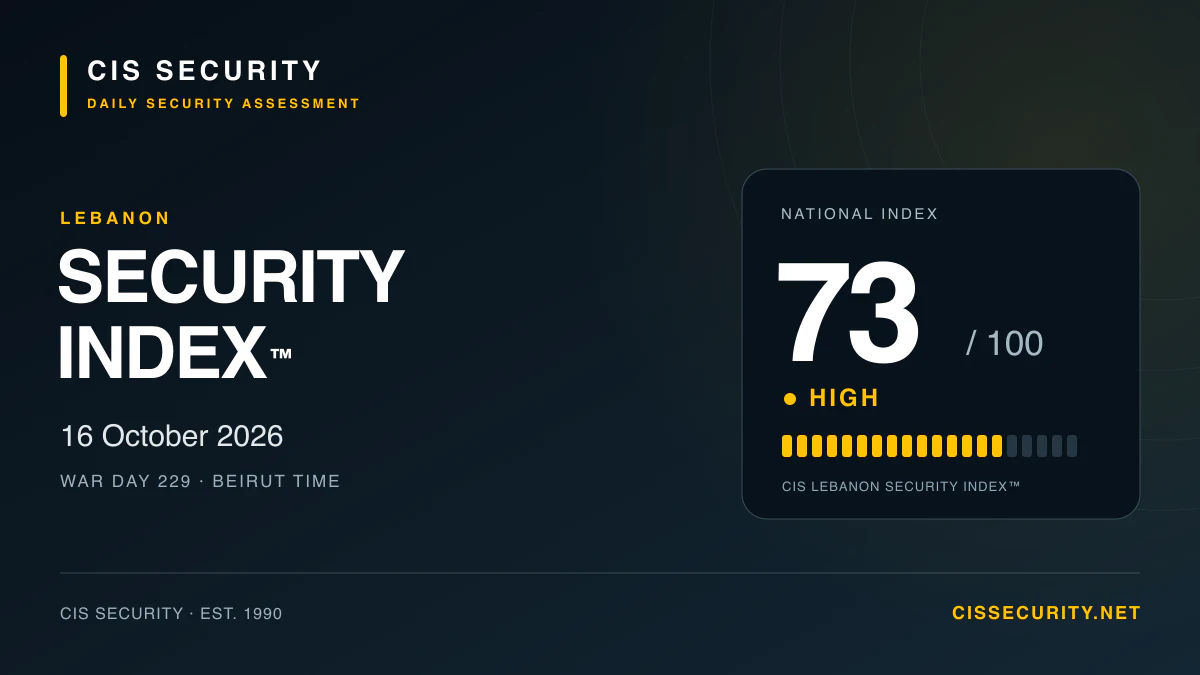
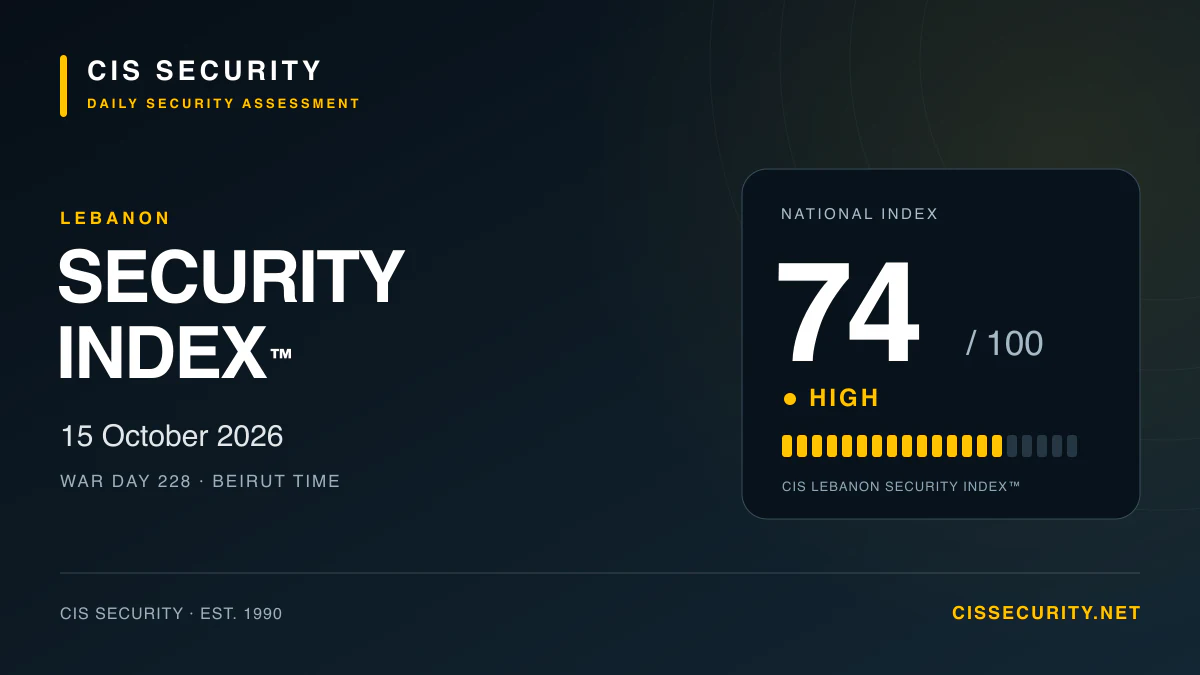
INDEX LEVEL: 🟠 HIGH — THE CONFLICT HAS MOVED FROM THE RIDGE ITSELF INTO NABATIEH CITY AND ITS INSTITUTIONS OVERALL INDEX: 80/100 TREND: ⬆️ RISING — CIS is correcting its own scale application from the September 5 edition, where an index reading in the 61–80 HIGH band was mislabeled CRITICAL. Applying the canonical five-band scale strictly, today's reading holds at the top of HIGH rather than crossing into CRITICAL — but the trend line points upward. What changed since Saturday's report is not a new claim about the ridge itself; it is that the fighting has visibly widened off the ridge and into Nabatieh's built-up areas and state institutions. Lebanon's National News Agency and the Health Ministry reported that Israeli strikes on Sunday morning destroyed the long-out-of-service Ghandour Hospital in Nabatieh al-Fawqa, damaged Finance and Agriculture Ministry offices and a historic building in Nabatieh city, and killed at least four people outright — two in Nabatieh al-Fawqa and two women in nearby Arab Salim — with the Health Ministry later adding three more deaths from a strike on a parking lot near Nabatieh, bringing the reported toll to at least seven, alongside roughly 20 to 32 wounded depending on the running tally cited. CIS is also updating the record on the central open question from its last two editions: Hezbollah's Islamic Resistance media office did not merely decline to confirm the loss of Ali al-Taher, as CIS reported Saturday — it issued a direct statement asserting the ridge remained free of Israeli forces and that its fighters were still deployed and in control there. That statement surfaced in wire reporting alongside, rather than after, CIS's own September 5 edition, and CIS is flagging the gap plainly rather than letting Saturday's more cautious framing stand uncorrected.
⛔ EXECUTIVE SUMMARY — SUNDAY SEPTEMBER 6, 2026 (WAR DAY 189)
THE FIGHTING HAS MOVED OFF THE RIDGE AND INTO THE CITY
Israeli strikes on Sunday hit multiple locations in and around Nabatieh — a governorate capital, not the contested ridge itself. The Lebanese Health Ministry said the strikes destroyed Ghandour Hospital, a facility it noted had already been out of service for about two months because of repeated Israeli attacks in the area, and separately damaged government-linked buildings in the city center, including offices used by the Finance and Agriculture ministries, plus a number of shops and cafés. The military said it also hit a motorcycle in the area. Israel's army said the operation targeted a Hezbollah command center it said had been established "inside a building previously used as a hospital," along with weapons storage facilities elsewhere in the strikes.
CIS assessment: whatever the underlying justification Israel offers for individual targets, the geographic and institutional character of Sunday's strikes marks a real shift from the Ali al-Taher-centered pattern CIS has tracked since late July. Government office buildings and a hospital site — however disused — being hit in a governorate capital is a materially different kind of event than strikes on a contested rural ridge, and it is the reason CIS is moving its trend arrow upward even while holding the numeric band at HIGH rather than CRITICAL.
THE TRIGGER: A HEZBOLLAH DRONE LAUNCH TOWARD ALI AL-TAHER
Israel's military said the strikes followed Hezbollah's launch of two explosive-laden drones toward Israeli troops operating in the Ali Taher Ridge area. The IDF said one drone was intercepted and that no soldiers were hurt, and it described the launch as a "blatant violation" of the ceasefire arrangement. Ahead of the strikes, Israel issued an evacuation warning for a building in Arab Salim it identified as a Hezbollah facility — its first such warning in Lebanon in several weeks — though it did not warn residents ahead of the other locations subsequently hit.
CIS assessment: Hezbollah has not claimed the drone launch, consistent with its pattern throughout August of neither confirming nor denying specific attacks attributed to it near Ali al-Taher. CIS treats the Israeli account of the trigger as the only public version currently available and notes the absence of a competing Hezbollah claim, without independently verifying it.
CORRECTION: HEZBOLLAH DID NOT MERELY "NOT CONFIRM" — IT ISSUED A DIRECT DENIAL
CIS's September 5 edition reported, based on AP and Dawn coverage, that Hezbollah had "not confirmed" losing Ali al-Taher. Wire reporting from Xinhua indicates this understated the group's actual position: Hezbollah's Islamic Resistance media office issued a formal statement asserting the ridge was free of any Israeli military presence and that its fighters remained deployed there and in control, ready to confront any Israeli attempt to advance. Separately, Hezbollah spokesman Youssef al-Zein had told reporters in the preceding weeks that Israel had exaggerated the ridge's importance while vowing the group would defend the position "as much as it can."
CIS assessment: this is a meaningful correction to CIS's own reporting sequence. "Has not confirmed losing a position" and "has formally denied losing a position, asserting continued control" are different claims with different implications for how contested the ground truth actually is. CIS regards the second, stronger framing as the more accurate one available as of today's edition, and will apply it going forward absent further clarification from either side.
PRESIDENT AOUN: STRIKES ON STATE INSTITUTIONS AND HEALTH FACILITIES
Lebanese President Joseph Aoun said Sunday's strikes — which he said damaged government premises and destroyed an out-of-service hospital — represented a "dangerous escalation" reaching Lebanese state institutions and health facilities, going beyond alleged military targets. He called on the United States and the wider international community to act urgently to halt the violations, noting Washington's role in sponsoring the direct Israel-Lebanon talks and the framework agreement signed in June. The Health Ministry said separately that 17 hospitals across Lebanon have sustained damage from Israeli strikes since March 2, with three hospitals in the south now out of service. Nabatieh's mayor, Abbas Fakhreddine, said the Lebanese government needed to take action.
CIS assessment: Aoun's language is notably sharper than his previous responses to Ali al-Taher-specific strikes, and CIS reads it as reflecting the shift described above — from a contested rural ridge to strikes reaching civilian and administrative infrastructure inside a governorate capital.
CONTEXT: THIS FOLLOWS SATURDAY'S WIDENING BEYOND THE SECURITY ZONE
Sunday's events follow a separate overnight bombing campaign reported Saturday, in which Israeli strikes killed five people and wounded 24 across five locations in southern Lebanon and, for the first time since June, in the western Bekaa Valley, near Ain al-Tineh, according to a preliminary Health Ministry toll. Hezbollah, in a statement issued Saturday, condemned what it called Israel's ongoing campaign of "killings, bombings, destruction and systematic demolition" and accused the United States of providing political and military cover for it — its first substantive public statement since Israel's Thursday announcement that it had achieved operational control of Ali al-Taher.
CIS assessment: taken together, Thursday's capture announcement, Friday's Hezbollah denial, Saturday's geographic widening into the western Bekaa, and Sunday's strikes on Nabatieh's institutions describe four consecutive days of escalation rather than a single, resolved event. CIS does not currently see evidence that the ceasefire framework agreed in June has formally collapsed, but the pattern of the last four days is inconsistent with the "held everywhere except one ridge" characterization CIS cited approvingly from the AP on September 5.
📊 UPDATED KEY FIGURES — AS OF SEPTEMBER 6, 2026
| Metric | Figure | Source |
|---|---|---|
| Killed, Sunday strikes on Nabatieh area (initial toll) | 4 (2 Nabatieh al-Fawqa, 2 women in Arab Salim) | Lebanese Health Ministry, via AFP/Al Jazeera/Reuters |
| Killed, Sunday strikes on Nabatieh area (updated toll, incl. parking-lot strike) | At least 7 | AFP, via President Aoun's office statement |
| Wounded, Sunday strikes | ~20–32 (reports vary by outlet and time of tally) | Lebanese Health Ministry, via multiple outlets |
| Killed, Saturday strikes (south Lebanon + first western Bekaa hit since June) | 5 killed, 24 wounded | Lebanese Health Ministry, via The National |
| Hospitals damaged in Lebanon since March 2, 2026 | 17, with 3 in the south out of service | Lebanese Health Ministry, via Middle East Monitor |
📌 WHAT CIS IS WATCHING — IMMEDIATELY
- Does the strike pattern continue to move into other governorate capitals and administrative centers, or does it recede back toward the Ali al-Taher area specifically?
- Does Israel respond publicly to Hezbollah's formal denial of losing the ridge, or does it continue to treat the matter as settled without engaging the denial directly?
- Does the United States, having sponsored the June framework agreement, respond in any concrete way to President Aoun's appeal — and does that response affect the framework's gradual-withdrawal terms?
- Does Hezbollah's Saturday rhetoric ("systematic demolition," US "cooperation, cover and planning") translate into any change in its posture, or does it remain limited to statements without claimed attacks?
🛡️ CIS SECURITY — SEPTEMBER 6 ASSESSMENT & GUIDANCE
Trusted Security Excellence Since 1990 | "Because Your Safety Isn't Optional"
CIS POSTURE: LEVEL 5 — SEVERE ALERT (maintained)
CIS maintains Level 5 — Severe Alert. Today's strikes on Nabatieh's institutions, alongside Saturday's expansion into the western Bekaa, are sufficient on their own to justify maintaining this posture; clients should not read the numeric HIGH-band correction above as a signal of reduced risk.
ZONE-BY-ZONE GUIDANCE
NABATIEH CITY AND NABATIEH AL-FAWQA: Avoid — today's strikes hit government-linked buildings, a hospital site, and commercial areas in the city itself, not only the outlying ridge. ARAB SALIM: Avoid — struck today following an Israeli evacuation warning. ALI AL-TAHER RIDGE AND SURROUNDING AREA: Avoid entirely — status remains disputed between Israeli and Hezbollah accounts. WESTERN BEKAA (AIN AL-TINEH VICINITY): Elevated caution — struck for the first time since June in Saturday's campaign. SECURITY ZONE / BUFFER ZONE (GENERAL): Do not approach under any circumstances. DAHIYEH, BEKAA VALLEY (GENERAL): Maintain elevated caution. BEIRUT (GENERAL), MOUNT LEBANON, NORTH LEBANON, AKKAR: Calm, normal operations continue; CIS notes no reporting of strikes in these areas today, though it is watching for any sign the pattern spreads further north.
📞 EMERGENCY CONTACTS — SEPTEMBER 6, 2026
CIS Security 24/7: +961 3 539900 | info@cissecurity.net | www.cissecurity.net Lebanese Army South Lebanon Liaison: +961-8-802-510 US Embassy Emergency: +1-202-501-4444 | BeirutACS@state.gov Lebanese Red Cross: 1760 Civil Defence: 125 ISF: 112 National Mental Health Lifeline: 1564 (24/7 — confidential)
⚠️ FINAL ASSESSMENT — WAR DAY 189, SEPTEMBER 6, 2026
Today's edition carries two corrections to CIS's own recent reporting, and CIS believes both are worth stating plainly rather than quietly absorbing into the record. First, the numeric-to-label mapping in the September 5 edition did not match CIS's own canonical scale; a reading in the 61–80 band belongs in the HIGH tier, not CRITICAL, and this edition applies that mapping strictly going forward. Second, and more substantively, Hezbollah's actual public position on Ali al-Taher is a direct denial of Israeli control — not merely an absence of confirmation — and CIS's last two editions understated that by relying on the more cautious "has not confirmed" framing carried by AP and Dawn.
Neither correction changes CIS's underlying concern. If anything, today's events argue for more concern, not less: strikes that reach a hospital site and government office buildings inside a governorate capital, on the heels of Saturday's first strikes on the western Bekaa since June, describe a widening pattern rather than a contained one. President Aoun's language — "dangerous escalation" reaching state institutions — is markedly sharper than his previous public responses to Ali al-Taher-specific strikes, and CIS reads that shift as significant in its own right.
CIS maintains Level 5 — Severe Alert and will be watching closely for whether this week's pattern of institutional and administrative targets in Nabatieh proves to be a one-day event or the start of a broader shift in where the conflict's active edge is located.
+961 3 539900 | info@cissecurity.net | cissecurity.net CIS Security — Because Your Safety Isn't Optional — Est. 1990
CIS Lebanon Security Index™ | Sunday, September 6, 2026 | WAR DAY 189
Sources: Al Jazeera / AFP, "Israeli air attacks on Lebanon kill at least four" (Sept. 6, 2026); Arab News / AFP, "Lebanon president calls for US help as Israeli strikes kill 7" (Sept. 6, 2026); France24, "Israeli strikes kill four in Lebanon after alleged Hezbollah drone launch" (Sept. 6, 2026) and "Israel widens Lebanon strikes after announcing control of strategic Ali Al Taher ridge," The National (Sept. 5, 2026); Times of Israel, "4 said killed as Israel strikes south Lebanon after Hezbollah drones target troops" (Sept. 6, 2026); Middle East Monitor / Anadolu, "Lebanese president condemns renewed Israeli strikes on Nabatieh" (Sept. 6, 2026); Malay Mail / AFP, "Lebanon says four dead in strikes that Israel calls response to Hezbollah drones" (Sept. 6, 2026); Xinhua, "Hezbollah denies Israeli claim of control over Ali al-Taher ridge" (Sept. 4–5, 2026); Tehran Times, statement summary of Hezbollah's Saturday condemnation (Sept. 5–6, 2026); prior CIS reporting (September 3–5, 2026) carried forward for context.
CIS explicitly notes it is correcting two points from its own September 5 edition in this report: the scale-label applied to Saturday's numeric reading, and the characterization of Hezbollah's public position on Ali al-Taher. All casualty figures are preliminary tolls as reported by the Lebanese Health Ministry via the cited outlets and may be revised. All military, diplomatic, and political statements are attributed to named officials or sourced reporting. Index compiled: Sunday, September 6, 2026 — Beirut time.
The CIS Lebanon Security Index™ is an informational professional assessment. It is not a guarantee of safety and not a substitute for official government guidance. In emergencies, follow official emergency services. CIS accepts no liability for decisions made solely on Index readings.