
🇱🇧 CIS LEBANON SECURITY INDEX™
Saturday, September 5, 2026
🔴 WAR DAY 188 | "CAPTURED" RIDGE STILL CONTESTED: HEZBOLLAH HAS NOT CONFIRMED LOSING ALI AL-TAHER — FRESH STRIKE NEAR THE RIDGE KILLS 2 TODAY | AP: THIS IS THE ONE PLACE IN LEBANON WHERE "FIGHTING HAS NOT STOPPED" SINCE THE JUNE CEASEFIRE | HEZBOLLAH OFFICIAL, LATE AUGUST: "IF IT IS LOST IT DOES NOT MEAN THE END OF HEZBOLLAH" | STRATEGIC STAKES: RIDGE'S FALL WOULD OPEN PATH TO NABATIYEH, "APPLE PROVINCE," RIHAN MOUNTAIN
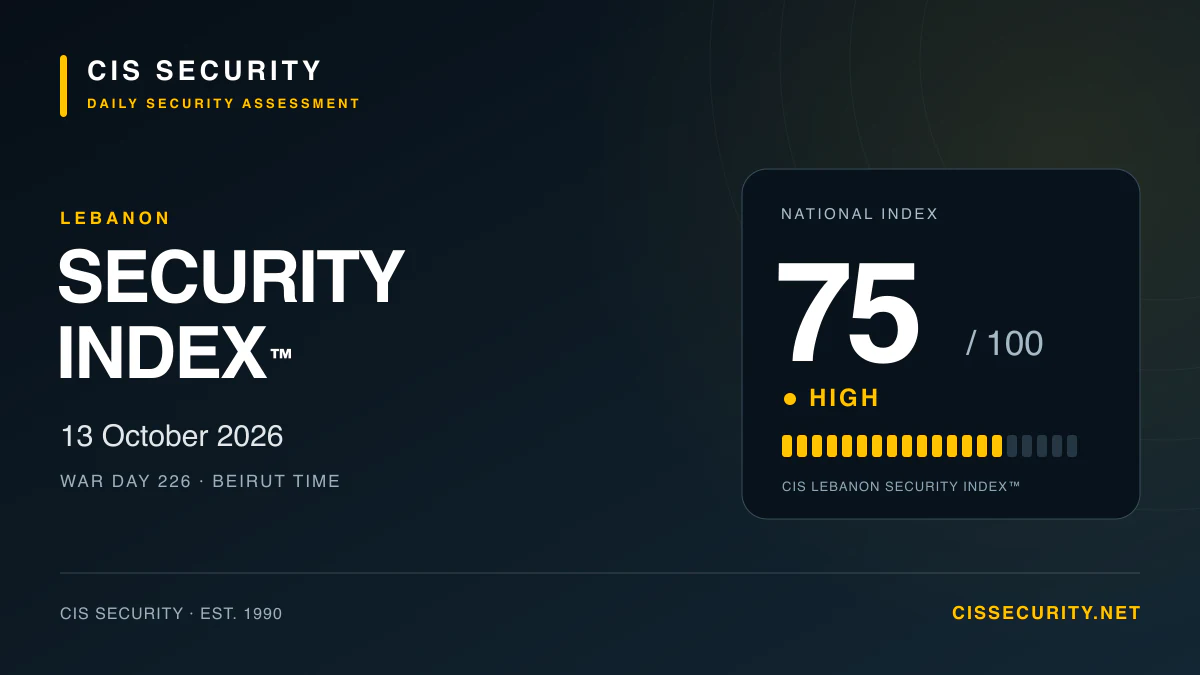
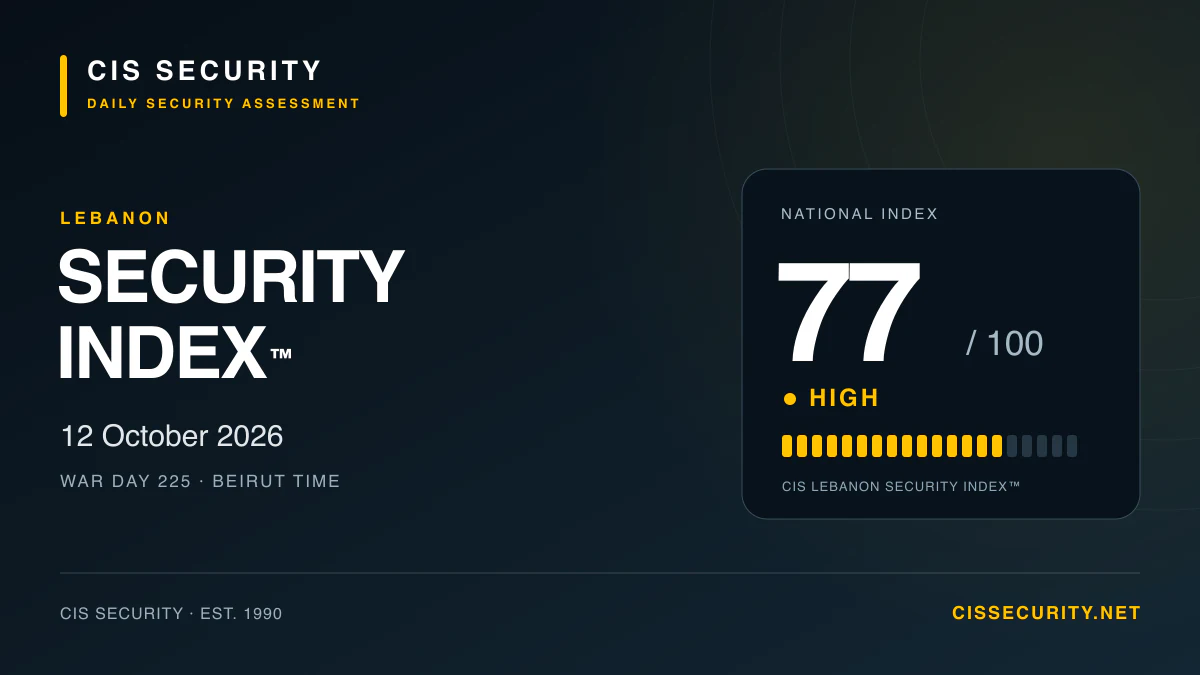
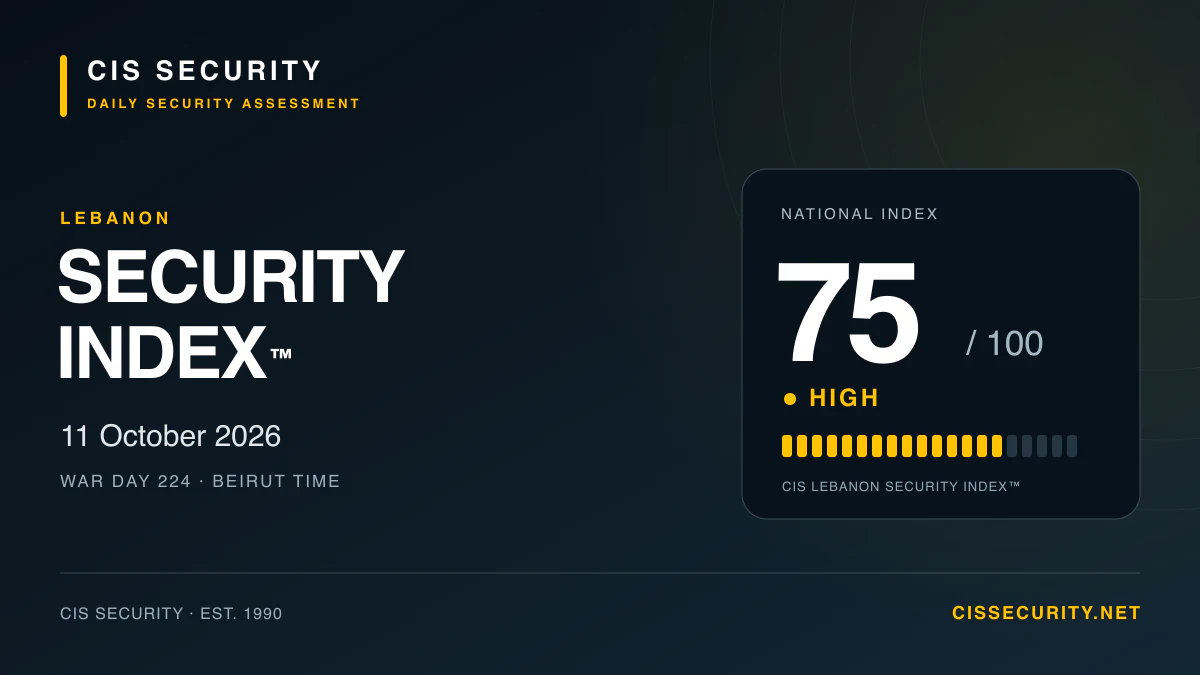
INDEX LEVEL: 🔴 CRITICAL — ISRAEL'S DECLARED VICTORY AT ALI AL-TAHER IS DISPUTED, NOT CONFIRMED, AND FIGHTING CONTINUES ON THE GROUND TODAY OVERALL INDEX: 75/100 TREND: ↔️ HOLDING AT SEVERE, WITH AN IMPORTANT CORRECTION TO YESTERDAY'S REPORT — CIS must directly qualify its September 4 update, in which it reported Netanyahu's and Katz's declarations that Ali al-Taher had been fully captured and "no longer threatens Israel." Lebanon's National News Agency reported Friday into Saturday that an Israeli strike killed two people near the ridge itself — and, critically, both Dawn and the Associated Press explicitly note that Hezbollah has not confirmed losing the position at all. The AP's own framing, in a dedicated feature published today, is unambiguous: "Since a ceasefire went into effect between Israel and Hezbollah more than two months ago, fighting has stopped in much of Lebanon, but not on a strategic hill overlooking parts of a main southern city." Ali Taher, per the AP, has been "the scene of daily shelling and airstrikes by Israel's military" for weeks — a pattern CIS has itself documented extensively since late July, now given its clearest outside journalistic confirmation as a genuine, singular exception to an otherwise-holding ceasefire. CIS is also incorporating today a Hezbollah official's own August remarks that had not previously entered CIS's reporting: Mahmoud Qamati told a Lebanese podcaster in late August that Hezbollah fighters were actively "repelling attempts" by Israeli troops to take the ridge, while simultaneously downplaying its ultimate significance — "Ali Taher is important, but if it is lost it does not mean the end of Hezbollah." This combination — active resistance paired with rhetorical preparation for eventual loss — helps explain both the ridge's remarkable durability as a flashpoint and Hezbollah's calibrated public response once Israel did announce its capture. CIS is also flagging, for the first time, the strategic logic behind why this specific hill has mattered so much to both sides: per the AP's reporting, the ridge's fall would open a path toward the city of Nabatiyeh and toward the areas Lebanese sources call "Apple Province" and Rihan Mountain, where Hezbollah has been building up its military presence since the late 1990s — suggesting that even if Ali Taher itself is now substantially under Israeli control, the underlying contest for the terrain beyond it may be far from over.
⛔ EXECUTIVE SUMMARY — SATURDAY SEPTEMBER 5, 2026 (WAR DAY 188)
THE "CAPTURE" IS DISPUTED, AND FIGHTING CONTINUES TODAY
Lebanon's National News Agency reported that an Israeli strike hit near the Ali al-Taher ridge, killing two people, according to AFP. In the same report, Dawn explicitly notes: "the Israeli army claims it had captured [the ridge], though Hezbollah has not confirmed losing it."
CIS assessment: This is a direct and important qualification of CIS's September 3-4 reporting, which — while noting Hezbollah's own muted, "not a disaster" response — largely proceeded from the premise that the IDF's own account of a completed capture was broadly accurate. Today's reporting makes clear that this remains, at minimum, a one-sided characterization: Israel says it has captured and cleared the ridge; Hezbollah has neither confirmed this nor issued any competing claim of its own, leaving the position's actual status genuinely ambiguous to outside observers. A fatal strike occurring at the same location the day after a declared "victory" is, at the very least, inconsistent with a clean, concluded operation.
AP: THIS IS THE ONE PLACE IN LEBANON WHERE THE CEASEFIRE HAS NOT HELD
The Associated Press published a dedicated feature today under the headline "Months after ceasefire, Israel and Hezbollah battle over a strategic hill in Lebanon," offering CIS the clearest independent journalistic confirmation yet of a pattern it has tracked since late July. Key points from AP's reporting:
- "Since a ceasefire went into effect between Israel and Hezbollah more than two months ago, fighting has stopped in much of Lebanon, but not on a strategic hill overlooking parts of a main southern city."
- "In recent weeks, Ali Taher hill has been the scene of daily shelling and airstrikes by Israel's military."
- Israel's Thursday statement described the hill as housing "underground command centers, weapons storage rooms, generators, living quarters, showers and a kitchen," and said it had cleared the hill of Hezbollah fighters and was working to "neutralize underground infrastructure sites."
CIS assessment: CIS regards this AP feature as significant precisely because it independently corroborates, from a major international wire service with its own on-the-ground reporting capacity, the exact characterization CIS has built incident-by-incident since July 30: that Ali al-Taher functions as a singular, persistent exception to an otherwise-functioning ceasefire elsewhere in Lebanon. This is a useful external check on CIS's own pattern-recognition throughout this index, and CIS finds it broadly consistent with its own tracking.
HEZBOLLAH'S QAMATI, LATE AUGUST: "REPELLING ATTEMPTS," BUT "NOT THE END OF HEZBOLLAH" IF LOST
CIS is incorporating today a set of remarks from Hezbollah official Mahmoud Qamati, made to a Lebanese podcaster in late August, which help contextualize both the ridge's contested status and Hezbollah's muted public response following Israel's capture announcement:
- "Ali Taher is important, but if it is lost it does not mean the end of Hezbollah."
- Qamati and other Hezbollah officials described the group's fighters as actively "repelling attempts by Israeli troops to take Ali Taher" at the time these remarks were made.
CIS assessment: Read together with this week's developments, these remarks suggest a coherent, if retrospectively visible, Hezbollah communications strategy: assert active resistance while the fight for the position was ongoing, while simultaneously pre-positioning public messaging to downplay its ultimate significance in the event of loss. This is consistent with, and helps explain, the Hezbollah MP's "not a disaster" comment CIS reported on September 4 — rather than an improvised, reactive response to an unexpected defeat, it now appears to reflect a messaging position Hezbollah's leadership had already prepared in advance.
THE STRATEGIC STAKES BEYOND THE RIDGE ITSELF: NABATIYEH, "APPLE PROVINCE," RIHAN MOUNTAIN
Per the AP's reporting, the capture of Ali Taher "would open the way to Nabatiyeh and also lead to the nearby Apple Province and Rihan Mountain, where Hezbollah has been building up its presence since the late 1990s."
CIS assessment: This is an important piece of strategic context CIS had not previously incorporated into its coverage. It suggests that Ali Taher's significance was never simply about the ridge itself — its underground facility, however extensive — but about its function as a gateway to a wider area where Hezbollah maintains a much longer-established and more deeply rooted military infrastructure. If Israel does intend to press its advantage beyond Ali Taher toward these areas, CIS would expect this to represent a substantially larger and more consequential operation than anything documented at this location to date — and a genuine test of whether the "renewed defensive posture" language the IDF used on September 3 (per CIS's prior reporting) describes consolidation and withdrawal, or a springboard for further advance.
📊 UPDATED KEY FIGURES — AS OF SEPTEMBER 5, 2026
| Metric | Figure | Source |
|---|---|---|
| Killed in today's strike near Ali al-Taher | 2 | Lebanese NNA, via AFP/Dawn |
| Time since the ceasefire took effect (per AP's framing) | "More than two months" | Associated Press |
| Areas Israel's advance from Ali Taher could open toward | Nabatiyeh, "Apple Province," Rihan Mountain | Associated Press |
| Since when Hezbollah has held presence in the Rihan Mountain/Apple Province area | Late 1990s | Associated Press |
📌 WHAT CIS IS WATCHING — IMMEDIATELY
- Does Hezbollah ever issue a direct, on-record confirmation or denial of losing Ali al-Taher, or does it continue to leave the question deliberately unaddressed?
- Does today's fatal strike near the ridge represent continued mopping-up activity consistent with Israel's "clearing" narrative, or evidence of ongoing, unresolved contact with Hezbollah fighters still present in the area?
- Does Israel's operational focus shift toward Nabatiyeh, "Apple Province," or Rihan Mountain in the coming weeks, which would confirm the ridge's capture was a springboard for further advance rather than a self-contained operation?
- Does the broader ceasefire elsewhere in Lebanon — which the AP explicitly credits with having "stopped" fighting outside this specific location — continue to hold, or does the Ali Taher pattern begin to spread to other locations?
🛡️ CIS SECURITY — SEPTEMBER 5 ASSESSMENT & GUIDANCE
Trusted Security Excellence Since 1990 | "Because Your Safety Isn't Optional"
CIS POSTURE: LEVEL 5 — SEVERE ALERT (maintained)
CIS maintains Level 5 — Severe Alert. Today's developments confirm that the Ali al-Taher situation remains genuinely unresolved rather than concluded, and CIS advises clients to treat any official Israeli "capture" or "victory" characterization for this location with continued caution pending clearer, mutually confirmed evidence of the position's actual status.
ZONE-BY-ZONE GUIDANCE
ALI AL-TAHER RIDGE (AND SURROUNDING AREA): Avoid entirely — today's fatal strike confirms this location remains actively contested, not a concluded operation. NABATIYEH (city and surrounding area): Elevated caution — identified today as a potential next objective if Israeli operations continue beyond Ali Taher. "APPLE PROVINCE" / RIHAN MOUNTAIN AREA: Elevated caution — identified as an area of established, long-term Hezbollah military presence that could become a focus of future operations. SECURITY ZONE / BUFFER ZONE (GENERAL): Do not approach under any circumstances. DAHIYEH, BEKAA VALLEY: Maintain elevated caution. BEIRUT (general), MOUNT LEBANON, NORTH LEBANON, AKKAR: Calm, normal operations continue; CIS notes the AP's own characterization that the ceasefire has held in most of Lebanon outside the specific Ali Taher flashpoint.
📞 EMERGENCY CONTACTS — SEPTEMBER 5, 2026
CIS Security 24/7: +961 3 539900 | info@cissecurity.net | www.cissecurity.net Lebanese Army South Lebanon Liaison: +961-8-802-510 US Embassy Emergency: +1-202-501-4444 | BeirutACS@state.gov Lebanese Red Cross: 1760 Civil Defence: 125 ISF: 112 National Mental Health Lifeline: 1564 (24/7 — confidential)
⚠️ FINAL ASSESSMENT — WAR DAY 188, SEPTEMBER 5, 2026
Today's update requires CIS to correct the record on a point of real substance: the "capture" of Ali al-Taher that Netanyahu and Katz declared so definitively just one day ago is not the concluded fact CIS's own September 3-4 reporting may have implied.
Hezbollah has not confirmed losing the ridge. A fatal strike occurred there today. And the Associated Press — an independent, internationally respected wire service with no stake in either side's narrative — describes this location, in its own words, as the singular place in Lebanon where the ceasefire genuinely has not held for more than two months. This is a materially more accurate and more cautious characterization than "Israel has captured the ridge and it no longer threatens Israel," and CIS regards it as important to make that correction plainly rather than let its own prior reporting stand as the last word on this specific question.
Hezbollah's Qamati appears, in retrospect, to have anticipated exactly this ambiguous outcome — asserting active resistance while simultaneously preparing the public case that the ridge's loss, if it comes, would not be existential for the organization. That dual messaging strategy is now playing out in close to real time, and CIS assesses it as a more sophisticated and more calculated response than a simple, reactive "not a disaster" comment might suggest on its own.
The identification of Nabatiyeh, "Apple Province," and Rihan Mountain as the areas Ali Taher's fall could open a path toward is, in CIS's assessment, the most important new strategic fact in today's report — it reframes the entire month-long Ali Taher saga not as an isolated contest over a single hill, but as a potential opening chapter in a larger campaign toward Hezbollah's deeper, longer-established positions further north. Whether that larger campaign proceeds, or whether Israel consolidates its current gains and holds, will likely become one of the defining questions for this conflict's next phase.
CIS maintains Level 5 — Severe Alert and will be watching closely for any sign of Israeli operations extending toward these next objectives, and for any eventual Hezbollah confirmation or denial of the ridge's status.
+961 3 539900 | info@cissecurity.net | cissecurity.net CIS Security — Because Your Safety Isn't Optional — Est. 1990
CIS Lebanon Security Index™ | Saturday, September 5, 2026 | WAR DAY 188
Sources: Dawn, "Israeli strike on Lebanon kills two: state media" (September 5, 2026 — full NNA/AFP quote, explicit note that Hezbollah has not confirmed losing the ridge); Associated Press (via News4Jax, KSAT, ClickOnDetroit, ClickOrlando), "Months after ceasefire, Israel and Hezbollah battle over a strategic hill in Lebanon" (September 5, 2026, by Bassem Mroue — full "fighting has not stopped" framing, "daily shelling and airstrikes" characterization, full Qamati late-August quotes, Nabatiyeh/Apple Province/Rihan Mountain strategic detail, Thursday IDF statement detail on tunnel contents); prior CIS reporting (July 4–September 4, 2026) carried forward for context, particularly the September 3-4 updates regarding Israel's announced capture of the ridge.
CIS explicitly notes it is qualifying its own September 3-4, 2026 reporting in light of today's confirmation that Hezbollah has not corroborated Israel's capture claim, and that fighting has continued at this location since that announcement. All other military, diplomatic, and political statements are attributed to named officials or sourced reporting, late August–September 5, 2026. Index compiled: Saturday, September 5, 2026 — Beirut time.