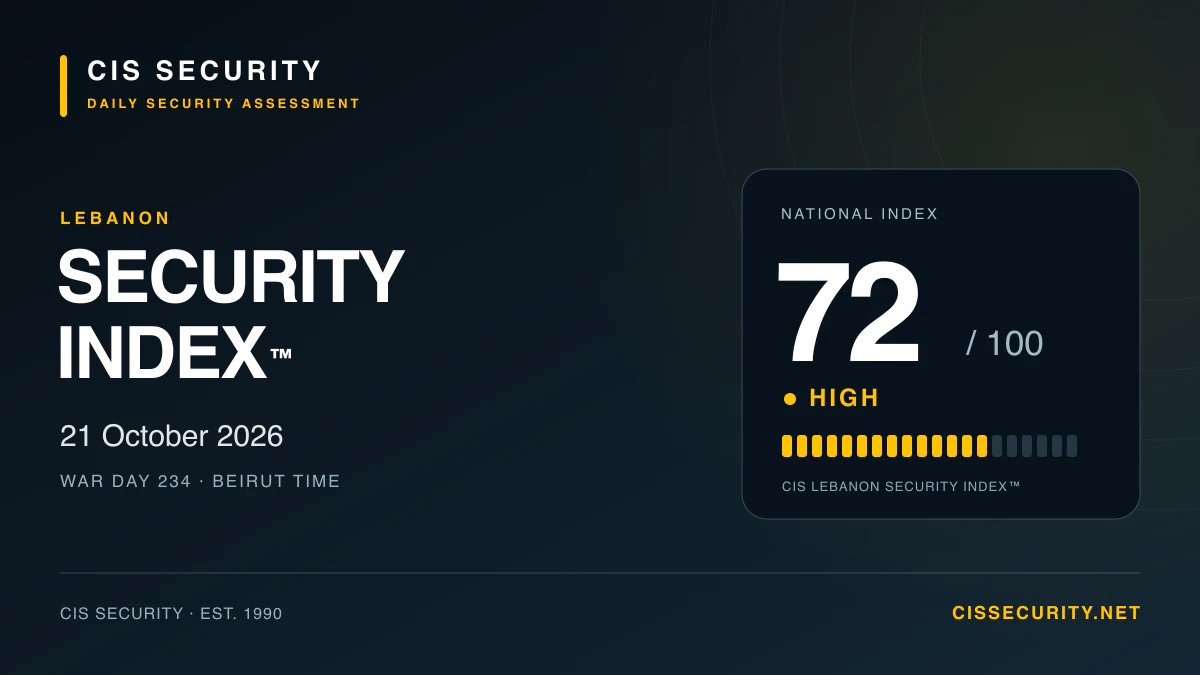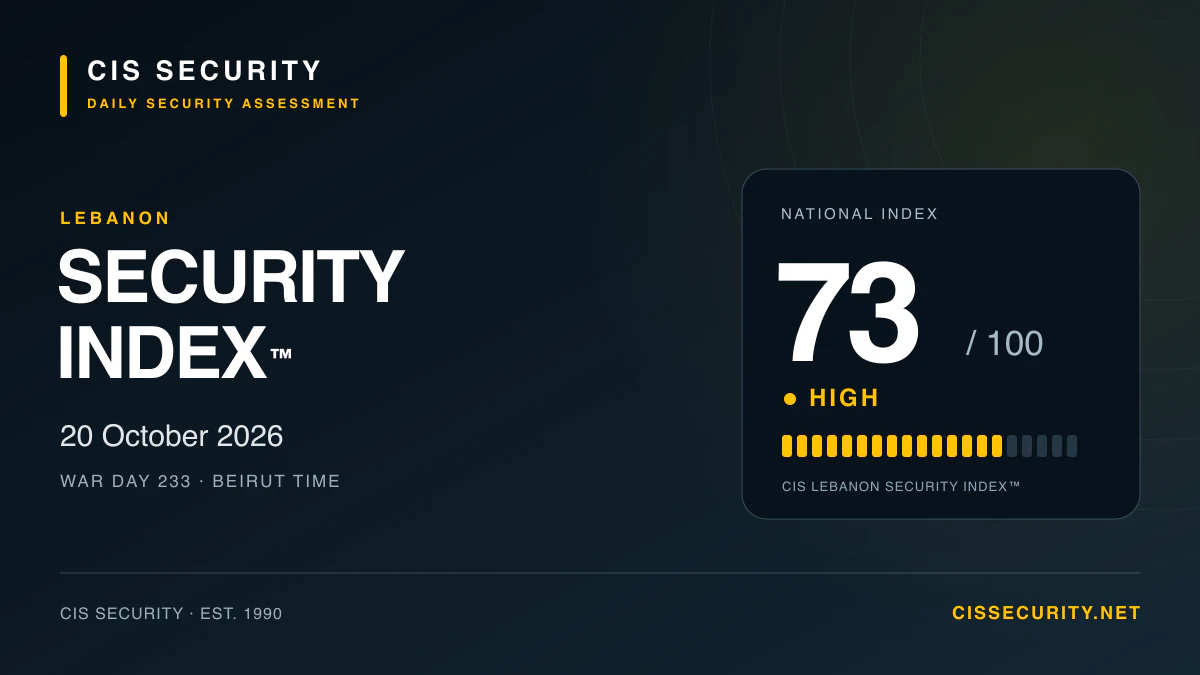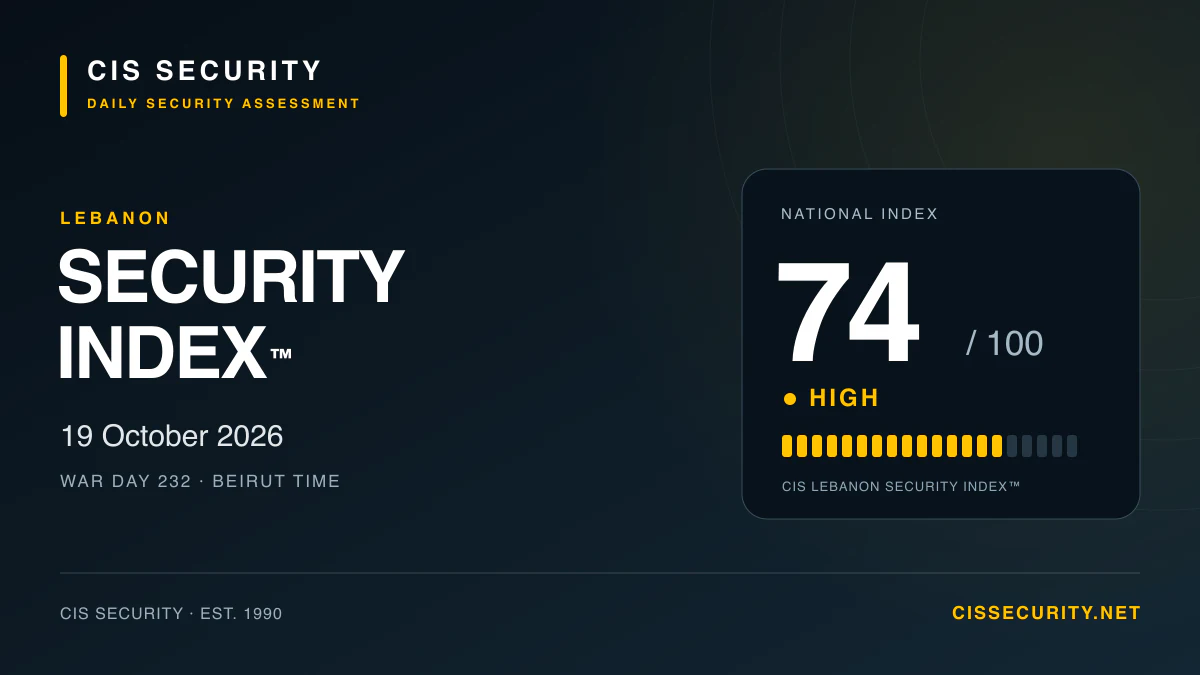
🇱🇧 CIS LEBANON SECURITY INDEX™
Wednesday, September 9, 2026
🟠 WAR DAY 194 | RELATIVE CALM RETURNS TO SOUTH LEBANON AFTER THREE-DAY NABATIEH ESCALATION | ONE KILLED IN STRIKE ON ZEBDINE-MARJ HAROUF ROAD | JOINT SAUDI-U.S. DIPLOMACY CREDITED WITH DE-ESCALATION | LEBANESE ARMY BEGINS PATROLS IN NABATIEH CITY
INDEX LEVEL: 🟠 HIGH — DOWNGRADED FROM CRITICAL AS DE-ESCALATION TAKES HOLD, BUT STRIKES CONTINUE ACROSS MULTIPLE SOUTH LEBANON LOCATIONS OVERALL INDEX: 76/100 TREND: ⬇️ EASING — Overnight into Wednesday, Israeli artillery shelled the southern towns of Kfar Remman, al-Mansouri, Wadi Zebqine, Mays al-Jabal and Qabrikha, while air and drone strikes hit Nabatieh al-Fawqa, Wadi Zebqine, Wadi Slouqi and Kfartebnit; Israeli forces also carried out controlled detonations in al-Mansouri. One person was killed when a strike hit his motorcycle on the Zebdine–Marj Harouf road. This is a sharp reduction from the toll of the preceding three days (Sunday–Tuesday), in which CIS and Lebanese media recorded 27 people killed and 69 wounded across the Nabatieh region. Two separate Lebanese media reports on Wednesday attributed the cooling to joint Saudi–U.S. diplomatic engagement with Israel over the past 24 hours, contacts led by President Joseph Aoun, Speaker Nabih Berri and PM Nawaf Salam, and the start of Lebanese Army patrols inside Nabatieh city — described as a step toward a larger stabilization move. CIS eases the Index accordingly, from Tuesday's 85 (Critical), but keeps the rating in the High band rather than Low or Medium: nine distinct locations were struck or shelled overnight, and Washington has reportedly told Beirut that any further Hezbollah action would draw a "fierce and violent" Israeli response.
⛔ EXECUTIVE SUMMARY — WEDNESDAY SEPTEMBER 9, 2026 (WAR DAY 194)
ONE KILLED ON ZEBDINE-MARJ HAROUF ROAD AS STRIKES CONTINUE ACROSS NINE LOCATIONS
One person was killed Wednesday when an Israeli strike hit his motorcycle on the Zebdine–Marj Harouf road, Lebanese media reported. Overnight, Israeli artillery shelled the southern towns of Kfar Remman, al-Mansouri, Wadi Zebqine, Mays al-Jabal and Qabrikha, while separate strikes targeted Nabatieh al-Fawqa, Wadi Zebqine, Wadi Slouqi and Kfartebnit. Israeli forces also carried out controlled detonations in al-Mansouri.
CIS assessment: A single fatality across a night of shelling and strikes spanning nine locations is a marked de-escalation from the pace of Sunday through Tuesday, when the Nabatieh region absorbed 27 deaths and 69 injuries in three days — including Monday's Kfar Rumman strike, whose toll was revised upward to 13 killed. The geographic spread of overnight activity shows Israeli forces remain operationally active across the same corridor, but the shift from multi-fatality strikes to a single, isolated casualty is consistent with the de-escalation reported through diplomatic channels (below).
JOINT SAUDI-U.S. DIPLOMACY CREDITED WITH REDUCING ESCALATION
Lebanese media reported Wednesday that joint Saudi–American diplomatic efforts over the previous 24 hours, following direct U.S. engagement with Israel, contributed to de-escalating tensions in southern Lebanon. Sources said meetings between American and Saudi officials focused on the Lebanese file, with Riyadh backing the Lebanese government's push for a permanent solution. A separate report said President Aoun had intensively pressed U.S. officials to persuade Israel to halt its military campaign, and that Washington responded by contacting Israeli officials to help contain the escalation. The outreach reportedly involved U.S. Ambassador to Beirut Michel Issa and Lebanon's ambassador to Washington, Nada Hamadeh Moawad.
Separately, Tuesday's Lebanese media reporting said contacts led by President Aoun, Speaker Berri and PM Salam, alongside Arab and international efforts, had helped pacify the situation in Nabatieh city following the three-day toll of 27 killed and 69 wounded. The Lebanese Army has reportedly begun staging patrols inside Nabatieh city, with deployment at additional points described as "paving the way for a bigger step."
CIS assessment: The combination of great-power diplomatic pressure and a visible Lebanese state security presence returning to Nabatieh is the clearest stabilization signal CIS has logged since the escalation began Sunday. This is a materially different picture from Tuesday's edition, which noted Israel's "operational control" declaration had not yet translated into reduced contact — today's reporting shows an actual reduction in casualty intensity alongside a credited diplomatic cause, which is why CIS moves the national rating out of the Critical band.
WASHINGTON'S WARNING AND THE DISARMAMENT TRACK
A Lebanese media report said Washington had informed the Lebanese government that Israel's escalation in and around Nabatieh was a response to Hezbollah's drone attack on Israeli troops and to Hezbollah's continued presence in the area — and that any further Hezbollah action would be met with a "fierce and violent" Israeli response.
Separately, the head of Lebanon's Higher Islamic Shiite Council, Sheikh Ali al-Khatib, told U.S. Ambassador Issa that the Shiite community did not take up arms by choice but out of necessity to confront Israeli occupation, and that it is open to resolving the disarmament question provided it receives security guarantees and protection for its future in Lebanon. President Aoun separately said Wednesday that ending the state of hostility with Israel means ending the wars that have devastated the country, framing negotiation as a sovereign choice rather than one made to appease any foreign party.
CIS assessment: The disarmament question remains the unresolved core issue behind the recurring escalation cycles. Today's messaging — a U.S. warning against further Hezbollah action, paired with a Shiite religious authority signaling conditional openness to disarmament — suggests both sides are testing terms for a more durable de-escalation, but neither the Israeli warning nor the guarantees sought by the Shiite community have been formalized. CIS treats this as a political development to monitor, not yet a resolution.
REGIONAL CONTEXT: U.S.–IRAN WAR SHARPLY ESCALATES OVERNIGHT — NO DIRECT LEBANON LINK IDENTIFIED
Separately from the Lebanon theater, the U.S.–Iran war escalated sharply overnight. U.S. Central Command said it destroyed five Iranian oil tankers on September 8 after Iran's Revolutionary Guard Corps twice targeted a U.S. Navy warship with ballistic missiles over the preceding two days; CENTCOM said the warship evaded the attacks and no American personnel were harmed. In response, Iran's Revolutionary Guard fired a missile salvo at a U.S. base in Jordan; Jordanian authorities said air defenses intercepted 18 of 20 missiles, with the remaining two landing in unpopulated areas and no casualties reported. Iran's Revolutionary Guard Navy also warned tanker crews near Kuwait and Bahrain to abandon their vessels, accusing both countries of hosting U.S. forces. U.S. Secretary of State Marco Rubio warned that further Iranian attacks on U.S. warships would result in the loss of more Iranian tankers. Iran's announced "restricted zone" near the Strait of Hormuz, first flagged in early September, remains formally undeclared as of this edition.
CIS assessment: CIS did not identify any incident today directly linking this exchange to Lebanon or Hezbollah. It is tracked here because a further widening of the U.S.–Iran war carries indirect risk for Lebanon — through oil/shipping costs, Iranian-aligned proxy activity regionally, and the broader posture of Hezbollah's principal external backer. CIS maintains a SEVERE rating on the Strait of Hormuz/Gulf of Oman corridor separately from the Lebanon national score.
📅 KEY TIMELINE — SEPTEMBER 8–9
| Date | Event |
|---|---|
| Sep 8 | Kfar Rumman toll from Monday's strikes revised upward to 13 killed |
| Sep 8 | Al-Jadeed TV reports contacts by Aoun, Berri and Salam, plus Arab/international efforts, have begun pacifying Nabatieh after 27 killed, 69 wounded over three days |
| Sep 8 | Lebanese Army reportedly begins staging patrols in Nabatieh city |
| Sep 8–9 (overnight) | Israeli artillery shells Kfar Remman, al-Mansouri, Wadi Zebqine, Mays al-Jabal, Qabrikha; strikes hit Nabatieh al-Fawqa, Wadi Zebqine, Wadi Slouqi, Kfartebnit; controlled detonations in al-Mansouri |
| Sep 9 | One person killed in strike on his motorcycle on the Zebdine–Marj Harouf road |
| Sep 9 | Lebanese media report joint Saudi-U.S. diplomacy over the prior 24 hours helped de-escalate southern Lebanon |
| Sep 9 | Sheikh Ali al-Khatib tells U.S. Ambassador Issa the Shiite community needs security guarantees to disarm |
| Sep 9 | President Aoun says ending hostility with Israel means ending the wars that have devastated Lebanon |
| Sep 8–9 (overnight, regional) | U.S. destroys 5 Iranian oil tankers after IRGC twice targets a U.S. warship; Iran fires missile barrage at U.S. base in Jordan (18 of 20 intercepted, no casualties); IRGC Navy warns tanker crews near Kuwait/Bahrain |
🗺️ GOVERNORATE-LEVEL SECURITY STATUS
| Governorate | Status |
|---|---|
| Nabatieh | 🟠 HIGH — downgraded from Critical; overnight shelling/strikes across multiple towns, one fatality, but casualty intensity down sharply and diplomatic de-escalation underway |
| South Lebanon | 🟠 HIGH — no new CIS-identified direct-fire incident today; elevated risk maintained given proximity to active Nabatieh-area operations (incl. al-Mansouri, near Tyre) |
| Beirut | 🟡 MEDIUM — no direct incident; elevated vigilance maintained given the wider regional escalation (U.S.–Iran war) |
| Mount Lebanon, Keserwan-Jbeil, North Lebanon, Akkar, Beqaa Valley, Baalbek-Hermel | 🟢 LOW — no CIS-identified incidents for today's reporting window |
| Rafic Hariri Airport | ✅ Operating — some international carriers continue schedule disruptions tied to the wider regional conflict; verify with airline before travel |
| Strait of Hormuz / Gulf of Oman | 🔴 SEVERE — active U.S.–Iran kinetic exchange overnight (tanker strikes, missile barrage on Jordan); Iran's announced restricted zone remains undeclared as of this edition |
📊 SEPTEMBER 9 STATISTICS — WAR DAY 194
| Metric | Figure | Source |
|---|---|---|
| Killed, Zebdine–Marj Harouf road strike (Sep 9) | 1 | Lebanese media (Naharnet) |
| Locations shelled/struck overnight (Sep 8–9) | 9 — Kfar Remman, al-Mansouri, Wadi Zebqine, Mays al-Jabal, Qabrikha, Nabatieh al-Fawqa, Wadi Slouqi, Kfartebnit, Zebdine–Marj Harouf road | CIS tally from Naharnet reporting |
| Cumulative toll, 3-day Nabatieh escalation (Sep 6–8) | 27 killed, 69 wounded | Al-Jadeed TV / Nidaa al-Watan, via Naharnet |
| Kfar Rumman toll, Sep 7 (revised) | 13 killed | Lebanese media, revised Sep 8 |
| Iranian oil tankers destroyed (US CENTCOM, overnight) | 5 | US Central Command |
| Missiles fired at US base in Jordan (IRGC) | 20 launched; 18 intercepted; 2 fell in unpopulated areas; 0 casualties | Jordanian Armed Forces |
| War duration | 194 days (CIS running count since March 2) | CIS calculation |
| Truce-day count | 82 days since the June 20 truce anchor | CIS calculation |
🔑 KEY STATEMENTS
| Actor | Statement (paraphrased/summarized) |
|---|---|
| Lebanese government (via U.S. channel, reported) | Told that Israel's Nabatieh-area escalation was a response to Hezbollah's drone attack and continued presence there, and that further Hezbollah action would draw a "fierce and violent" Israeli response |
| Sheikh Ali al-Khatib (Higher Islamic Shiite Council) | Told U.S. Ambassador Issa the Shiite community took up arms out of necessity against occupation, not by choice, and is open to disarmament discussions given security guarantees and protection |
| President Joseph Aoun | Said ending hostility with Israel means ending the wars that have devastated Lebanon; framed negotiation as a sovereign decision, not appeasement of any foreign party |
| Saudi/U.S. diplomatic sources (reported) | Said joint engagement with Israel over the prior 24 hours helped de-escalate the situation in southern Lebanon |
| US Secretary of State Marco Rubio | Warned Iran that further attacks on U.S. warships will result in the loss of more Iranian tankers |
🛡️ CIS SECURITY — SEPTEMBER 9 ASSESSMENT & GUIDANCE
CIS POSTURE: LEVEL 5 — ELEVATED VIGILANCE ALERT (Downgraded from Level 6 — Critical Escalation Alert)
CIS downgrades its posture and eases the underlying Index score from 85 to 76/100, moving the national rating from Critical to High. This reflects a genuine, multiply-sourced de-escalation: a single fatality overnight versus the 27-killed, 69-wounded toll of the preceding three days; credited joint Saudi-U.S. diplomatic engagement; and the Lebanese Army's first patrols inside Nabatieh city in this escalation cycle. CIS does not treat this as a return to normal conditions — nine locations were shelled or struck overnight, and Washington has reportedly conveyed to Beirut that renewed Hezbollah activity would trigger a forceful Israeli response, meaning the underlying triggers for the past week's escalation remain unresolved.
What CIS is watching: Whether the reduced strike tempo holds through the coming days or proves a temporary lull; whether the Lebanese Army's Nabatieh patrols expand into the "bigger step" reportedly being prepared; any formalization of security guarantees tied to the Shiite community's disarmament terms; and whether the sharply escalating U.S.–Iran war — including the unresolved, still-undeclared Iranian restricted zone near the Strait of Hormuz — produces any spillover into Lebanon or Hezbollah's posture.
📞 EMERGENCY CONTACTS
CIS Security 24/7 (for active clients): +961 3 539900 | info@cissecurity.net Lebanese Army South Lebanon Liaison: +961-8-802-510 US Embassy Emergency: +1-202-501-4444 Lebanese Red Cross: 1760 | Civil Defence: 125 | ISF: 112 National Mental Health Lifeline: 1564
⚠️ FINAL ASSESSMENT — WAR DAY 194, SEPTEMBER 9, 2026
Wednesday's single fatality — a motorcyclist killed on the Zebdine–Marj Harouf road — sits against a night of continued but visibly lower-intensity Israeli activity across nine locations in and around Nabatieh, a sharp reduction from the 27 killed and 69 wounded recorded over the preceding three days. CIS attributes this cooling to a specific, reported cause rather than a lull: joint Saudi-U.S. diplomatic engagement with Israel over the past 24 hours, sustained contacts by President Aoun, Speaker Berri and PM Salam, and the Lebanese Army's first patrols inside Nabatieh city since the escalation began Sunday.
The underlying dispute remains unresolved. Washington has reportedly told Beirut that further Hezbollah activity will draw a forceful Israeli response, and the Shiite community's religious leadership says disarmament remains conditional on security guarantees not yet delivered. Separately, the U.S.–Iran war escalated sharply overnight — the U.S. destroyed five Iranian tankers, Iran fired a missile barrage at a U.S. base in Jordan, and Iran's Revolutionary Guard warned tanker crews near Kuwait and Bahrain to evacuate — but CIS identified no direct link between this exchange and today's events in Lebanon.
CIS downgrades from Level 6 — Critical Escalation Alert to Level 5 — Elevated Vigilance Alert, with the underlying Index score easing from 85 to 76/100, reflecting a credible, diplomatically-driven de-escalation that has not yet resolved the conditions that produced the past week's escalation.
The CIS Lebanon Security Index™ is an informational professional assessment. It is not a guarantee of safety and not a substitute for official government guidance. In emergencies, follow official emergency services. CIS accepts no liability for decisions made solely on Index readings.
+961 3 539900 | info@cissecurity.net | cissecurity.net CIS Security — Because Your Safety Isn't Optional — Est. 1990
CIS Lebanon Security Index™ | Wednesday, September 9, 2026 | WAR DAY 194 Sources: Naharnet, September 8–9, 2026 ("One killed in strike on Zebdine-Harouf road despite relative calm"; "Joint Saudi-American diplomacy reduced Lebanon escalation, report says"; "Report: Local, Arab and int'l efforts lead to de-escalation in Nabatieh"; "Aoun: Ending hostility with Israel means ending wars"; "Shiites need guarantees to disarm, al-Khatib reportedly told Issa"; "Death toll from Monday strikes rises to 13"); The Times of Israel liveblog, September 9, 2026 (US tanker strikes, Iranian missile barrage on Jordan, Rubio statement); US Central Command public statement, September 8, 2026.