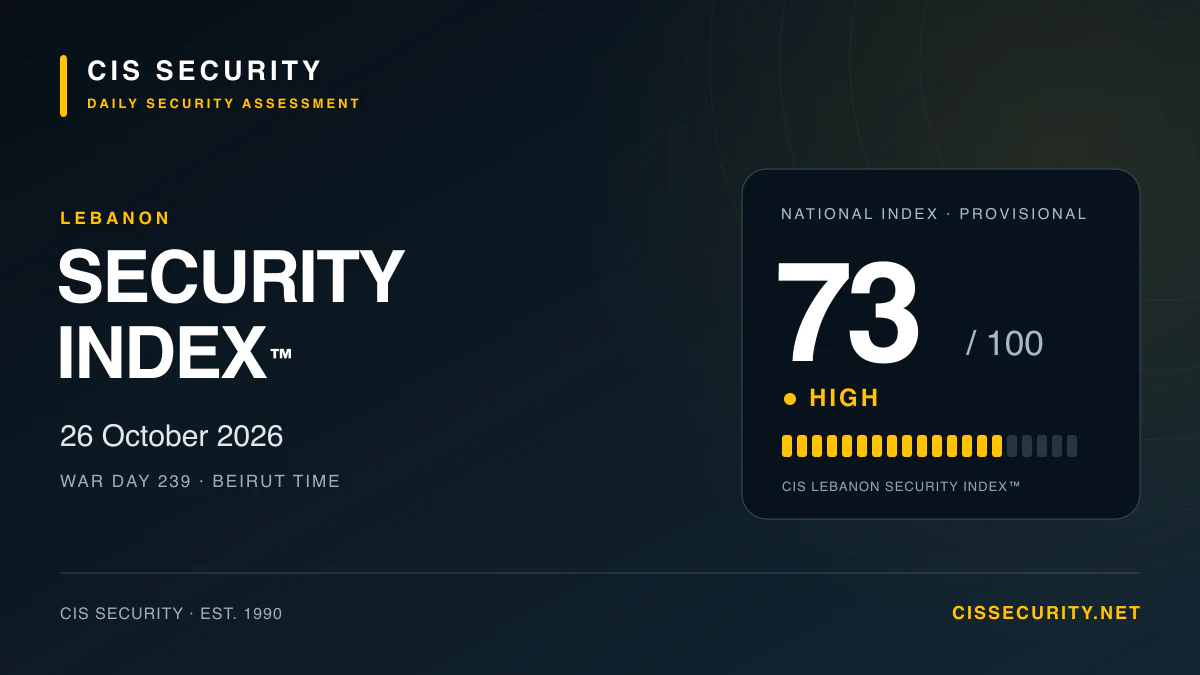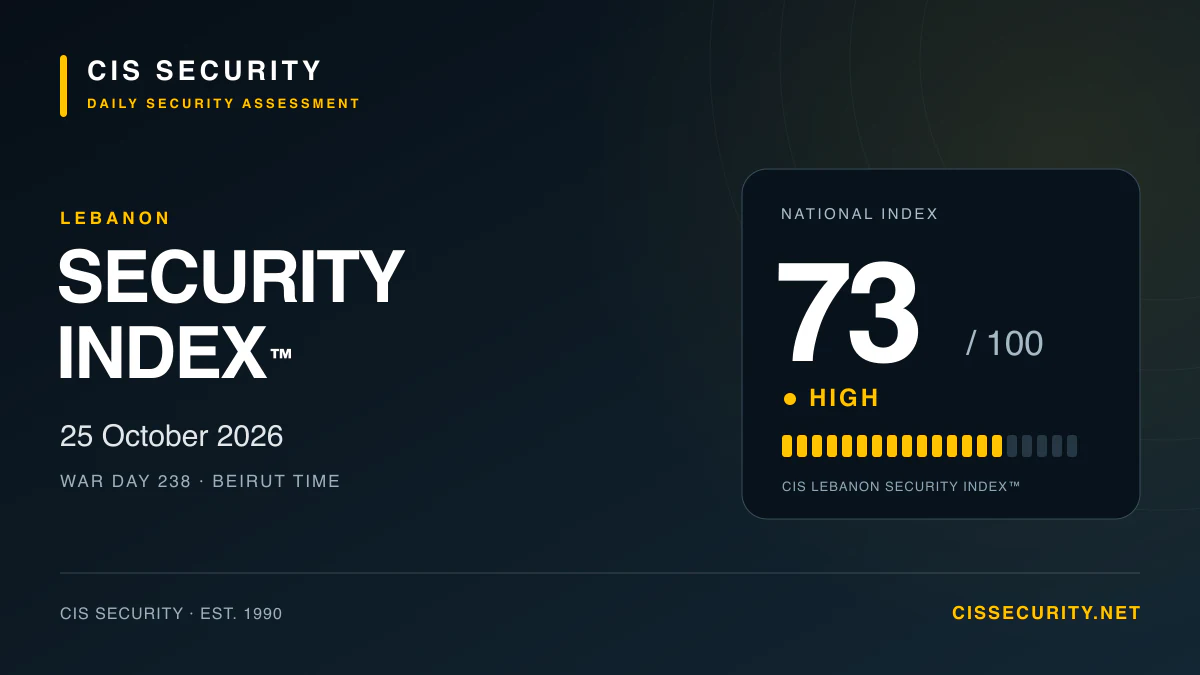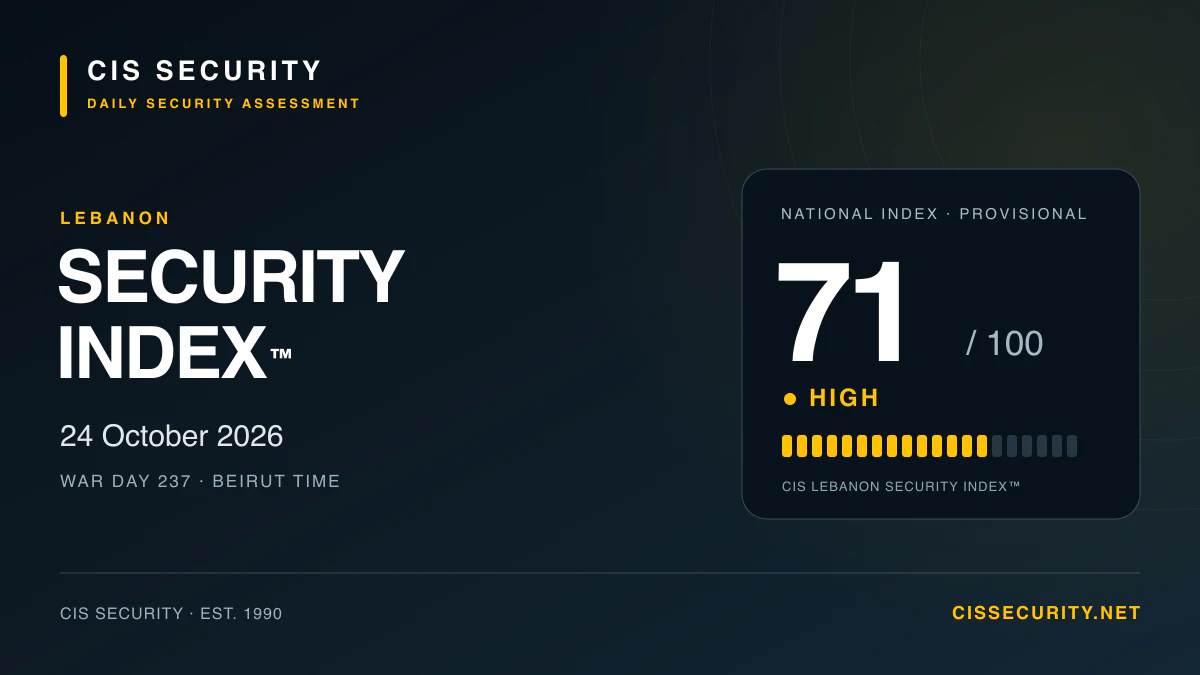
🇱🇧 CIS LEBANON SECURITY INDEX™
Friday, August 28, 2026
🔴 WAR DAY 180 | HEZBOLLAH'S RETALIATION ARRIVES: TWO EXPLOSIVE DRONES LAUNCHED AT ALI AL-TAHER RIDGE — 12 DAYS AFTER THE AUG 15 STRIKES | ISRAEL RESPONDS, KILLING 1 WOMAN, WOUNDING 6 INCLUDING A CHILD IN NABATIEH | SALAM REJECTS ISRAEL'S CLAIM DESTROYED VILLAGES WERE "MILITARY SITES" | UNIFIL: 137 PROJECTILES/DAY AVERAGE OVER TWO WEEKS, PEAKING AT 208 IN A SINGLE DAY | MEANWHILE: HORMUZ DECLARED MINE-FREE, TRUMP: "THAT SUCKER IS OPEN" | EX-MOSSAD CHIEF: "NO CHOICE" BUT TO KEEP HITTING IRAN "UNTIL THE REGIME FALLS"
INDEX LEVEL: 🔴 CRITICAL — THE LOCAL ESCALATORY CYCLE CIS HAS TRACKED FOR WEEKS AT ALI AL-TAHER RIDGE HAS REIGNITED, EVEN AS THE BROADER REGIONAL WAR SHOWS ITS CLEAREST DE-ESCALATION YET OVERALL INDEX: 74/100 TREND: ⬆️ RISING ON THE LEBANON-SPECIFIC TRACK, EASING ON THE BROADER REGIONAL TRACK — CIS must correct and update the picture from its August 25 report. At that time, CIS noted Hezbollah's retaliation threat for the August 15 Ansar and Deir al-Zahrani strikes remained unfulfilled after 10 days, and treated this restraint as a genuinely positive signal. On the night of Wednesday, August 26 into Thursday, August 27 — 12 days after those strikes — Hezbollah launched two explosive drones at Israeli troops operating at the Ali al-Taher Ridge, the same underground-tunnel flashpoint CIS has tracked as the single most consistently volatile location in this entire index since early July. The IDF says one drone was intercepted and contact was lost with the second; no Israeli soldiers were reported hurt. Israel responded with a series of strikes on what it described as Hezbollah weapons-storage sites in the Nabatieh area — strikes that, per the Lebanese Health Ministry, killed one woman and wounded six people, including a child, in the village of Biout es Sayed. Separately, Prime Minister Nawaf Salam issued a direct, on-record rejection of Israel's characterization of recently destroyed southern villages as "military sites" — a notable, sharpening departure from Beirut's earlier, more procedural criticisms. Underscoring the severity of the preceding fortnight, UNIFIL formally reported that Israeli forces fired an average of 137 projectiles per day into south Lebanon between August 5 and 16, peaking at 208 projectiles on a single Saturday — figures the UN's own Secretary-General spokesperson called part of an "alarming and worrying intensification of violence." Set against this local reignition, the broader regional war showed its clearest sign yet of winding down: US Central Command formally declared shipping lanes through the Strait of Hormuz mine-free, with President Trump telling reporters bluntly, "That sucker is open." Qatar's prime minister and foreign minister met Iran's Araghchi in Tehran on Wednesday. But hardline voices in Israel are pushing back against any broader de-escalation narrative — former Mossad chief Barnea said Thursday there is "no choice" but to continue striking Iran "until the regime falls."
⛔ EXECUTIVE SUMMARY — FRIDAY AUGUST 28, 2026 (WAR DAY 180)
HEZBOLLAH'S RETALIATION FINALLY COMES: TWO DRONES AT ALI AL-TAHER RIDGE
CIS must directly update its August 25 assessment. At that time, CIS reported Hezbollah's explicit vow to retaliate for the deadly August 15 strikes remained unfulfilled after 10 days, and treated this as a genuinely positive sign of restraint reinforced by broader regional de-escalation signals. That restraint has now ended. On the night of Wednesday, August 26, per the IDF's own account, Hezbollah launched two explosive drones at Israeli troops operating at the Ali al-Taher Ridge, beneath which — as CIS has documented extensively since early July — Hezbollah maintains a major underground facility that Israeli forces have been unable to fully clear under ceasefire terms.
The IDF said troops shot down one of the drones and lost contact with the second, with no soldiers reported hurt in the incident.
CIS assessment: Twelve days between an explicit, public retaliation threat and its actual execution is a long interval by the standards of this conflict's prior escalatory cycles — CIS's own review of comparable historical incidents from 2024 (referenced in its August 22 update) generally shows Hezbollah retaliating within days, not nearly two weeks, of a major commander assassination. This extended delay is consistent with CIS's assessment that Hezbollah's leadership weighed the broader regional de-escalation environment — the tentative Iran-US Hormuz negotiations, Syria's formal delisting, the reported US embassy staffing normalization — before ultimately deciding some response was still necessary. That the response was calibrated to a drone strike against military equipment at the specific site of the original trigger, rather than a broader rocket barrage into Israeli territory, suggests continued deliberate limitation rather than an attempt at significant escalation.
ISRAEL'S RESPONSE: ONE KILLED, SIX WOUNDED IN NABATIEH
The IDF said it carried out a series of strikes on Hezbollah infrastructure in the Nabatieh area of southern Lebanon in response, targeting sites it said were used to store weapons Hezbollah intended to use in attacks on troops and Israeli civilians.
The Lebanese Health Ministry said the resulting strikes killed one woman and wounded six people, including a child, in the village of Biout es Sayed, near Tyre — smoke from the strike was visible from the city itself, per AFP photography.
CIS assessment: This is a proportionally smaller civilian toll than the August 15 strikes (11 killed) but confirms the same underlying pattern CIS has documented throughout this index: a Hezbollah action against Israeli military equipment or personnel, followed by an Israeli retaliatory strike package that produces civilian casualties in a populated area, rather than a strictly military-on-military exchange. CIS notes Biout es Sayed is a location it has not previously documented as a recurring flashpoint, suggesting the current strike pattern may be expanding geographically rather than remaining confined to the small number of villages (Ansar, Deir al-Zahrani, Ali al-Taher, Mansouri, Nabatieh al-Fawqa) that have dominated CIS's incident tracking through most of August.
SALAM DIRECTLY REJECTS ISRAEL'S "MILITARY SITES" CLAIM
Prime Minister Nawaf Salam issued a direct, on-record rejection of Israel's claim that villages destroyed in recent strikes across southern Lebanon were legitimate military sites.
CIS assessment: This is a notable escalation in the specificity and directness of Salam's criticism. Where CIS has previously documented Salam issuing general condemnations of "Israel's latest deadly bombings" (August 15) or expressing hope for "positive progress" in negotiations (August 7-8), a direct, substantive rebuttal of Israel's own stated legal/military justification for its strikes represents a more confrontational posture from Lebanon's head of government — one that, combined with Aoun's own sharpened "clear message" framing from CIS's August 22-23 updates, suggests the Lebanese government's most senior officials are increasingly unwilling to accept Israel's public justifications for its continued strikes at face value.
UNIFIL'S FORMAL FIGURES: 137 PROJECTILES/DAY, PEAKING AT 208
CIS is incorporating UNIFIL's formal statement, issued August 17 and covering the two-week period surrounding the August 15 escalation, providing authoritative quantification of the scale of Israeli military activity CIS documented in real time. Per UNIFIL's own account:
- Between August 5 and 16, UNIFIL recorded an average of 137 projectiles fired per day into south Lebanon.
- This included 208 projectiles on a single Saturday (August 15, the day of the Ansar/Deir al-Zahrani strikes) and 185 on the following Sunday.
- UN Spokesperson Stéphane Dujarric said: "We are witnessing, both through our humanitarian colleagues and those of the peacekeeping forces, an alarming and worrying intensification of violence" in southern Lebanon, adding that the violence "includes civilian casualties on the Lebanese side" and that families displaced from areas they had just returned to were forced to seek refuge elsewhere.
- UNIFIL stressed that Resolution 1701 "remains the framework for restoring stability" and called for "renewed commitment by all parties to its principles."
CIS assessment: These figures substantially exceed the already-severe data CIS reported from UNIFIL on August 10 (455 projectiles and 97 airspace violations over a single weekend). A sustained two-week average of 137 projectiles per day — nearly one thousand projectiles over the period — combined with a single-day peak of 208, represents the most severe sustained UNIFIL-documented tempo CIS has incorporated into this index. This authoritative data lends further weight to CIS's assessment that the "de-escalation" narrative CIS reported on August 25 applies primarily to the broader regional US-Iran-Hormuz dynamic, and not — as this week's events have now confirmed — to the specific, still-live Lebanon-Israel-Hezbollah confrontation.
MEANWHILE: HORMUZ DECLARED MINE-FREE — "THAT SUCKER IS OPEN"
In the clearest sign yet of genuine progress on the broader regional war, US Central Command formally declared shipping lanes through the Strait of Hormuz mine-free, with President Trump telling reporters plainly: "That sucker is open." Qatar's Prime Minister and Foreign Minister Sheikh Mohammed bin Abdulrahman bin Jassim Al-Thani met with Iran's Foreign Minister Abbas Araghchi in Tehran on Wednesday, continuing the mediation efforts CIS has tracked since early August.
CIS assessment: This is a substantial, concrete milestone in the broader Iran war's de-escalation — a formal military declaration regarding a strategic waterway is a different order of confirmation than the diplomatic statements or reported internal staffing documents CIS has previously had to treat cautiously. Combined with the reported US embassy staffing normalization CIS covered on August 25, this represents genuine, accumulating evidence that the broader US-Iran confrontation is moving toward resolution — even as, per today's other developments, the Lebanon-specific Hezbollah-Israel dynamic continues to operate largely on its own separate timeline.
HARDLINE PUSHBACK: EX-MOSSAD CHIEF SAYS "NO CHOICE" BUT TO KEEP HITTING IRAN
Former Mossad chief Barnea said Thursday there is "no choice" but to keep hitting Iran "until the regime falls" — a hardline position that stands in direct tension with the Hormuz de-escalation and diplomatic engagement CIS is reporting the same day.
CIS assessment: CIS flags this as evidence of continued, unresolved internal division within Israel's own security establishment regarding the appropriate endpoint for the broader Iran confrontation — a dynamic CIS has tracked in various forms throughout this index (including the Katz-Bluth civil-military clash covered on August 3, and Zamir's own escalating rhetoric regarding "full-on fighting" readiness covered on August 10). Even as concrete, official steps toward de-escalation proceed (the Hormuz declaration, embassy staffing), senior, influential voices within Israel's security establishment continue to advocate for regime change as the only acceptable outcome — a position that, if it gains political traction, could directly undermine the diplomatic progress CIS has documented this week.
📊 UPDATED KEY FIGURES — AS OF AUGUST 28, 2026
| Metric | Figure | Source |
|---|---|---|
| Days between Aug 15 strikes and Hezbollah's retaliatory drone attack | 12 days | CIS calculation |
| Killed in Aug 27 Nabatieh-area response strikes | 1 (woman) | Lebanese Health Ministry |
| Wounded, including 1 child | 6 | Lebanese Health Ministry |
| UNIFIL-recorded average daily projectiles, Aug 5-16 | 137/day | UNIFIL |
| Peak single-day projectile count (Aug 15) | 208 | UNIFIL |
| Second-highest single-day count (Aug 16) | 185 | UNIFIL |
| UNIFIL mandate expiration | End of 2026 | UNIFIL, via Al Jazeera |
📌 WHAT CIS IS WATCHING — IMMEDIATELY
- Does Hezbollah's drone attack represent a single, calibrated response that closes out the August 15 grievance, or the opening move of a further escalatory exchange?
- Does Israel consider its Nabatieh-area strikes a sufficient response, or does further retaliation follow given the civilian casualties involved?
- Does Salam's direct rejection of Israel's "military sites" justification prompt any formal diplomatic complaint or affect the already-stalled Rome talks track?
- Does the Hormuz mine-free declaration and continued Qatar-Iran mediation translate into renewed momentum specifically on the Lebanon file, or does the Lebanon-Israel-Hezbollah dynamic continue operating on its own separate track as it has throughout this index?
- Does the internal Israeli debate reflected in Barnea's regime-change comments gain political traction in a way that could affect the government's willingness to pursue further de-escalation?
🛡️ CIS SECURITY — AUGUST 28 ASSESSMENT & GUIDANCE
Trusted Security Excellence Since 1990 | "Because Your Safety Isn't Optional"
CIS POSTURE: LEVEL 5 — SEVERE ALERT (raised from Level 4)
CIS is raising its posture back to Level 5 — Severe Alert, reflecting the confirmed reignition of the Ali al-Taher Ridge escalatory cycle, the resulting civilian casualties in a previously undocumented location (Biout es Sayed), and the UNIFIL-confirmed severity of the preceding two-week period. CIS's August 25 easing to Level 4 was based on genuine, credible regional de-escalation signals that remain valid for the broader Iran-US dynamic, but this week's events confirm that the Lebanon-specific security situation requires a higher level of caution regardless of that broader trajectory.
ZONE-BY-ZONE GUIDANCE
ALI AL-TAHER RIDGE: Avoid entirely — site of this week's renewed drone attack; the single most consistently volatile location CIS has tracked throughout this index. BIOUT ES SAYED (near Tyre): Avoid — newly documented site of Israel's retaliatory strikes, with civilian casualties. NABATIEH (broader area): Avoid — site of the retaliatory strike package. ANSAR, DEIR AL-ZAHRANI, MANSOURI, NABATIEH AL-FAWQA: Continue to avoid, consistent with prior guidance. SECURITY ZONE / BUFFER ZONE (GENERAL): Do not approach under any circumstances. DAHIYEH, BEKAA VALLEY: Maintain elevated caution. BEIRUT (general), MOUNT LEBANON, NORTH LEBANON, AKKAR: Calm, normal operations continue; CIS advises renewed heightened situational awareness given the confirmed reignition of active hostilities this week.
📞 EMERGENCY CONTACTS — AUGUST 28, 2026
CIS Security 24/7: +961 3 539900 | info@cissecurity.net | www.cissecurity.net Lebanese Army South Lebanon Liaison: +961-8-802-510 US Embassy Emergency: +1-202-501-4444 | BeirutACS@state.gov Lebanese Red Cross: 1760 Civil Defence: 125 ISF: 112 National Mental Health Lifeline: 1564 (24/7 — confidential)
⚠️ FINAL ASSESSMENT — WAR DAY 180, AUGUST 28, 2026
This week offers, in unusually sharp relief, the two competing realities CIS has spent nearly two months documenting in this index: a broader regional war that is credibly, verifiably winding down, and a Lebanon-specific confrontation that continues to operate on its own, largely independent, and still-dangerous trajectory.
The Strait of Hormuz declared mine-free, a US president confirming it in his own blunt words, continued Qatar-Iran mediation, and last week's reported embassy staffing normalization together describe real, accumulating progress toward ending the broader US-Iran war. CIS does not want today's Lebanon-specific developments to obscure that genuine progress.
But genuine progress on one track has not, this week, prevented Hezbollah from finally executing the retaliation it threatened nearly two weeks ago, nor has it prevented Israel from responding with strikes that killed a woman and wounded a child in a village CIS had not previously had cause to flag. UNIFIL's own formal figures — 137 projectiles a day, sustained over two weeks, peaking at 208 — confirm at an authoritative level that the "de-escalation" language appropriate to the Hormuz story simply does not describe conditions on the ground in south Lebanon.
CIS's operating conclusion, reinforced rather than contradicted by this week's events, is that these two tracks — the broader regional war and the specific Lebanon-Hezbollah-Israel confrontation — must continue to be assessed separately, even as they remain connected through shared actors, shared history, and Iran's continued position as Hezbollah's patron. CIS is raising its posture back to Level 5 — Severe Alert on the Lebanon-specific track and will be watching closely for whether this week's exchange proves contained or opens a further escalatory chapter.
+961 3 539900 | info@cissecurity.net | cissecurity.net CIS Security — Because Your Safety Isn't Optional — Est. 1990
CIS Lebanon Security Index™ | Friday, August 28, 2026 | WAR DAY 180
Sources: The Times of Israel liveblog, "Aug. 27: Ex-Mossad chief Barnea says 'no choice' but to keep hitting Iran 'until the regime falls'" (August 27, 2026 — full drone-attack/response sequence, Biout es Sayed strike photo, Ali Taher Ridge tunnel context); The Times of Israel liveblog, "August 28, 2026" (August 28, 2026 — Hormuz mine-free declaration, Trump "that sucker is open" quote, Qatar PM-Araghchi Tehran meeting); Haaretz, "IDF Strikes in Lebanon Kill One, Wound Six, Including Child, Woman" (August 27, 2026 — full Lebanese Health Ministry casualty figures); Al Jazeera, "Israel attacks Lebanon" tag page (accessed August 28, 2026 — "PM Nawaf Salam rejects Israel's claim that villages destroyed... were military sites" headline, "Hezbollah criticises Beirut's approach" headline); Al Jazeera, "Civilians paying price as Israeli military raises stakes in Lebanon: UNIFIL" (August 17, 2026 — full UNIFIL statement, Dujarric quote, 137/208/185 projectile figures); TRT World, "UNIFIL flags surge in Israeli military activity across southern Lebanon" (August 17, 2026); Middle East Monitor, "UN peacekeeping force reports sharp rise in Israeli military activity in southern Lebanon" (August 17, 2026 — Resolution 1701 background, UNIFIL mandate expiration detail); Al-Manar TV Lebanon, "UNIFIL Reports Sharp Rise in Israeli 'Military Activity' in Southern Lebanon" (August 17, 2026); Antiwar.com, "UN 'Alarmed' as Israeli Strikes Against Lebanon Surge Substantially" (August 18, 2026 — Dujarric "alarming" quote); NewsCord, "Israeli Forces Shell Mansouri and Deir Siryan, UNIFIL Records 137 Projectiles Daily: 14 outlets compared" (August 18, 2026); The Amit Terrorism and Intelligence Research Institute, "Spotlight on Terrorism: Hezbollah and Lebanon (July 27 – August 4, 2026)" (referenced for background — Hezbollah-presidency channel severance detail); prior CIS reporting (July 4–August 25, 2026) carried forward for context.
CIS notes it is directly updating its August 25, 2026 assessment, which described Hezbollah's retaliation threat as unfulfilled after 10 days; that restraint ended with the August 26-27 drone attack reported here. All military, diplomatic, and political statements are attributed to named officials or sourced reporting, August 25–28, 2026. Index compiled: Friday, August 28, 2026 — Beirut time.